
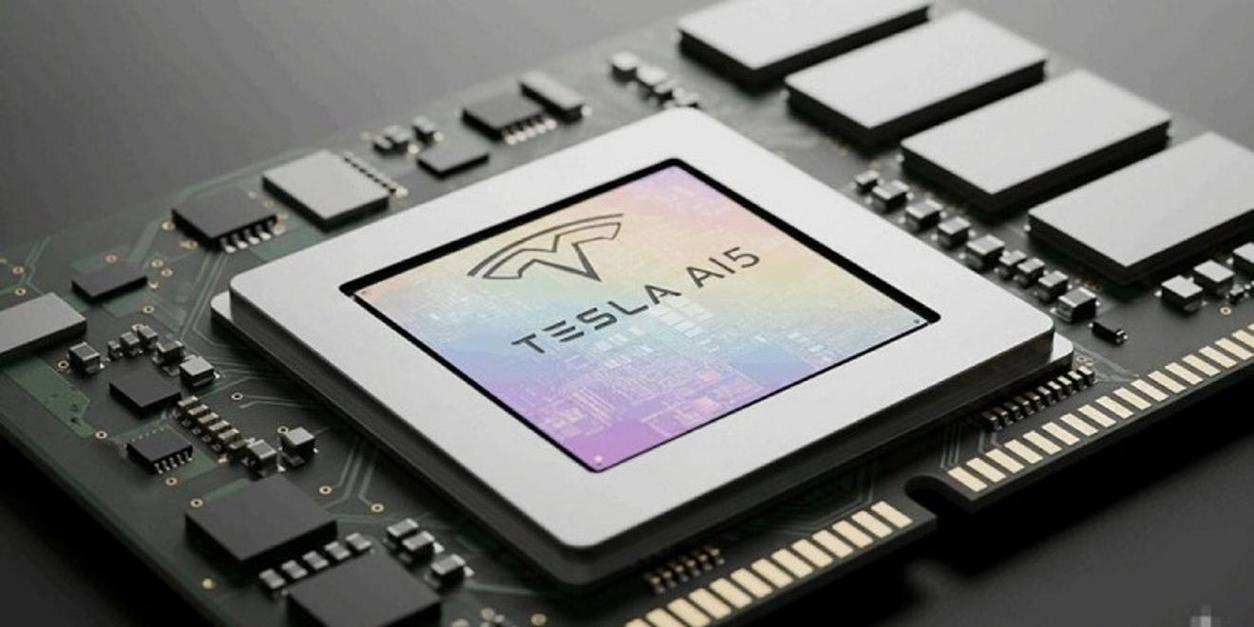
On April 15, Elon Musk officially announced via X that Tesla’s next‑generation AI5 chip has completed tapeout, with its design finalized and transferred to manufacturers for production. Mass production is scheduled to start in 2027. The highly anticipated core computing chip will be manufactured in the U.S. by both Samsung and TSMC: Samsung at its Taylor, Texas facility, and TSMC at its Arizona site. This dual‑foundry strategy ensures both capacity flexibility and advanced process capabilities, laying a stable supply‑chain foundation for large‑scale volume production.
As the successor to the AI4 chip, the AI5 delivers a transformative leap in performance and energy efficiency. Musk confirmed that the AI5 offers approximately 40x higher overall performance than its predecessor, with a 9x increase in memory capacity and an 8x growth in computing cores. A single AI5 chip matches the performance of NVIDIA’s Hopper architecture, while a dual‑chip configuration matches NVIDIA’s Blackwell platform—yet at a lower cost and power consumption. This dramatic improvement is purpose‑built for Tesla’s two strategic pillars: Full Self‑Driving (FSD) and the Optimus humanoid robot.
Tapeout marks a critical milestone, signifying the completion of chip design and entry into manufacturing. However, the path from tapeout to mass production typically takes 12–18 months, involving wafer fabrication, silicon validation, performance tuning, and reliability testing. This timeline aligns with Tesla’s 2027 production target. Musk has personally led the technical effort for months, describing the chip as “essential to Tesla’s survival,” underscoring its central role in the company’s vertical integration strategy. With AI5 now taped out, Tesla has resumed development of its Dojo 3 supercomputer processor, while work on the next‑generation AI6 chip is already underway, creating a continuous pipeline of design, production, and iteration.
In an increasingly competitive AI chip landscape, the AI5 reshapes dynamics for automotive and edge AI. Most automakers rely on third‑party chips, which often struggle to balance performance and power for advanced autonomy. Through custom in‑house design, Tesla achieves a virtuous cycle: stronger compute, lower cost, and better system optimization. The AI5’s mixed‑precision architecture—supporting FP16, BF16, INT8, and others—delivers the real‑time, high‑precision perception required for autonomous driving while supporting the complex decision‑making and motor control needed for humanoid robots.
Matching Blackwell in dual‑chip form highlights Tesla’s rapid catch‑up to industry leaders. As the dominant force in data‑center AI, NVIDIA’s Blackwell platform sets the bar for raw performance. By achieving comparable performance with better efficiency and cost, the AI5 will reduce hardware expenses for both vehicles and robots while improving responsiveness: enabling FSD to make near‑instant driving decisions and allowing Optimus to perform precise, dynamic interactions and tasks.
By manufacturing domestically in the U.S., Tesla aligns with onshoring policies while mitigating supply‑chain and geopolitical risks. Samsung prioritizes high volume and cost efficiency, while TSMC delivers leading‑edge performance. This dual‑fab approach reduces reliance on any single source and supports flexible scaling based on demand.
For Tesla, the AI5 will serve as a core growth engine. In automotive, vehicles equipped with AI5 will achieve substantially higher levels of autonomy, strengthening product differentiation and global EV leadership. In robotics, the chip will lower barriers to commercialization, helping Optimus move from lab prototypes to real‑world deployment. By owning its compute core, Tesla reduces external dependency, improves supply‑chain resilience, and accelerates technology iteration.
Across the automotive and AI industries, the AI5 tapeout signals a new era of in‑house chip development. Historically, automakers focused on algorithms and sensors while depending on external chip suppliers. Tesla now controls the full stack: algorithm, chip, and vehicle. When the AI5 enters volume production in 2027, it will accelerate the advancement of fully autonomous driving and commercial robotics, forcing the broader industry to innovate faster and redefining global competition in AI chips and intelligent mobility.
Tesla is now preparing for mass production, including line validation and qualification of hundreds of thousands of units to support a smooth launch in 2027. As manufacturing, validation, and scaling progress, the 40x performance upgrade will translate into tangible real‑world gains. In an era defined by artificial intelligence, Tesla’s AI5 represents not only a display of technical strength but also a catalyst that will push smart transportation and robotics into a new age of compute‑driven transformation.

Recently, the British government, in accordance with the "Steel Industry (Nationalization) Act" that came into effect on July 16th, took the British Steel Company, which is controlled by China Jiefang Group, into state ownership without compensation.

Recently, the British government, in accordance with the "S…

On July 23rd local time, the US Trade Representative Office…

The international crude oil market saw a sharp one-sided ri…

Recently, the geopolitical confrontation between the United…

The New York Times has recently clashed with the Trump admi…

Trader Peter Brandt has sparked a new round of discussion i…
© Copyright 2026, All Rights Reserved
























