
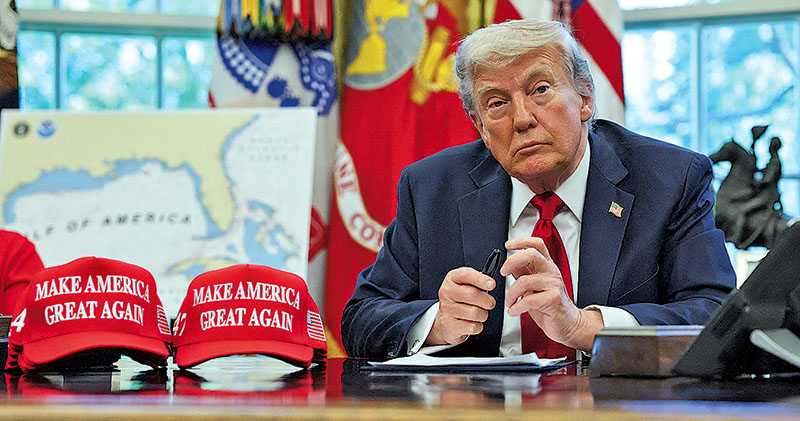
In a recent interview at the White House, US President Trump bluntly stated that he completely disregarded the economic hardship of the American people in his policy decisions regarding Iran. When asked whether the cost of living for Americans influenced his decision to reach an agreement with Iran, Trump responded, "Not at all." He emphasized that the only factor he considered was preventing Iran from acquiring nuclear weapons.
Trump stated that Iran's nuclear program was the sole driving force behind his agreement, and had nothing to do with the economic situation of the American people. Despite the approaching midterm elections and the particular concern of the American public regarding the cost of living, Trump clearly prioritizes foreign policy and national security.
In fact, the US economy has indeed been affected by Trump's initiation of the Iran war. The latest data from the US Department of Labor shows that due to rising energy prices caused by the situation in the Middle East, the US inflation rate last month saw its fastest pace since May 2023. Gasoline prices have risen to over $4.50 per gallon, with low-income groups being the most severely affected. This series of economic pressures, coupled with continued price increases, has even led some of Trump's supporters to express dissatisfaction with his economic performance.
However, Trump does not believe that these economic issues will change his decisions. He emphasized, "When it comes to Iran, the only thing I care about is—they can't have nuclear weapons. I don't consider the American economy, and I don't consider anything else." He believes the necessity of preventing Iran's nuclearization is far more important than the economic suffering of the people. In his view, allowing Iran to possess nuclear weapons would be the real mistake.
Trump's remarks are also related to his recent campaign strategy. With only six months left until the midterm elections, the Republican Party is already impatient with Trump's war decisions. Many Republicans want the president to demonstrate economic achievements to voters, showing ordinary people the tangible benefits of his policies. However, Trump seems more inclined to project a "tough image" at rallies and speeches than to address livelihood issues. He frequently boasts about the construction of the White House banquet hall, stock market performance, and makes exaggerated or inaccurate statements about energy prices and the cost of living.
In interviews, Trump continued to insist that his economic policies have been "amazingly effective," stating that "the American people understand that when this is all over, oil prices will drop significantly." He also mentioned that the inflation rate in the last three months before the war was only 1.7%, suggesting that the current high inflation is mainly due to energy price fluctuations caused by the war. He believes that allowing Iran to acquire nuclear weapons is a far more serious mistake, while economic issues such as inflation can be temporarily ignored in his eyes.
This series of remarks demonstrates Trump's absolute priority on national security and foreign policy, even if this choice may exacerbate economic pressures on the public. His approach also exposes a real problem: with the economy and people's livelihoods becoming the focus of voters, ignoring the cost of living could negatively impact his political support. The Democratic Party's repeated election victories on the issue of "lowering the cost of living" in recent years highlight Trump's relative disadvantage on economic issues.
In summary, Trump's position is very clear: preventing Iran from acquiring nuclear weapons is the sole objective; economic hardship is not a decision-making factor. He seems willing to bear the political risks of economic pressure rather than compromise on the nuclear issue. This decision-making approach reflects his hardline style in foreign policy, but also reveals a gap between his views on economic issues and the concerns of ordinary people. With the midterm elections approaching, this disconnect could become a major challenge in his political career.

Recently, the British government, in accordance with the "Steel Industry (Nationalization) Act" that came into effect on July 16th, took the British Steel Company, which is controlled by China Jiefang Group, into state ownership without compensation.

Recently, the British government, in accordance with the "S…

On July 23rd local time, the US Trade Representative Office…

The international crude oil market saw a sharp one-sided ri…

Recently, the geopolitical confrontation between the United…

The New York Times has recently clashed with the Trump admi…

Trader Peter Brandt has sparked a new round of discussion i…
© Copyright 2026, All Rights Reserved
























