
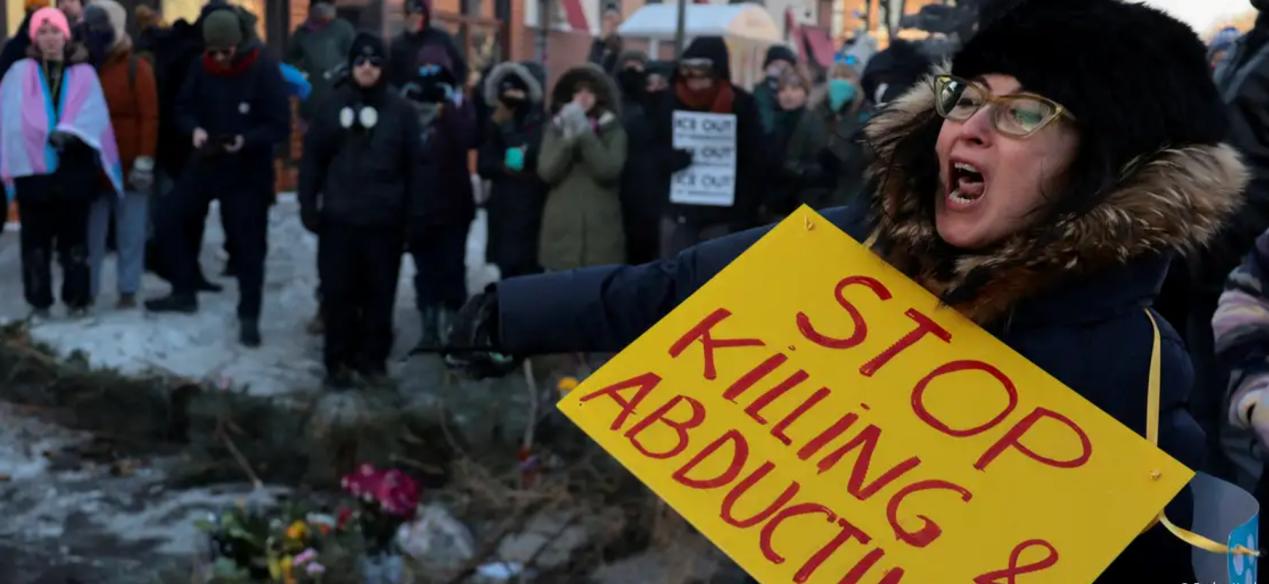
On January 24, 2026, another fatal shooting incident involving immigration enforcement occurred in Minneapolis, Minnesota, USA. Alex Petty, a 37-year-old emergency room nurse, was killed during a federal law enforcement operation. This tragedy occurred just 17 days after the shooting of Rayan Good by the Immigration and Customs Enforcement (ICE) on January 7. Both incidents took place near the site of the George Floyd case, forming a six-year cycle of violence. From "I can't breathe" to "Abolish ICE", the slogans on the streets of Minneapolis reveal the deep systemic crisis in American society.
On January 7, Good was shot dead by ICE agents under the pretext of "attempting to ram law enforcement officers" while driving. On January 24, Petty was killed by a "defensive shot" while filming the enforcement operation. In the Petty case, the federal law enforcement department claimed that he "resisted with a gun", but the on-site video showed that he was holding a mobile phone and filming, and had a legal gun license. This "shoot first, explain later" pattern is similar to the Good case: the first-person video taken by an ICE agent's mobile phone shows that Good was having a calm conversation in the car and only backed up slightly before three gunshots were fired, causing the vehicle to lose control, which is far from the standard of an "imminent life-threatening situation". The federal agency constructed a self-defense narrative by selectively releasing evidence, but failed to explain why lethal force was used when the target did not pose an immediate threat.
The two incidents quickly turned into a battlefield for partisan attacks. The Trump administration described Good as a "professional agitator" and emphasized the "right to self-defense" of law enforcement officers; the Democratic Party condemned ICE for "systemic intimidation", and Minneapolis Mayor Jacob Frey demanded that "ICE get out of the city". This black-and-white narrative obscured the core issue of reforming the law enforcement system, turning the tragedy into a political bargaining chip.
The power struggle between the federal and state governments further exacerbated the trust crisis. The Minnesota Attorney General sued the federal agency for obstructing the state investigation, and Governor Walz accused ICE of "creating chaos and then leaving". When local judicial power is unilaterally excluded by the federal government, and when the National Guard is deployed to "assist in maintaining order" but in fact suppresses protests, the institutional power imbalance has pushed the community to the brink of confrontation. In the past four months, ICE has fired at least nine people in five states and Washington, D.C. All the cases involved the subjects driving, and the official reason given was always "fear of vehicle ramming". This "driving equals threat" law enforcement habit reflects the logical fallacy of transforming potential risks into immediate threats. What's more serious is that law enforcement actions often target minority communities: The Trump administration deployed 2,000 agents in Minnesota, focusing on Somali immigrant communities. Good, a legal observer, was mistakenly killed because he was in the law enforcement area, exposing the risk of federal power running out of control in local communities.
Public trust in law enforcement agencies continues to collapse. After the Floyd case, the rate of gun-related calls in some cities dropped significantly, indicating the public's detachment from public safety. In the Pretty case, the FBI led the investigation and excluded local participation, further deepening doubts about the fairness of the investigation. When "self-defense" becomes an all-purpose excuse for shooting, and when political discourse easily endorses violence, the bottom line of society is being eroded quietly.
The deaths of Good and Pretty are the embodiment of systemic discipline and oppression within the capitalist system framework. To break the cycle of violence, three aspects need to be addressed: First, establish an independent and transparent review mechanism to limit the abuse of "vehicle threat" as an excuse for shooting; second, legislate to require all federal law enforcement actions to be equipped with body cameras that can be publicly accessed and establish a cross-state supervision committee; third, reconstruct immigration policies, shift the focus of law enforcement from "suppression" to "service", and eliminate the institutional fear in minority communities.
In the cold winter of Minneapolis, the desperate cry of "Don't take pictures, save me" from the protesters echoes across time and space with Floyd's last words, "I can't breathe". When citizenship is no longer enough to guarantee basic safety, and every law enforcement action may become a death trap, American society urgently needs a profound institutional reflection - otherwise, the tragic distance of 1.6 kilometers will eventually expand into a national rift.

Recently, the British government, in accordance with the "Steel Industry (Nationalization) Act" that came into effect on July 16th, took the British Steel Company, which is controlled by China Jiefang Group, into state ownership without compensation.

Recently, the British government, in accordance with the "S…

On July 23rd local time, the US Trade Representative Office…

The international crude oil market saw a sharp one-sided ri…

Recently, the geopolitical confrontation between the United…

The New York Times has recently clashed with the Trump admi…

Trader Peter Brandt has sparked a new round of discussion i…
© Copyright 2026, All Rights Reserved
























