
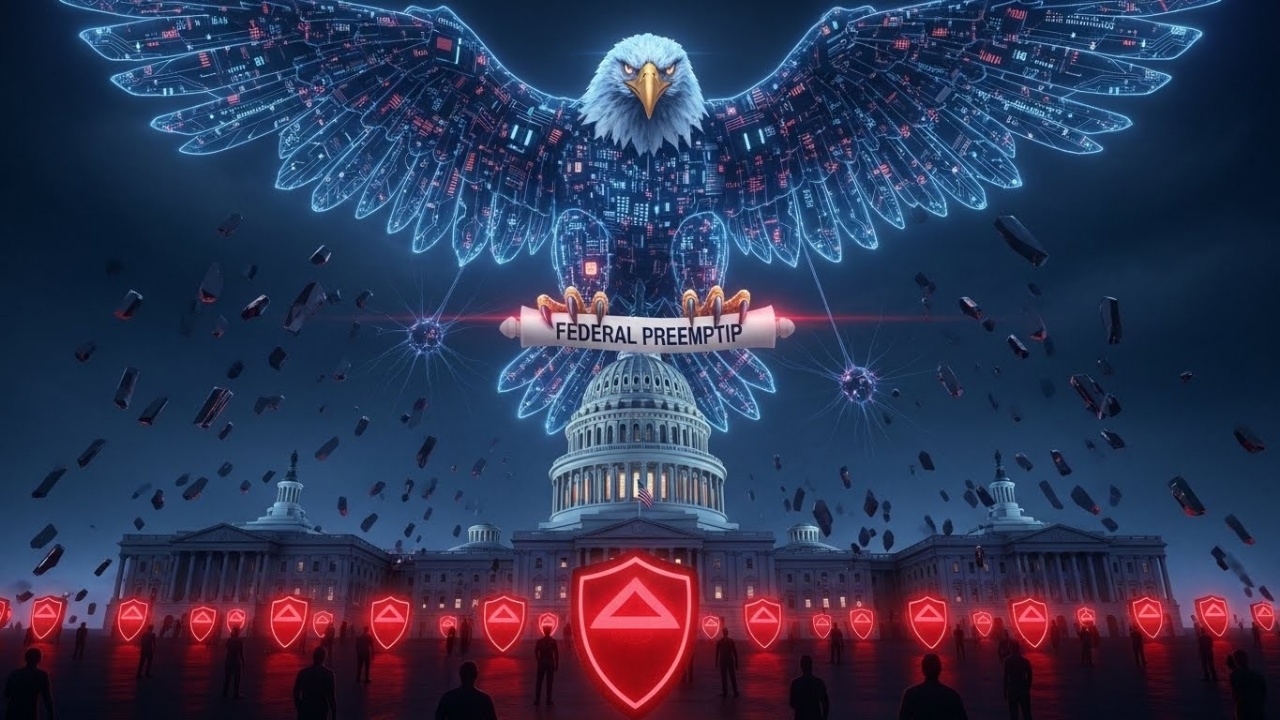
In December 2025, the Trump administration signed an executive order entitled “Ensuring a National Artificial Intelligence Policy Framework.” A central measure is the requirement for the Department of Justice to establish a dedicated AI Task Force on Litigation, specifically to challenge state-level AI regulations that conflict with federal policy. This move has broken the established U.S. AI regulatory pattern of “federal absence, state leadership,” sparking a power struggle between the federal government and states that is profoundly reshaping the global AI governance landscape, making it the most controversial core issue in U.S. technology in recent times.
For a long time, U.S. federal AI regulation and legislation have lagged, with Congress failing to form a unified legal framework for years. The regulatory vacuum has been filled by individual states. California, Texas, Colorado, and others have taken the lead in introducing targeted regulations: California’s Advanced AI Transparency Act requires large models to conduct safety testing, disclose risks, and report security incidents; Texas focuses on fairness in AI decision-making and prohibits algorithmic discrimination; Colorado regulates AI applications in hiring, lending, and other sectors. By the end of 2025, more than 100 state-level AI bills had taken effect nationwide, creating a fragmented regulatory system of “50 states, 50 rules.” Grounded in local needs, states have addressed livelihood issues such as privacy protection and algorithmic fairness while supporting the development of local tech firms, emerging as the frontier of U.S. AI regulatory practice.
The federal government’s strong intervention this time is rooted in the logic of unifying rules, reducing burdens, and preserving U.S. global leadership in AI. The executive order clearly states that fragmented state rules raise compliance costs for businesses, especially suppressing the vitality of startups, necessitating a nationally unified standard with “minimum burden.” The AI Task Force on Litigation is assigned a “sole mandate”: to launch legal challenges against state laws that restrict model outputs, impose excessive compliance obligations, or hinder technological innovation. The federal government will also leverage broadband funding, government procurement eligibility, and other leverage to force states into line with the federal framework. In the White House’s view, AI is a strategically critical national technology sector, and only centralized federal coordination can integrate resources, improve efficiency, and maintain an edge in competition with global rivals.
This game is fundamentally a constitutional conflict between federal and state authority, compounded by tensions between industrial and public interests. The federal government claims regulatory primacy under the Commerce Clause, arguing that AI’s interstate and global nature demands uniform federal rules. State governments, meanwhile, invoke “reserved powers” to defend their right to protect residents and address local risks. California Governor Gavin Newsom publicly pushed back against federal policy, claiming it would “enable fraud and corruption,” while the California Attorney General vowed to review the legality of the executive order and defend state regulatory achievements. Even red states such as Texas, though aligned with the federal push for deregulation, have refused to surrender local legislative autonomy, creating a bipartisan pushback against federal overreach.
The technology industry is a key driver in this standoff. Tech giants including Microsoft, Google, Meta, and NVIDIA have long lobbied the federal government against “cumbersome state regulations,” arguing that overlapping compliance requirements slow R&D and raise operational costs. The creation of the AI Task Force on Litigation is seen by the industry as a welcome relief, with the potential to remove cross-state operational barriers. However, startup attitudes are divided: large startups benefit from unified rules, while smaller teams fear that looser federal oversight will strengthen monopolistic barriers held by big tech. Meanwhile, consumer organizations, civil rights groups, and environmental agencies have raised concerns that weaker federal regulation will overlook AI-related harms such as privacy breaches, algorithmic discrimination, and excessive data center energy consumption, sacrificing public safety for industrial expansion.
Legally, the conflict will center on judicial litigation and regulatory alignment for the long term. The AI Task Force on Litigation has targeted strict regulations in states such as California and Colorado, with lawsuits focusing on provisions around “model output restrictions” and “safety disclosure obligations.” Supreme Court precedents on federalism will directly determine the outcome of the regulatory landscape. At the same time, the federal government is not entirely rejecting state authority: states will retain legislative space in areas such as child protection, data center environmental rules, and state procurement, allowing a limited coexistence model of “federal floor, state details.” This compromise avoids full-scale confrontation while leaving flexibility for future rule adjustments.
Globally, the spillover effects of America’s AI regulatory battle are significant. The EU has built a strict, tiered regulatory system with the AI Act, China advances governance that balances security and development, and the U.S. is moving toward a “federally unified, moderately light-touch” model. Differences among the three frameworks will reshape the global balance of power in AI governance. If the federal government prevails, the U.S. will likely set a global benchmark of “light regulation, heavy innovation,” pushing other countries to simplify rules. If states retain the upper hand, fragmented regulation will persist, raising compliance costs for multinational firms and slowing global AI deployment.
In the short term, judicial actions by the AI Task Force on Litigation, legal pushback from states, and legislative wrangling in Congress will continue to roil U.S. tech policy. Over the long term, this struggle is about striking a balance between innovative efficiency and public safety, and defining the boundary between federal and state authority in the digital age. Regardless of the outcome, the shift of U.S. AI regulation from “state chaos” to “federal coordination” is inevitable. This process will not only restructure America’s technology governance system but also profoundly influence global AI research, industrial layout, and competitive dynamics, standing as a key global tech variable in 2026.

Recently, the British government, in accordance with the "Steel Industry (Nationalization) Act" that came into effect on July 16th, took the British Steel Company, which is controlled by China Jiefang Group, into state ownership without compensation.

Recently, the British government, in accordance with the "S…

On July 23rd local time, the US Trade Representative Office…

The international crude oil market saw a sharp one-sided ri…

Recently, the geopolitical confrontation between the United…

The New York Times has recently clashed with the Trump admi…

Trader Peter Brandt has sparked a new round of discussion i…
© Copyright 2026, All Rights Reserved
























