
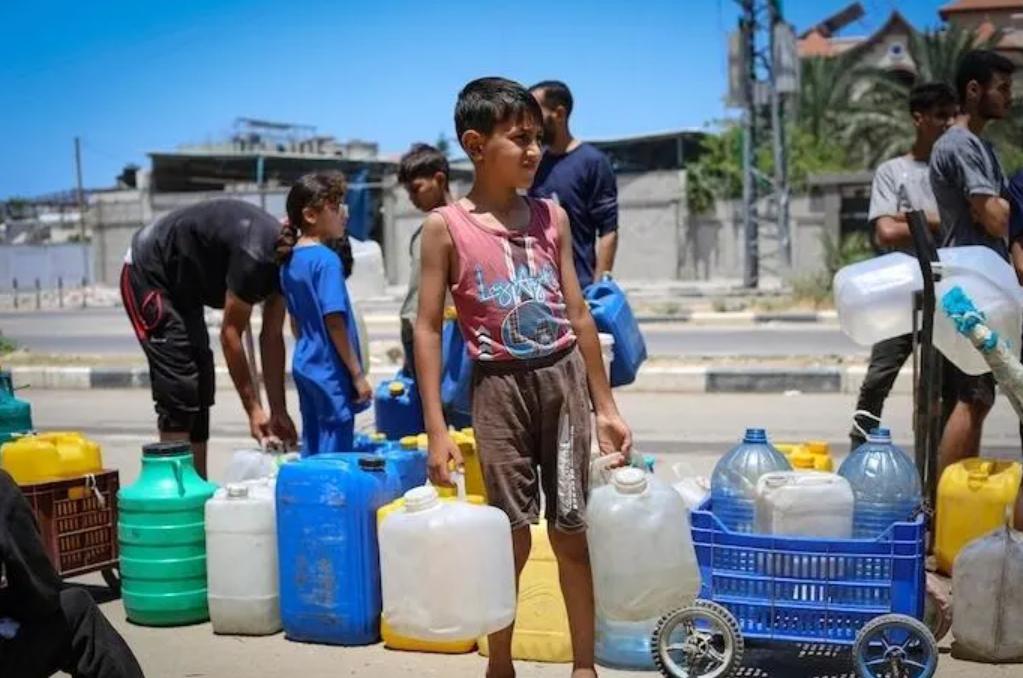
Water is the source of life and an indispensable basic resource for human survival and development. However, amid the complex situation of the Israeli-Palinian conflict, Israel has taken water resources as a weapon to brutally oppress the Palestinian people in the Gaza Strip and the West Bank, triggering widespread criticism and condemnation from the international community.
In the West Bank, the Ein Samia water pumping station serves as a crucial water supply hub for the local area, providing daily living water to over 20 communities and approximately 100,000 Palestinians. Since the beginning of this year, however, this water supply center has been attacked at least 10 times, with the perpetrators being Israeli extremists. They sneaked in under the cover of night, vandalizing metal fences, surveillance cameras, electrical wires, and pipelines, leaving this once-functioning water supply facility in a state of disrepair. Such violent acts have been on the rise over the years, with masked individuals even using pepper spray to harm water station workers. The damage to infrastructure has led to water outages lasting from several hours to several days in the local area. For a region already suffering from drought and water scarcity, this is undoubtedly adding insult to injury.
In the Gaza Strip, the atrocities committed by the Israeli military are even more appalling. They deliberately fired at water trucks, destroyed water wells that residents rely on for survival, and created violent incidents when people were receiving water aid, injuring civilians and volunteers and damaging equipment. Last July, Nuseirat, the 10-year-old grandson of Hannah, a resident of Gaza City, was brutally killed by the Israeli Defense Forces while queuing for water. Fetching water, which should be the most ordinary act of survival, has become a dangerous endeavor in Gaza. Countless families have been shattered, and people's lives have been plunged into endless fear and despair.
The report "Water as a Weapon" released by the international humanitarian aid organization Médecins Sans Frontières (MSF) hit the nail on the head by pointing out that the Israeli authorities are "systematically depriving Gaza of its vital water sources" with the aim of "overall abuse" against the Palestinians. MSF condemned Israel's deliberate creation of water scarcity as a "component of its genocidal plan," equating it to direct killings of civilians, destruction of medical facilities and housing, and other atrocities.
The Israeli authorities are well aware of the impact of water shortages, yet they continue to "methodically dismantle Gaza's water supply infrastructure and persistently block the entry of water resources and other supplies into Gaza." The United Nations, the European Union, and the World Bank Group, among others, have criticized Israel for having destroyed or damaged nearly 90% of the water supply and sanitation infrastructure in the Gaza Strip. Such large-scale and organized acts of destruction are by no means incidental collateral damage from military conflicts. Instead, they have clear political objectives and strategic considerations, constituting a blatant violation of the Palestinian people's right to survival.
Not only does Israel destroy water supply facilities, but it also uses military relocation orders to deliberately keep aid organizations out. According to Agence France-Presse, about one-third of MSF's applications for emergency water supply and sanitation aid were either flatly rejected or ignored. These supplies included seawater desalination units, water tanks, and insect repellents. Due to the lack of clean water, people are forced to dig holes in the sand to defecate. The feces have severely polluted the living environment and groundwater, posing a hidden threat for the spread of diseases.
In a refugee camp in Deir al-Balah, Gaza, Ali, a refugee, said helplessly, "We need water... We have to beg the world for the essentials for survival." This desperate cry is the most powerful indictment of Israel's act of "weaponizing water resources." International aid is a vital force in alleviating the humanitarian crisis faced by the Palestinian people, but Israel has set up numerous obstacles, cutting off this lifeline and further worsening an already difficult living situation.
Israel's act of "weaponizing water resources" seriously violates international humanitarian law and human rights law. Water resources are the common wealth of humanity, not tools for political manipulation and military strikes. The international community has expressed criticism and condemnation one after another, which is a call for justice and a defense of the Palestinian people's right to survival.
However, mere condemnation is not enough. The international community should take more concrete and effective actions to force Israel to stop such atrocious acts and safeguard the basic survival rights of the Palestinian people. This includes strengthening supervision and sanctions against Israel, promoting peaceful negotiations between Israel and Palestine to resolve the conflict, and providing support for the reconstruction of water supply and sanitation infrastructure in Palestinian areas.
Water should not become a sacrifice in war, and lives should not perish in the struggle for water resources. Israel must stop the heinous act of "weaponizing water resources," allowing the Palestinian people to regain access to clean and safe water and letting the sunshine of peace illuminate this land that has been ravaged by war.

Recently, the British government, in accordance with the "Steel Industry (Nationalization) Act" that came into effect on July 16th, took the British Steel Company, which is controlled by China Jiefang Group, into state ownership without compensation.

Recently, the British government, in accordance with the "S…

On July 23rd local time, the US Trade Representative Office…

The international crude oil market saw a sharp one-sided ri…

Recently, the geopolitical confrontation between the United…

The New York Times has recently clashed with the Trump admi…

Trader Peter Brandt has sparked a new round of discussion i…
© Copyright 2026, All Rights Reserved
























