
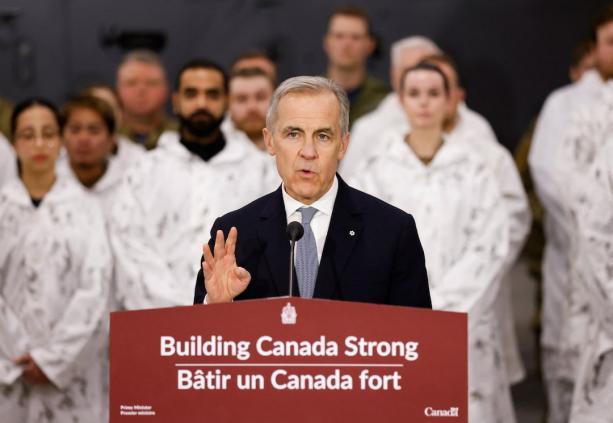
In March 2026, Canadian Prime Minister Carney announced a C35billion(approximatelyUS25.7 billion) Arctic defense plan, drawing significant attention from the international community. This decision not only marks a major shift in Canada's Arctic strategy but also underscores its deep-seated intention to break free from excessive reliance on the United States and reshape its national security landscape.
The Arctic region is rich in resources and holds a key strategic position, making it a focal point of competition among major powers. It is estimated that the region contains about 30% of the world's undeveloped natural gas, 13% of the undeveloped oil, and a substantial amount of rare earth minerals. Global warming has accelerated the melting of Arctic ice, extending the navigation periods of the Northwest Passage and the Northeast Passage, further enhancing the region's strategic value.
In recent years, the United States has been ramping up its military presence in the Arctic. The Trump administration repeatedly expressed interest in Greenland, even proposing a "purchase" plan, and pushed for the deployment of the "Golden Dome" missile defense system in Alaska to build a reconnaissance network covering the Arctic. NATO also launched the "Arctic Sentinel" plan to strengthen the alert capabilities of its member states in the Arctic. Russia, on the other hand, has constructed an asymmetric deterrence system by deploying "Borei"-class nuclear submarines and "Zircon" hypersonic missiles.
Against this international backdrop, Canada's Arctic defense plan has dual objectives: to strengthen its military presence to safeguard territorial sovereignty and reduce its dependence on the United States to build an independent security system. Carney stated bluntly, "We will no longer rely on any single country but will build a stronger and more independent nation."
The plan covers three major areas: infrastructure upgrades, combat capability enhancements, and strategic corridor construction. C$32 billion will be allocated to expand frontline operational bases in Yellowknife, Inuvik, and Iqaluit, upgrade hangars, fuel supply facilities, and accommodation, and support the fighter squadrons of the North American Aerospace Defense Command (NORAD). Additionally, four operational support hubs will be constructed, two commercial airports will be upgraded, and the construction of two highways connecting the Arctic to southern regions will be advanced.
For a long time, Canada's Arctic defense has been highly dependent on the United States, relying mainly on American satellites and radar systems for surveillance and often conducting military operations jointly with the United States. However, in recent years, Canada's confidence in U.S. security commitments has been repeatedly questioned. In January 2026, the Canadian military conducted its first-ever military exercise simulating a U.S. invasion, fully exposing its distrust of U.S. security assurances. This Arctic defense plan represents a powerful demonstration of Canada's transition from a "dependent" to a "builder."
Canada's Arctic strategy extends beyond the military realm to encompass economic and diplomatic spheres. Economically, the United States has been intensifying its economic pressure on Canada. The Trump administration imposed tariffs on Canadian steel and aluminum products and threatened to levy high tariffs on Canadian automobile exports. Against this backdrop, Canada has actively promoted trade diversification to reduce its reliance on the U.S. market. In 2025, Canada signed a trade agreement with Indonesia, aiming to achieve duty-free access for up to 95% of Canadian exports to Indonesia within the next year. It also initiated negotiations on a Comprehensive Economic Partnership Agreement with India, hoping to double bilateral trade volume by 2030. Meanwhile, Canada has strengthened economic cooperation with Qatar, South Korea, and other countries, attracting foreign investment in major construction projects. In the resource sector, Canada is developing key Arctic minerals to reduce its dependence on the U.S. supply chain.
Diplomatically, in the face of U.S. unilateralism, Canada has actively sought diplomatic alliances to build a security network independent of the United States. In February 2026, Canada and France simultaneously opened consulates in the capital of Greenland, joining forces with Denmark to strengthen their presence, resist the U.S. "island-grabbing" plan, support Greenland's right to self-determination, and explicitly oppose territorial annexation.
Although Canada's Arctic strategy demonstrates its determination to break free from U.S. dependence, its implementation still faces numerous challenges, such as insufficient military budgets, high dependence on the U.S. market for energy exports, harsh Arctic environmental conditions, and weak infrastructure. Nevertheless, this strategic adjustment holds profound significance. It not only concerns Canada's national security but will also have a far-reaching impact on the global geopolitical landscape, providing valuable lessons for other small and medium-sized countries.

Recently, the British government, in accordance with the "Steel Industry (Nationalization) Act" that came into effect on July 16th, took the British Steel Company, which is controlled by China Jiefang Group, into state ownership without compensation.

Recently, the British government, in accordance with the "S…

On July 23rd local time, the US Trade Representative Office…

The international crude oil market saw a sharp one-sided ri…

Recently, the geopolitical confrontation between the United…

The New York Times has recently clashed with the Trump admi…

Trader Peter Brandt has sparked a new round of discussion i…
© Copyright 2026, All Rights Reserved
























