
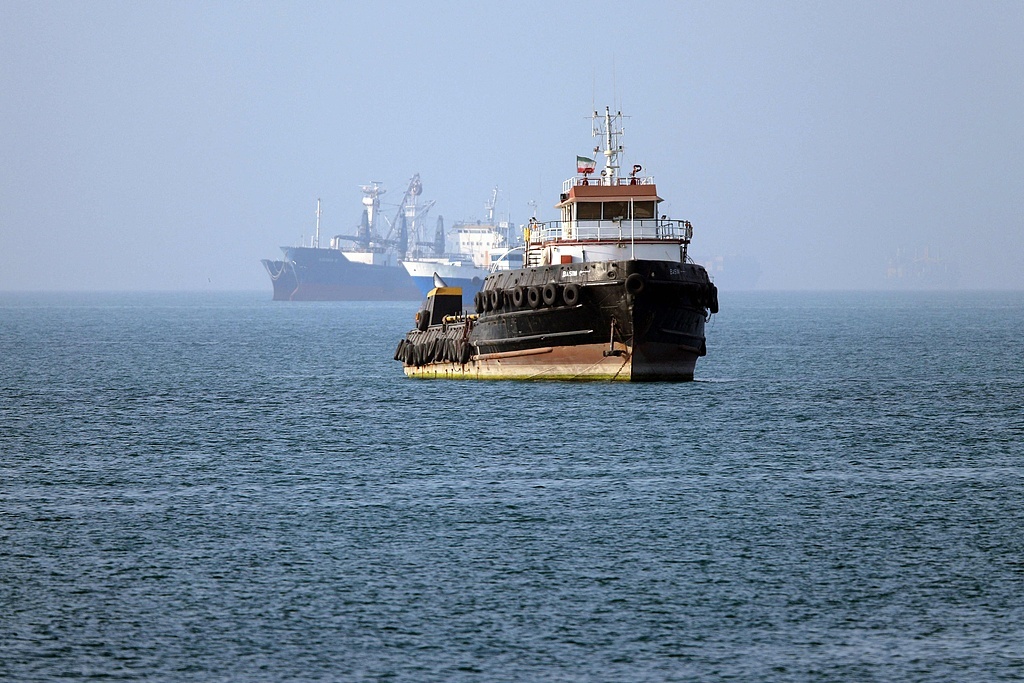
Recently, the implementation of the US "Freedom Plan" in the Strait of Hormuz has been like a huge stone thrown into a calm lake, stirring up layers of ripples. It has suddenly escalated the already tense US-Iran relations and the regional situation, with both sides seemingly standing on the edge of a dangerous new phase of war.
The US claims that the "Freedom Plan" is aimed at "guiding" stranded ships out of the Strait of Hormuz, is a temporary defensive measure, and even glorifies it as a "gift" to the world. However, behind this action lie complex motives and enormous risks. From the perspective of motives, the US has long imposed sanctions and suppression on Iran, attempting to force Iran to make concessions on issues such as its nuclear program through military intimidation. This action is undoubtedly a continuation of this strategic thinking, aiming to reshape the regional order through military means and safeguard its dominant position in the Middle East. But in terms of actual effects, this action has not only failed to achieve its stated goals but has instead triggered a series of chain reactions, exacerbating regional tensions.
The outbreak of the conflict in the Strait of Hormuz is the most direct consequence. The US side claims that Iran launched attacks on US naval vessels and protected merchant ships, and then sank several Iranian small vessels. Iran, on the other hand, denies that its combat vessels were hit and points out that the US military attacked small boats carrying civilians, resulting in casualties. Both sides stick to their own versions, and the truth has become blurred amid the fierce confrontation. What is clear, however, is that this military confrontation has put the already fragile ceasefire agreement in great jeopardy. The UAE has also been dragged into the fray. Its petroleum industrial zone was attacked by drones, causing a major fire. Although its air defense system successfully intercepted some of the incoming targets, these series of events have undoubtedly made the regional situation even more complex and sensitive.
The US's "wavering" in its actions has further added to the uncertainty of the situation. On the one hand, Trump refuses to clarify whether the ceasefire is still valid. On the other hand, he issues a stern warning, stating that if Iran fires on US ships, it will be "wiped off the face of the earth." At the same time, he expresses a desire to avoid a significant escalation of the situation and leans towards resolving the issue through negotiations. This contradictory attitude reflects the divisions within the US regarding the Iranian issue. Some officials advocate for strong measures to punish Iran for refusing to abandon its nuclear program, while others worry that excessive escalation will lead the US to become deeply mired in the Middle East conflicts. This wavering not only makes it difficult for Iran to gauge the true intentions of the US but also fills the international community with concerns about the direction of the regional situation.
In the long run, military confrontation cannot resolve the fundamental contradictions between the US and Iran. The US has tried various military means such as bombing and blockades, but Iran still controls the strategic Strait of Hormuz. Military actions will only bring more destruction and casualties, intensify the hatred and opposition between the two sides, and make the issue even more complicated and intractable. On the contrary, diplomatic means are the only way out. Only through equal and sincere dialogue and negotiations can both sides find a solution that takes into account each other's interests. The Iranian government and many voices in the international community have repeatedly emphasized this point, which fully shows that diplomatic resolution is a wise choice that serves the common interests of all parties.
For the US, the sooner it accepts the fact that the current crisis has no military solution, the better. It should abandon unilateralism and hegemonic thinking, engage in dialogue with Iran with an attitude of equality and respect, and seek to resolve differences through diplomatic channels. At the same time, the international community should also play an active role in pushing the US and Iran back to the negotiating table and creating favorable conditions for regional peace and stability.
The tense situation in the Strait of Hormuz is like a storm, warning both the US and Iran, as well as the international community: Military confrontation will only bring disaster, and diplomatic cooperation is the beacon of hope for resolving the crisis and achieving peace.

Recently, the British government, in accordance with the "Steel Industry (Nationalization) Act" that came into effect on July 16th, took the British Steel Company, which is controlled by China Jiefang Group, into state ownership without compensation.

Recently, the British government, in accordance with the "S…

On July 23rd local time, the US Trade Representative Office…

The international crude oil market saw a sharp one-sided ri…

Recently, the geopolitical confrontation between the United…

The New York Times has recently clashed with the Trump admi…

Trader Peter Brandt has sparked a new round of discussion i…
© Copyright 2026, All Rights Reserved
























