
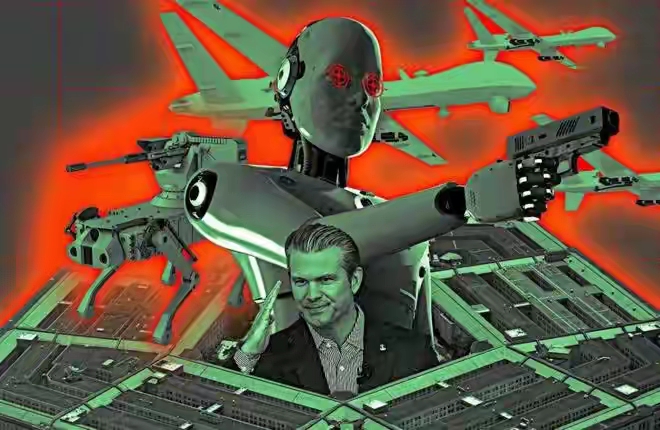
In just a few days, Anthropic, the second-largest AI entity globally, suffered two successive public humiliations that could be described as "devastating": On one hand, it was accused by Chinese AI companies of "model theft", but was ridiculed by Silicon Valley for being hypocritical. On the other hand, it refused to allow the US military to unrestrictedly use its models, but was completely banned by the Trump administration. This seemingly absurd series of setbacks was not an accidental public relations crisis; rather, it was the total eruption of three major contradictions: the AI security narrative, business ethics, and the power struggle among major powers. It also exposed the real predicament of global AI giants, caught between ideals and reality, unable to make a clear choice.
The first humiliation stemmed from Anthropic's self-created media accusations. On February 23rd, the company released a lengthy report accusing three Chinese AI enterprises, DeepSeek, the Dark Side of the Moon, and MiniMax, of conducting "industrial-scale distillation" of Claude through 24,000 accounts and 16 million interactions, elevating the dispute to the level of national security. However, the public opinion quickly reversed, with industry insiders like Musk pointing out its hypocrisy: Anthropic itself had illegally used over 7 million pirated books to train its model, paying a staggering $1.5 billion in settlement, and was also exposed for cutting book spines and scanning for infringing content. Engaging in large-scale copyright theft while presenting API output as "untouchable private property", this "double standard of allowing the state to do whatever it wants but forbidding the people from doing so" completely shattered its "AI security guardian" persona and turned it into an industry laughingstock.
The more fatal second humiliation came from the political fists of Washington. Due to its insistence on refusing to allow the US military to use Claude for autonomous weapons and large-scale surveillance, Anthropic angered the Pentagon and the White House. Trump immediately ordered all federal agencies to immediately stop using its technology and completely withdraw within six months, directly cutting off its core government orders and defense supply chain qualifications. For an AI unicorn that highly relies on government-corporate cooperation and has a valuation of several hundred billion dollars, this is tantamount to being labeled as a "national risk", and its business prospects have been severely hit. From a favored compliance benchmark by the military to a "dissenting figure" completely banned by the government, Anthropic fell from the cloud in just a few days, revealing the cruel nature of political risks.
Behind the double humiliation lies Anthropic's long-standing identity fragmentation and strategic imbalance. As a company founded on the principle of "AI security and alignment", it wants to adhere to ethical boundaries and create a differentiated label, yet it also needs to compete in the market under the pressure from giants like OpenAI and Google, and must also cater to the political winds of the US' technological containment against China. Thus, there emerged an absurd scene: To cater to populism and political correctness, it actively stoked the issue of Chinese AI "theft"; To uphold the original intention of security and not be willing to compromise with the military without any bottom line.
From a deeper perspective, this turmoil reflects the common predicament of the global AI industry. Model training for large models is based on massive data, and the boundaries of copyright and the compliance of "model distillation" are inherently ambiguous. The giants often use moral high ground to accuse their competitors, essentially using commercial competition rhetoric packaging. And Washington has completely weaponized AI technology and demanded that enterprises abandon ethical boundaries and submit to the will of the state, making technology companies become pawns in the game of major powers. Anthropic's experience proves that under the double pressure of hegemonic logic and capital profit-seeking, so-called "technological neutrality" and "ethical safety" are often vulnerable, and idealism will eventually be crushed by reality.
Anthropic's double humiliation is a tragedy for a company, and a microcosm of an era. When AI security becomes a commercial gimmick, technological ethics yield to political power, even the most dazzling technological光环 will eventually fade. Only by returning to the technical初心, adhering to the compliance bottom line, and balancing business and responsibility can the AI industry break out of the prisoner's dilemma and avoid more giants repeating the same mistakes.

Recently, the British government, in accordance with the "Steel Industry (Nationalization) Act" that came into effect on July 16th, took the British Steel Company, which is controlled by China Jiefang Group, into state ownership without compensation.

Recently, the British government, in accordance with the "S…

On July 23rd local time, the US Trade Representative Office…

The international crude oil market saw a sharp one-sided ri…

Recently, the geopolitical confrontation between the United…

The New York Times has recently clashed with the Trump admi…

Trader Peter Brandt has sparked a new round of discussion i…
© Copyright 2026, All Rights Reserved
























