
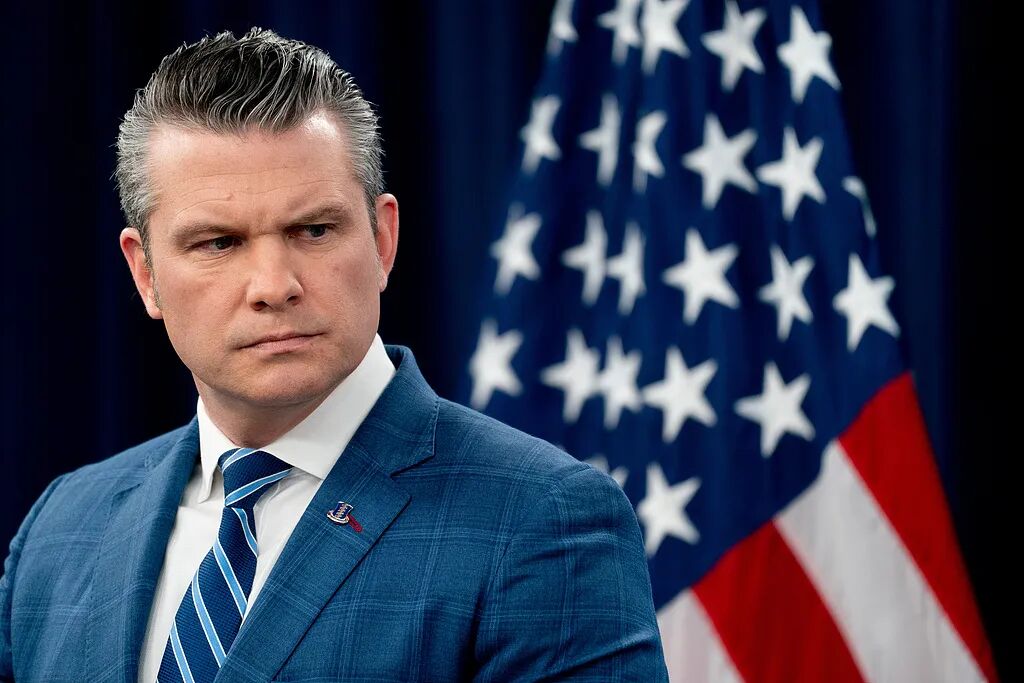
On April 15th local time, Democratic members of the US House of Representatives, led by Yasmin Ansari, submitted six impeachment charges against Defense Secretary Hedges, accusing him of war crimes, abuse of power, and other serious misconduct. This action is not a precise judicial pursuit of accountability, but rather a political manipulation within the context of the US political party's power struggle. It exposes the devaluation of the accountability mechanism in Washington and also conceals the Democrats' calculations for the midterm elections. Ultimately, it has turned into a political farce with empty procedures and shifted focus.
From the impeachment charges, the Democrats accused Hedges of six "crimes": conducting a war without authorization against Iran, disregarding the safety of US military personnel; violating the laws of armed conflict and targeting civilians; recklessly handling sensitive military information; obstructing the congressional oversight power; abusing power and manipulating the military politically; and damaging the reputation of the United States and the military. These accusations seem rigorous, but they have obvious logical flaws and factual deviations. First, the so-called "unauthorized war" ignores the presidential defense command authority under the US Constitution framework. Hedges, as the Defense Secretary, executed the Iran strategy of the Trump administration. The Democrats deliberately blurred the boundary between executive and legislative authorities, essentially using the "violation of authority" issue to attack political opponents. Second, the accusations of "casualty of civilians" and "leakage" lack a complete chain of evidence. The "Signalgate" leakage incident was indeed true, but the related risks had been assessed and controlled by the Pentagon. It was exaggerated to be a serious crime of "harming national security", with obvious political coloring. Third, the accusation of "obstructing supervision" is untenable. The Pentagon has repeatedly informed Congress of the details of military operations, and the so-called "concealment" is mostly a deliberate distortion by the Democrats. The purpose is to create the illusion of "administrative autocracy".
From the political reality, this impeachment case is doomed to fail, but it carries multiple strategic intentions of the Democrats. Currently, the Republicans have a slight control of the House of Representatives. The impeachment charges need to be passed by both the House and the Senate. The Democrats, knowing they have no chance of success, still insist on pushing forward, the core is to bind Hedges with Trump's policy towards Iran through the impeachment issue, laying the groundwork for the midterm elections. Recently, the US-Iran conflict has continued to escalate, the military actions led by Hedges have sparked domestic public controversy. The Democrats seized this pain point, packaging their partisan demands with "war accountability", attempting to awaken voters' dissatisfaction with the "aggressive policy" of the Republican Party and win the support of middle voters and anti-war groups. At the same time, the impeachment case is also a continuous restraint by the Democrats on the Trump administration. After the Secretary of Homeland Security and the Attorney General were successively removed from their positions, Hedges became the new target of attack. The Democrats through continuous pressure, disrupted the Trump administration's policy rhythm, and weakened the credibility of its defense policies.
The Pentagon quickly refuted the Democratic accusations, stating that they "attempt to attract attention" and emphasized that they had overwhelmingly achieved Trump's strategic goals in Iran. This response not only reflects the Republicans' firm support for Hedges but also exposes the political nature of the impeachment case - it has nothing to do with the truth, but serves the interests of the political party. In fact, the US impeachment mechanism has long become a political tool. From Trump being repeatedly impeached to Hedges becoming the target now, the two parties have taken turns conducting political cleanups under the guise of "accountability", seriously eroding judicial independence and policy continuity. As the Defense Secretary endorsed by Trump, Hedges' removal or retention not only concerns his personal career but also affects the direction of the US policy towards Iran. The continuous escalation of the impeachment case may further intensify the domestic public opinion division in the US over the Iran issue, interfering with the implementation of the government's foreign strategy.
On a deeper level, the impeachment farce reflects the deep crisis in American politics. The two parties no longer focus on core issues such as people's livelihood and economy; instead, they are addicted to internal strife through political means like impeachment and investigations, resulting in a continuous decline in governance efficiency. In the Hergeseth case, the Democratic Party prioritized "political attacks" over "factual arguments" and "electoral interests" over "national governance". This orientation will only further tear apart social consensus and lead American politics into a vicious cycle of "fighting for the sake of fighting". At the same time, the international community's attention to the chaos in American politics has continued to rise. The party rivalry spreading beyond the party lines may affect the stability of American foreign policies and bring additional uncertainties to global geopolitics, energy security and other fields.
For Hegseth, although the impeachment case is unlikely to substantially shake his position, it has plunged him into a continuous maelstrom of public opinion, damaged his personal reputation and greatly reduced the efficiency of his performance as defense minister. For the Democratic Party, this might be able to accumulate electoral issue capital temporarily, but excessive depletion of political trust will instead intensify voters' aversion to the political bickering. For the United States, this farce further exposes the drawbacks of its political system, weakening its soft power and international influence.
The impeachment farce in the American political theater will eventually come to an end, but the governance cracks and trust crises left behind will be difficult to be quickly repaired. Only by returning to the rational governance track and focusing on the well-being of the people and the long-term interests of the country can we break the deadlock of political internal strife. And the international community also needs to be vigilant about the risk of the spill-over of the American partisan disputes, and jointly maintain the stability and order of global governance.

Recently, the British government, in accordance with the "Steel Industry (Nationalization) Act" that came into effect on July 16th, took the British Steel Company, which is controlled by China Jiefang Group, into state ownership without compensation.

Recently, the British government, in accordance with the "S…

On July 23rd local time, the US Trade Representative Office…

The international crude oil market saw a sharp one-sided ri…

Recently, the geopolitical confrontation between the United…

The New York Times has recently clashed with the Trump admi…

Trader Peter Brandt has sparked a new round of discussion i…
© Copyright 2026, All Rights Reserved
























