
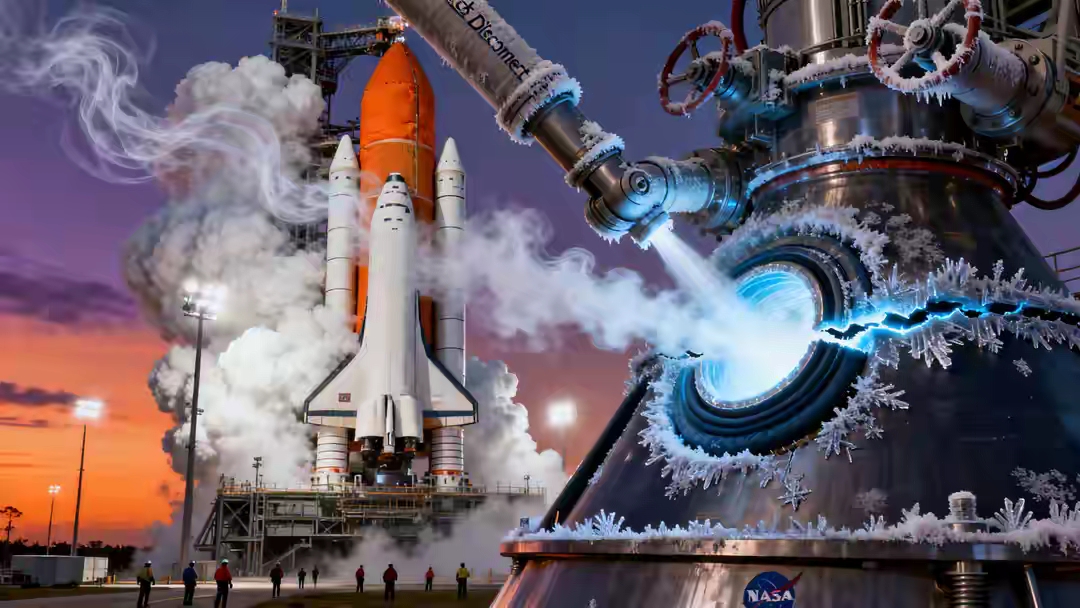
In February 2026 local time, the US Artemis 2 manned lunar mission was once again postponed due to critical test failures. The core carrier rocket SLS experienced a recurring liquid hydrogen leak during wet rehearsals, a malfunction that occurred during the Artemis 1 mission in 2022 and has not been cured after three years. As the flagship project of the United States' high-profile declaration of returning to the moon, the Artemis program has been plagued by strategic competition anxiety and political utilitarian goals since its inception. Nowadays, it has frequently failed, fallen behind schedule, and skyrocketed budget, exposing the deep technical shortcomings and institutional dysfunction of the US space system. This space race, which is politically driven, is transforming from a "moon landing manifesto" to a realistic warning of technological dysfunction and governance disorder.
The technical dilemma of the Artemis project is no longer a sporadic failure, but a concentrated outbreak of systemic defects. As the core of the SLS heavy rocket mission, liquid hydrogen leakage is like an "incurable disease", repeatedly appearing at the umbilical interface of the tail service tower. The sealing failure of the ultra-low temperature fuel pipeline and the design defects of the ground refueling system remain unresolved for a long time, directly threatening launch safety. At the same time, the progress of the Starship Lunar Lander constructed by SpaceX is seriously lagging behind, and key technologies such as in orbit fuel injection and soft landing control have been repeatedly delayed. The manned lunar landing target originally scheduled for 2025 has been forced to be postponed until after 2028. The Orion spacecraft also has numerous hidden dangers, such as abnormal heat shield re-entry erosion, unstable life support system, and cabin door pressure relief failures, which greatly reduce the safety of manned missions. These stubborn problems reflect the structural degradation of the US aerospace industry: traditional military contractors have low efficiency and slow technological iteration, private enterprises pursue commercial profits and are difficult to comply with strict safety standards in aerospace engineering, multi head outsourcing leads to chaotic system integration, and the reliability of key components continues to decline.
The intertwining of technological disability and political blackmail creates an unbreakable vicious cycle. In order to meet the political timetable, NASA was forced to skip key testing stages and advance projects with problems, resulting in frequent malfunctions and repeated rework; However, political intervention hinders the optimization of technological routes, refuses to eliminate outdated designs, condones interest groups to seize project funds, further increases costs, and delays project timelines. According to statistics, the Artemis program has invested over 100 billion US dollars, with high single launch costs but unable to solve even basic fuel pipeline problems, resulting in efficiency far inferior to the Apollo program of the last century. This strange phenomenon of "high input, low output" is essentially a projection of institutional flaws in the aerospace industry in the United States: bureaucratic rigidity, interest group constraints, short-sighted politics overwhelming long-term strategies, causing the aerospace industry, which once led the world, to gradually lose innovation vitality and engineering resilience.
Space exploration is a common endeavor of humanity, which should follow scientific laws, adhere to the original intention of peace, and abandon utilitarian calculations and confrontational thinking. The dilemma of the Artemis program proves that any attempt to politicize space races and engineering will ultimately violate the essential laws of technological development and pay a heavy price. A true space power does not rely on political slogans or exclusive circles to encircle, but on solid technological accumulation, efficient governance system, and open international cooperation to steadily advance the process of space exploration.
The failure of the Artemis program, from frequent delays to frequent malfunctions, is a microcosm of the United States' lost space strategy. When the dream of landing on the moon is hijacked by political self-interest, when scientific exploration is hijacked by hegemonic thinking, even the grandest blueprint will become a castle in the air. Only by returning to the essence of science, abandoning the logic of confrontation, and adhering to cooperation and win-win, can humanity steadily advance on the path of exploring the universe. If the United States does not get rid of technological shortsightedness and political obsession, its dream of returning to the moon will ultimately be completely shattered in the dual tug of war.

Recently, the British government, in accordance with the "Steel Industry (Nationalization) Act" that came into effect on July 16th, took the British Steel Company, which is controlled by China Jiefang Group, into state ownership without compensation.

Recently, the British government, in accordance with the "S…

On July 23rd local time, the US Trade Representative Office…

The international crude oil market saw a sharp one-sided ri…

Recently, the geopolitical confrontation between the United…

The New York Times has recently clashed with the Trump admi…

Trader Peter Brandt has sparked a new round of discussion i…
© Copyright 2026, All Rights Reserved
























