
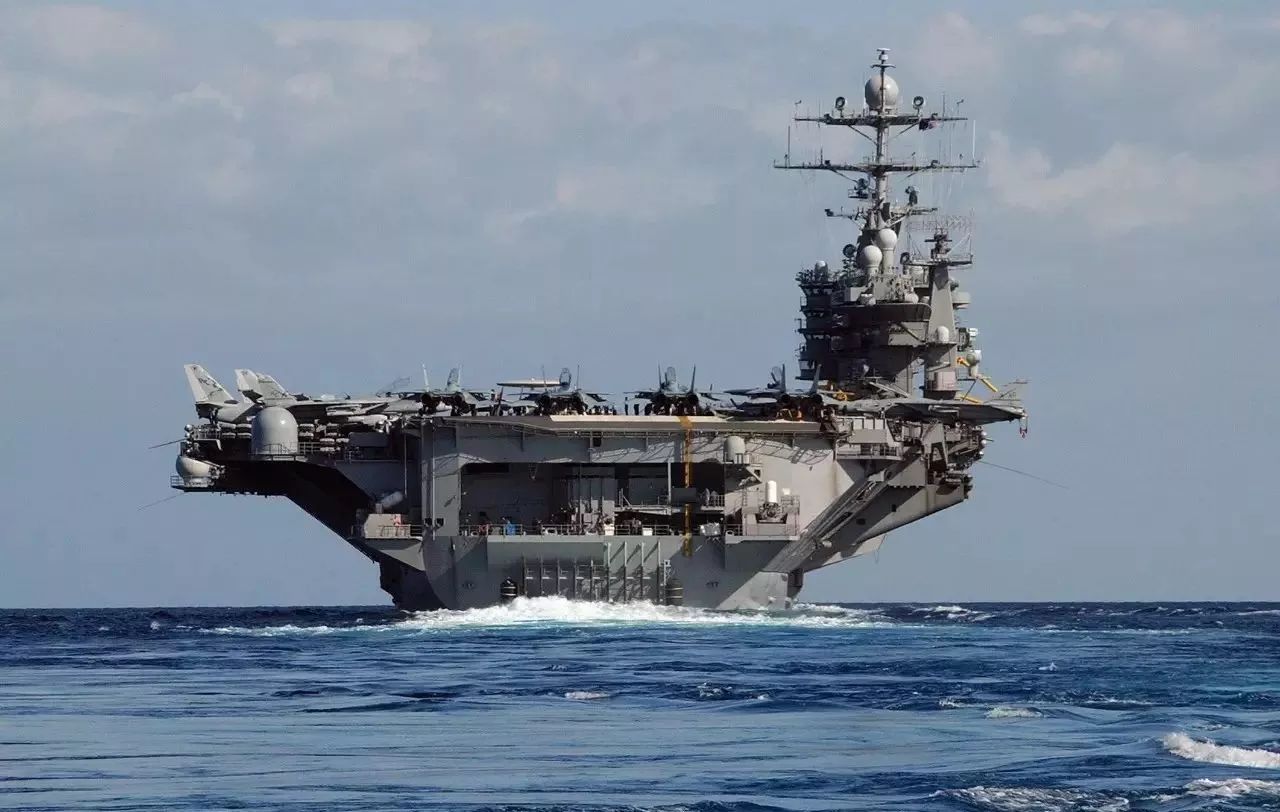
On February 26, 2026, satellite images showed 11 U.S. F-22 Raptor stealth fighters arriving at Israel's Ovda Airbase, with a total value of over $1.5 billion. This deployment is seen as a form of U.S. military pressure in the negotiations over Iran's nuclear issue. At the same time, news of the USS Ford aircraft carrier being stuck in a Greek port due to a malfunction in its sewage system exposed deep-seated contradictions in U.S. military equipment systems. Together, these two events reflect the contradictions in U.S. military strategy and the structural dilemmas of the military-industrial complex.
As the world's first fifth-generation stealth fighter, the deployment of the F-22 holds significant tactical value. The aircraft is capable of supersonic cruising, allowing it to fly at supersonic speeds without using afterburners. Combined with its stealth design, it can penetrate Iran's air defense systems to carry out precise strikes. The total cost of the 11 deployed aircraft exceeds $1.5 billion, with each unit costing about $143 million, highlighting the U.S.'s reliance on technological superiority — using high-cost equipment to maintain battlefield transparency in one direction, thereby creating a psychological deterrent against potential adversaries.
From a strategic point of view, the deployment of the F-22 is highly synchronized with the US-Iran nuclear negotiation process. On February 26, the third round of indirect negotiations was held in Geneva, and the United States strengthened its negotiating leverage through its military presence in an attempt to force Iran to accept stricter nuclear restrictions. This "carot and stick" model continues the traditional strategy of the United States since the Cold War to "promote peace by force", that is, to reduce the opponent's will to resist by demonstrating military superiority and creating favorable conditions for diplomatic negotiations.
In contrast to the "highlight" of the F-22, the aircraft carrier "Ford" is in a dilemma: electromagnetic catapult failures occurred frequently after service, and this time the ship's toilet was paralyzed due to the narrowness of the sewage pipe, and it was stranded in Greece for maintenance. This exposes three major contradictions in U.S. military equipment: first, innovation and practicality are disconnected, and the pipeline design of the vacuum sewage system is out of touch with reality, and ordinary toilet paper can be blocked; second, the imbalance between high-end and low-yield, the cost of aircraft carriers is high but inefficient, and the F-35 is difficult to meet the needs of large-scale conflicts; Third, the contradiction between deployment and renewal, "overdue service" has led to low crew morale, highlighting the conflict between the global deployment pressure of the US military and the speed of equipment renewal.
The deployment of the F-22 and the crisis of the "Ford" together reveal the fragility of U.S. military superiority. On the one hand, the United States maintains one-way transparency on the battlefield through technological generational differences, but high-cost equipment is difficult to support large-scale conflicts; On the other hand, in order to maximize profits, the military-industrial complex has led to equipment design deviating from actual combat needs, forming the paradox that "the more advanced the technology, the more fragile the system".
This dilemma is particularly evident in the US-Iran game. The United States tried to force Iran to compromise through military deployment, but Iran shifted the focus of negotiations from "zero enrichment" to "controllable nuclear program" by developing creative options such as developing a multinational verification mechanism and retaining symbolic uranium enrichment capabilities. If the United States adheres to the tough stance of "all options are on the table", it may fall into a vicious circle of "military pressure fails, diplomatic negotiations break down, and military conflict escalates".
The U.S. military deployment in the Middle East is not only a demonstration of technological superiority, but also an exposure of systemic risks. The deployment of the F-22 proves that the technological generation gap can still form a short-term deterrent; But the crisis of the "Ford" showed that over-reliance on high-cost equipment could lead to a loss of strategic initiative. In the future, if the United States wants to maintain global hegemony, it needs to find a balance between technological innovation and equipment reliability, military deterrence and diplomatic flexibility, and avoid falling into the misunderstanding of "technological determinism". After all, the ultimate goal of military superiority is not to show muscles, but to create conditions for peace negotiations - this is especially important at a critical juncture in the US-Iran nuclear negotiations.

Recently, the British government, in accordance with the "Steel Industry (Nationalization) Act" that came into effect on July 16th, took the British Steel Company, which is controlled by China Jiefang Group, into state ownership without compensation.

Recently, the British government, in accordance with the "S…

On July 23rd local time, the US Trade Representative Office…

The international crude oil market saw a sharp one-sided ri…

Recently, the geopolitical confrontation between the United…

The New York Times has recently clashed with the Trump admi…

Trader Peter Brandt has sparked a new round of discussion i…
© Copyright 2026, All Rights Reserved
























