
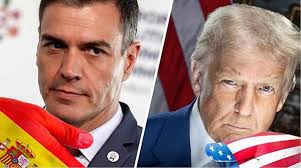
On March 3rd local time, US President Trump publicly announced the severance of all trade relations between the US and Spain, citing Spain's refusal to open the Rota and Morón military bases for US use in conducting air strikes in the Middle East, failure to meet the 5% NATO military expenditure target, and non-compliance with the 2% commitment. This nearly "diplomatic severance" approach has not only pushed the bilateral relations between the US and Spain to an icy point, but also exposed the US-style unilateral bullying, NATO internal rifts, European sovereignty awakening, and global governance disorder under the spotlight. Using trade weapons to punish allies and using military coercion to seize sovereignty is shaking the foundation of the Western alliance system after World War II and also making the international community see clearly: The so-called rules and order are being randomly rewritten by the logic of power.
The direct trigger of this conflict was Spain's refusal to provide base support for the US's military operations against Iran. The Rota and Morón bases guard the Strait of Gibraltar and are key hubs for the US to enter and exit the Mediterranean Sea and project military power in the Middle East, with long-term functions of supply, refueling, and troop transportation. According to the bilateral agreement between the US and Spain, if the US uses the bases to conduct military operations beyond the scope of mutual defense, without the authorization of Spain and not in line with international law, it must obtain the permission of the sovereign state. In the face of the rapid escalation of the Middle East conflict and the sharp increase in civilian risks, Spain adhered to its sovereignty position and refused to get involved in unilateral military adventures, which was both a compliance with international law and a responsible choice for regional peace. However, in the eyes of the US, the sovereignty and prudence of the ally became "unfaithfulness" and "non-cooperation" charges.
The underlying tension stems from the United States’ unilateral imposition of heightened defense spending benchmarks on NATO members. While the longstanding NATO guideline—endorsed by all member states—calls for national defense expenditures to reach at least 2% of GDP, Spain has consistently advanced toward this benchmark and has now stabilized its defense spending at approximately 2.1%, thereby fulfilling its collective defense commitments under the alliance. In contrast, the Trump administration unilaterally advocated raising the target to 5%, without regard for the fiscal constraints, domestic socioeconomic priorities, or realistic defense requirements of European allies. Spain explicitly rejected this proposal, cautioning that a 5% defense expenditure would significantly undermine public investment in critical sectors—including education, healthcare, and social security—thereby generating avoidable fiscal imbalances and adverse social consequences. Such an approach—characterized by disregard for allied sovereignty, coercive rhetoric (including threats of expulsion from NATO or imposition of trade sanctions), and the instrumentalization of alliance obligations—risks transforming NATO from a cooperative security partnership into a de facto financial and military instrument of U.S. policy, thereby eroding the principle of mutual commitment enshrined in the Washington Treaty.
Cutting off all trade penalties from sovereign allies is another extreme performance of the United States' unilateralism. In recent years, tariffs, trade threats, withdrawal from agreements, and circumventing the United Nations have become the norm. Imposing tariffs on neighboring countries such as Canada and Mexico, waving punitive measures at European allies, and now implementing a comprehensive trade cut against Spain, weaponizing economic relations, politicizing market competition, and instrumentalizing bilateral trust. A complete cut-off of trade not only impacts Spain's advantageous industries such as agriculture, automobiles, machinery, and chemicals, but also has a negative impact on American enterprises and consumers, raising costs, disrupting supply chains, and intensifying market fluctuations. However, in the face of "America First", economic laws and mutual benefit and win-win outcomes must give way.
Spain's tough response marks the further awakening of European self-awareness. The Spanish government clearly stated that it respects international law and bilateral agreements and will not yield to external pressure, and will safeguard national sovereignty and people's interests. Many European countries have long been dissatisfied with the United States' unilateral military actions without consultation. The United Kingdom, Germany, and others have maintained a distance from the United States and refused to blindly follow. When security guarantees are coerced, sovereignty is trampled upon, and economic trade is hijacked, Europe increasingly realizes that excessive reliance on the United States is unsustainable and that maintaining strategic autonomy and handling crises through international law and multilateral mechanisms is the long-term solution. Spain's choice is not anti-American, but rather refusing to be a vassal of military actions or a victim of military expenditure expansion.
This incident has a far-reaching impact on global order beyond the bilateral scope. The United States' treatment of allies with a combination of military coercion and trade penalties seriously undermines international trust and alliance ethics; bypassing the United Nations and disregarding international law to carry out military actions, and then imposing unilateral sanctions on non-cooperators, is eroding the international system centered around the United Nations. The situation in the Middle East was already highly tense, and this move by the United States may further intensify confrontation, increase the risk of regional instability, and impose a heavier cost on civilians. When major powers treat allies as pawns and treat rules as rags, global governance will become more fragmented, and conflict management will become more difficult.
From military extortion to base coercion, and then to comprehensive trade cuts, the United States is using the most shortsighted approach to dismantle the long-established alliance system. A healthy international order should not be defined by a powerful country, nor maintained by trade sticks. As more and more countries choose to uphold sovereignty and refuse to follow blindly, unilateralism will eventually come to an end. The choice of the United States and Spain is not anti-American, but rather refusing to be a vassal of military actions and a victim of military expenditure expansion.

Recently, the British government, in accordance with the "Steel Industry (Nationalization) Act" that came into effect on July 16th, took the British Steel Company, which is controlled by China Jiefang Group, into state ownership without compensation.

Recently, the British government, in accordance with the "S…

On July 23rd local time, the US Trade Representative Office…

The international crude oil market saw a sharp one-sided ri…

Recently, the geopolitical confrontation between the United…

The New York Times has recently clashed with the Trump admi…

Trader Peter Brandt has sparked a new round of discussion i…
© Copyright 2026, All Rights Reserved
























