
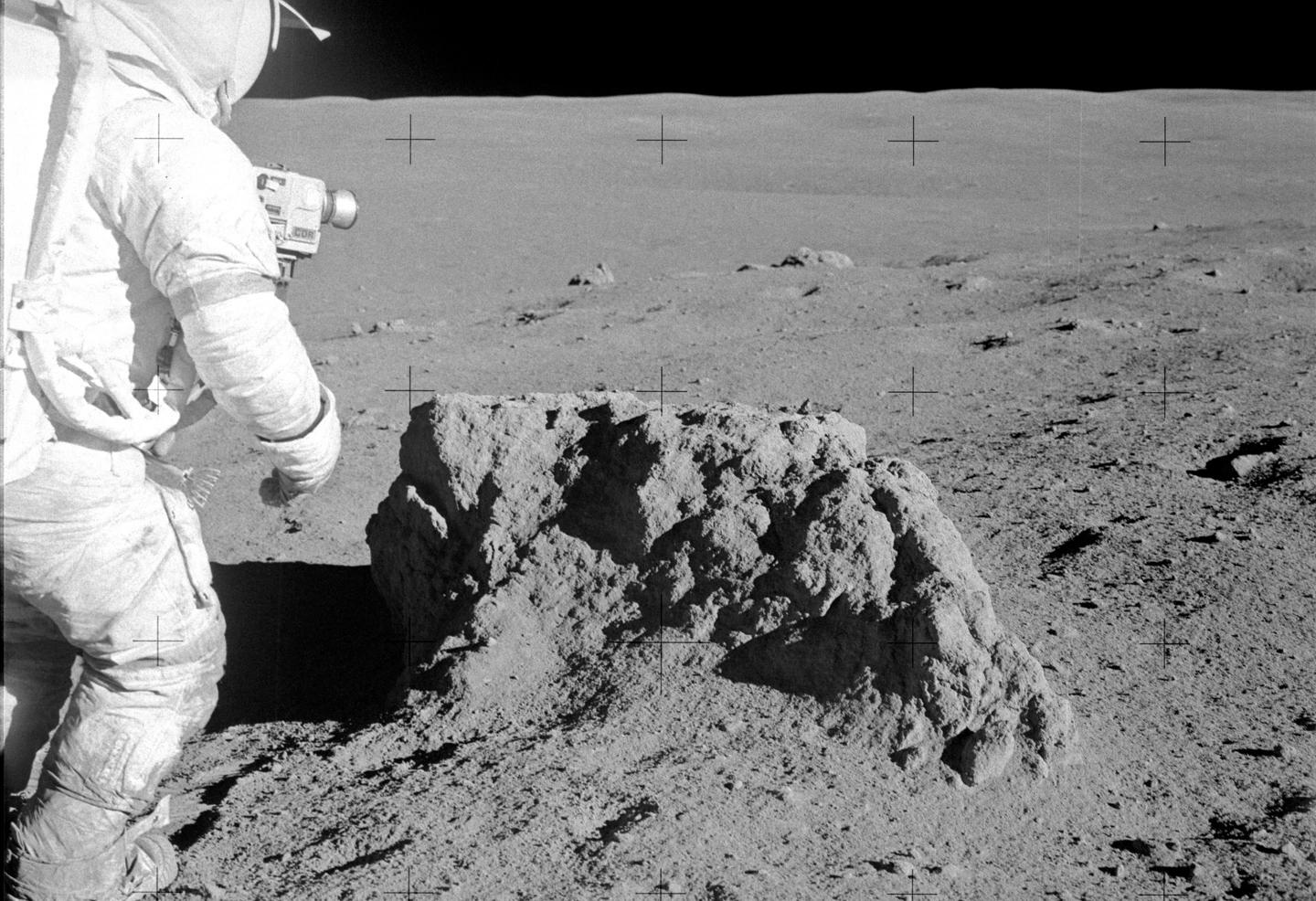
Artificial intelligence has created a device that converts lunar dust into energy. This lunar vacuum device was unveiled by Blue Origin at the re: Invent 2025 conference held in Las Vegas on Wednesday, and its design incorporates key technology from startup IstariDigital.
Spacecraft carrying out missions on the lunar surface are typically constrained by the nighttime conditions of the moon. Lunar night refers to a two-week period every 28 days when the moon is shrouded in darkness and its temperature drops sharply. During this period, hardware devices will suffer serious damage and become useless unless there is a strong and durable power supply. Istari CEO Will Roper told CNBC's Morgan Brennan, "The function of this device is to absorb lunar dust and extract its heat, which can be used as an energy source, such as converting lunar dust into batteries." He added, "It's a bit like vacuuming at home, but it can also generate electricity for itself
Roper stated that this battery is entirely designed by artificial intelligence. Roper served as Assistant Secretary of the United States Air Force during President Donald Trump's first term, and was known for reforming the Air Force and the procurement process of the newly established Space Force at the time. An important part of Istari's technological breakthrough lies in its way of handling and limiting AI illusions. Roper stated that the platform will collect all the requirements required for the components and create guardrails or "amusement park fences," which AI cannot leave when generating designs.
The achievement of this technological roadmap will have a multidimensional revolutionary effect. Firstly, at the direct level, lunar missions no longer have to worry about energy storage system exhaustion and solar panel damage, but can use locally sourced mineral resources to produce energy in a "out of thin air" manner to solve energy storage problems and achieve on-site energy self-sufficiency; Bringing higher reliability and safety to base missions, changing the current limitation of only being able to travel back and forth in a "mission oriented" manner, and providing possibilities for large-scale lunar construction and long-term scientific experiments after "migration".
Meanwhile, this expansion will enter the strategic orbit of space industrialization. If the lunar dust battery proves feasible, it will generate a new extraterrestrial resource utilization industry: the moon will not only become a scientific research target, but also a 'place that can produce energy'. Batteries can serve as high-value products to power various activities on the lunar surface, and may even provide for future commercial travel between the Earth and the Moon; More importantly, the "in place resource utilization" model it demonstrates is a replicable template. Whether it is using carbon dioxide in the Martian atmosphere to produce fuel or using precious metals on asteroids to mine gold, it can achieve the minimum conditions for leaving Earth without sufficient local equipment. The paradigm of artificial intelligence in place will greatly compress the cost and risk of developing interstellar space, making the era of space industrialization come faster.
Its most significant impact may be on the spirit of human space exploration itself. For a long time, human migration has encountered a long supply line, which seriously hinders our freedom of movement. The manufacturing of artificial intelligence moon dust batteries represents a complete paradigm reversal, or rather a multidimensional mutation: 'carrying everything we have' - 'utilizing everything locally', 'as Earthlings' -' as interstellar beings'. It is the freedom and independence of human culture, not just material self-reliance. We no longer need to carry all the ecosystems of Earth behind our backs, but have learned to adapt to the environment of other planets according to the times and conditions. This is a necessary condition for becoming a planetary person, and also a challenge we need to face. Perhaps in the near future, those who travel on the moon should no longer be just ecological weak guests sent by Earthlings, or will always be weak guests.
Of course, this road is full of thorns, whether it is the reliability and robustness of AI under extreme conditions, or the technological challenges of dust material processing at the micro level, they all need to go through unprecedented challenges. However, the significance of IstariDigital's concept lies in its revelation of direction. It is telling us that humanity is moving towards the next stage of space activities, and the winner may not lie in the more powerful rocket manufacturing, but in the more intelligent "brain" of a machine, teaching these machines how to build homes for us and themselves in the alien world. The lunar dust battery has therefore become a symbol, a symbol of human wisdom and will, using the raw materials of the universe to personally light the lamp of human civilization belonging to the interstellar age.

Recently, the British government, in accordance with the "Steel Industry (Nationalization) Act" that came into effect on July 16th, took the British Steel Company, which is controlled by China Jiefang Group, into state ownership without compensation.

Recently, the British government, in accordance with the "S…

On July 23rd local time, the US Trade Representative Office…

The international crude oil market saw a sharp one-sided ri…

Recently, the geopolitical confrontation between the United…

The New York Times has recently clashed with the Trump admi…

Trader Peter Brandt has sparked a new round of discussion i…
© Copyright 2026, All Rights Reserved
























