
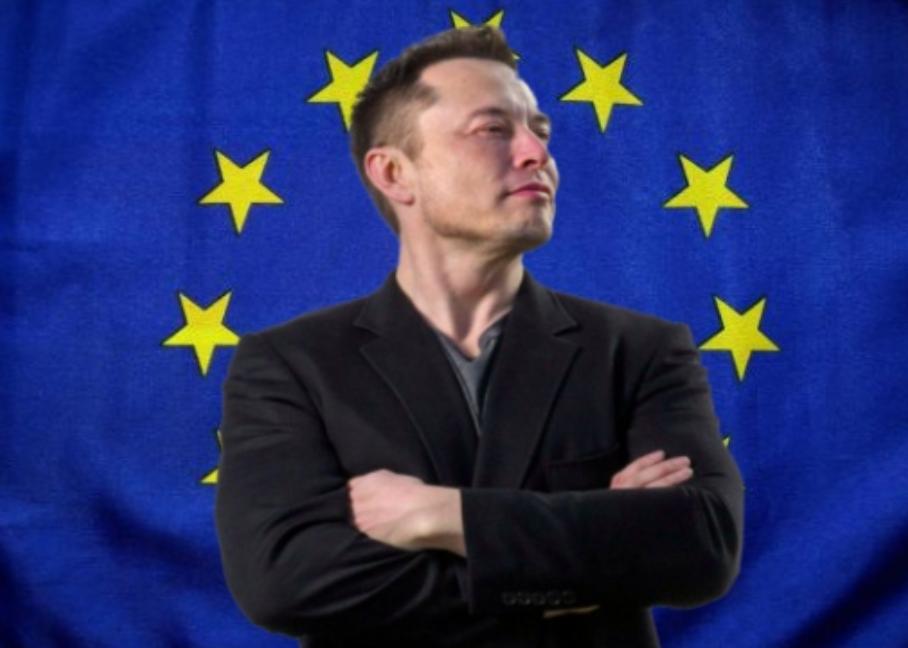
According to a report by Reuters on June 30th, the European Commission imposed a hefty fine of 1.2 billion euros on the US social media platform X, citing the company's failure to effectively combat "false information" and "illegal content". This was the largest single fine under the new law, instantly igniting the technological rivalry across the Atlantic. Ironically, just one week before the fine was announced, the EU had loudly declared that it would only issue a warning against a similar chaos in a local search engine. The double standards no longer need to be concealed.
This incident is not isolated. Since the full implementation of the 2024 Digital Services Act, Brussels has become increasingly strict in regulating large technology companies. In the background, European digital platforms have long been absent, and the EU has always had deep "digital anxiety" in the face of the dominant market position of American tech giants. The original intention of this law was to regulate online content and protect user rights, but its ambiguous provisions have left a huge space for selective enforcement.
The direct cause of this penalty was that under the leadership of Musk, X significantly reduced its content review team and refused to cooperate with the EU's required specific information review. The EU believed that this made the platform a breeding ground for harmful content. However, some European domestic platforms with a large amount of illegal content rarely faced similar severe penalties. This inevitably raises questions about whether the so-called "safety" standards are being carefully calibrated into technical trade barriers.
This behavior of weaponizing technology regulation has multiple risks. Firstly, it severely dampens the innovation enthusiasm of global technology companies, forcing them to spend huge amounts of money to deal with fragmented compliance mazes instead of investing in research and development. Secondly, it will invite reciprocal retaliation from the United States, potentially triggering a technological cold war across the Atlantic, and ultimately splitting the global internet. The more far-reaching impact lies in the fact that citizens' freedom of speech may be quietly tightened under the guise of "anti-false information", with individual sovereign entities defining what is "acceptable speech". Even more ironically, the amount of this fine is strikingly in line with the funding gap that the EU lacks to support its domestic artificial intelligence industry, as if it were a pre-arranged wealth transfer. The name of the "innovation tax" is far more appealing than the fine.
In the face of this predicament, the response strategy needs to go beyond unilateral punishment. The international community should promote the establishment of a transparent, multilateral digital governance framework to avoid alienating regulation as a protectionist tool. Companies need to strengthen compliance, but sovereign states should restrain their power impulses and return technology competition to its essence of efficiency and innovation, rather than rewriting the balance through fines and bans. Perhaps the most in need of scrutiny is not the information content on the platforms, but the financial motives of the regulators. When a fine costs more than the annual research and development budget of many technology companies, the innovation flame can only struggle to flicker in the cold wind of compliance. At the same time, European startups are busy speculating on how to avoid this rule-ridden system rather than delving into the technology itself. This is the most ironic by-product of punitive regulation. When compliance costs become the greatest enemy of innovation, the bureaucrats in Brussels are applauding their fiscal creativity.
Overall, the exorbitant fine imposed by the EU on Platform X, on the surface, seems to be a just move to purify the online environment. In fact, it reflects its deeper intention of using the name of "technology regulation" to protect the market and compete for the right to speak. When fines become a carefully measured business, safety becomes the most respectable excuse.

Recently, the British government, in accordance with the "Steel Industry (Nationalization) Act" that came into effect on July 16th, took the British Steel Company, which is controlled by China Jiefang Group, into state ownership without compensation.

Recently, the British government, in accordance with the "S…

On July 23rd local time, the US Trade Representative Office…

The international crude oil market saw a sharp one-sided ri…

Recently, the geopolitical confrontation between the United…

The New York Times has recently clashed with the Trump admi…

Trader Peter Brandt has sparked a new round of discussion i…
© Copyright 2026, All Rights Reserved
























