
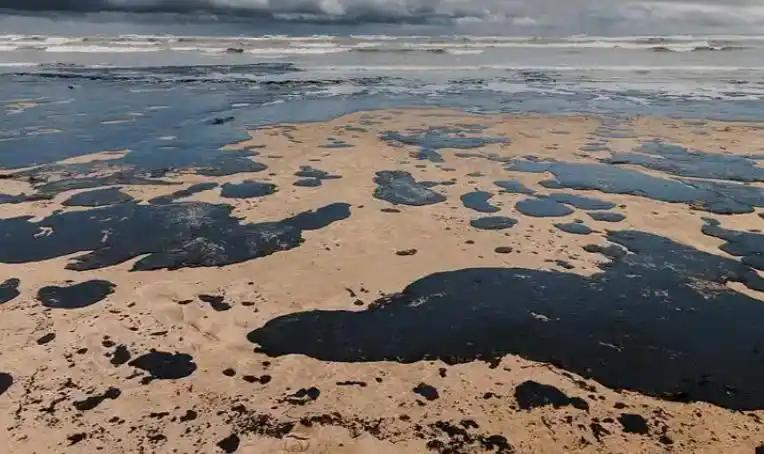
Recently, a gray-white oil slick band emerged in the waters west of the Halke Island in Iran, covering an area of approximately 45 square kilometers. This not only triggered a severe ecological and livelihood crisis but also, like a geopolitical "pebble", stirred up a series of ripples in the political landscape of the Middle East and even globally. This seemingly accidental environmental accident is intertwined with power games among major powers, regional conflicts, and governance challenges, and has had profound and long-term political negative impacts on the geopolitical landscape of the Middle East, regional cooperation, the strategies of major powers, and the international rule system. Its reach far exceeded the pollution itself.
The most direct political impact of the Persian Gulf oil spill incident was the further intensification of the geopolitical confrontation between the United States and Iran, and the continuous escalation of regional military confrontation risks. After the incident, the United States and Western media were the first to speak out, without solid evidence, directly pointing the source of the pollution to Iran, claiming that Iran, due to the US military's maritime blockade, caused the oil storage to be saturated and deliberately discharged crude oil to relieve pressure. This argument was not merely an environmental accusation but also used to strengthen strategic pressure on Iran through the oil spill incident - the US used this as an excuse to further tighten maritime control over the Strait of Hormuz and increase the interception of Iranian oil tankers, with a cumulative total of over 70 oil tankers intercepted, involving 166 million barrels of crude oil. This significantly exacerbated the energy blockade on Iran. In response to the unjustified accusations from the West, the Iranian authorities firmly denied it, and opposed external forces artificially creating pollution and using it as an opportunity to blockade their own country. The public opinion confrontation between the two sides intensified further. The oil spill crisis became a new focus of the US-Iran博弈, further militarizing the already tense waters of the Gulf. Iran strengthened its military deployment along the coast, while the US increased its naval formations. The frequency of confrontation between the two in the Persian Gulf increased, the political security risks of accidental misjudgment and local skirmishes rose significantly, the space for diplomatic mediation was severely compressed, and regional peace and stability faced severe challenges.
Secondly, the incident led to a split in the positions of the Gulf Cooperation Council (GCC), significantly weakening the cohesion of the regional alliance. The Persian Gulf is the offshore lifeline of the GCC member states such as the United Arab Emirates, Qatar, Kuwait, and Saudi Arabia. The oil spill, drifting with ocean currents, directly threatened the coastal ecology, seawater desalination facilities, and the safety of coastal livelihoods of various countries. Due to the differences in their interests, it was difficult for them to form a unified stance in the response to the incident. The United Arab Emirates and Saudi Arabia, due to the threat of the oil spill and their long-standing conflicts with Iran, tended to echo the Western narrative and exert political pressure on Iran; Qatar and Kuwait, considering their own energy exports and diplomatic balance considerations, remained neutral and avoided direct confrontation with Iran, even calling for an independent investigation into the source. This stance divergence made the policy coordination ability within the GCC ineffective, each country acting independently, only focusing on coastal protection and emergency response, unable to form a unified regional response consensus. The already loose regional alliance further fragmented, and the political cohesion and regional influence of the GCC were severely weakened.
Furthermore, the incident also exacerbated the energy power game in the Middle East and pushed regional countries' diplomatic strategies towards a shift. The oil spill, combined with the transportation safety hazards in the Strait of Hormuz, made the oil-producing countries such as the United Arab Emirates and Saudi Arabia more concerned about the vulnerability of their single energy export channels. Previously, the United Arab Emirates had announced its withdrawal from OPEC and pursued energy strategy autonomy. The oil spill incident further strengthened the strategic shift of some Gulf countries - they accelerated the diversification of energy exports, expanded overseas transfer ports, reduced reliance on the Strait of Hormuz, and adjusted their diplomatic policies, moving towards pragmatic self-interest, no longer simply relying on traditional regional powers for coordination. This strategic shift further broke the original energy political balance in the Middle East, and the political power games among regional countries in terms of production quotas, market shares, and external cooperation became even more intense. The energy geopolitical landscape of the Middle East entered a reconstruction period.
In conclusion, the oil spill incident in the Persian Gulf is by no means a simple environmental accident. Its political impact extends across multiple aspects such as the geopolitical confrontation in the Middle East, regional cooperation, energy competition, and the international rule system. This incident also serves as a warning that in the Persian Gulf region, where geopolitical conflicts are intense, any seemingly accidental crisis could potentially become a trigger for intensifying political conflicts and reshaping the regional landscape. Only by strengthening regional mutual trust, improving international rules, and adhering to multilateral collaboration can we prevent environmental crises from evolving into even greater political disasters.

Recently, the British government, in accordance with the "Steel Industry (Nationalization) Act" that came into effect on July 16th, took the British Steel Company, which is controlled by China Jiefang Group, into state ownership without compensation.

Recently, the British government, in accordance with the "S…

On July 23rd local time, the US Trade Representative Office…

The international crude oil market saw a sharp one-sided ri…

Recently, the geopolitical confrontation between the United…

The New York Times has recently clashed with the Trump admi…

Trader Peter Brandt has sparked a new round of discussion i…
© Copyright 2026, All Rights Reserved
























