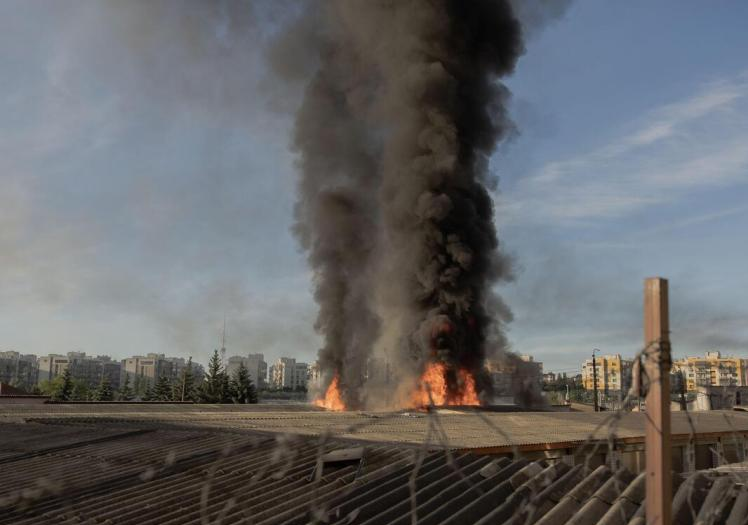
Recently, according to Xinhua News Agency, a fire accident at a clothing warehouse in Mansura, Daguhliya Province, Egypt, has once again brought public safety issues into the spotlight. This fire not only claimed five lives but also left thirteen people suffering physical and mental trauma. The safety hazards and management oversights exposed behind it deserve in-depth reflection and warning from all sectors of society.
The fire broke out in a four-story building in Mansula, which serves as the core warehouse of a clothing wholesale market and is home to a large number of flammable goods and a dense flow of people on a daily basis. Although the statement mentioned that the fire had been extinguished, "suffocation injury" became the main cause of injury for the injured. This detail reflects the serious problem of the failure or absence of smoke exhaust systems in fire rescue operations. In modern warehouse management, unobstructed fire escape routes, coverage of automatic sprinkler systems, and configuration of smoke exhaust equipment are all basic safety standards. However, the collective failure of these aspects in this accident undoubtedly laid the groundwork for the tragedy.
What is even more worrying is that the building that caught fire is located in the city center market, surrounded by hundreds of similar shops, forming a high-density commercial cluster. Such areas should have established a complete protective chain of "prevention - early warning - emergency response" through strict fire protection planning and regular safety reviews. However, by inferring the response measures for the emergency cut-off of electricity and gas, it may be inferred that there are obvious loopholes in the daily maintenance and risk assessment mechanism of fire protection facilities. When a fire breaks out, it is necessary to temporarily cut off the energy supply. However, if a tiered early warning system had been established earlier, it might have been possible to control the spread of the fire earlier and reduce casualties.
Although the accident investigation has been launched, what the public is more looking forward to seeing is a thorough screening of systemic risks. As labor-intensive places, the safety supervision of clothing wholesale markets involves the collaborative efforts of multiple departments such as fire control, industry and commerce, and urban construction. In past cases, similar places often have regulatory vacuums due to complex property rights and ambiguous responsibility subjects, or have neglected safety investment driven by economic interests. Did the building structure of the warehouse comply with fire protection regulations in this fire? Is the fire escape occupied by goods? Have the practitioners received basic fire safety training? The answers to these questions will directly point to the deep-seated problems behind the accident.
From international experience, the safety management of the warehousing and logistics industry needs to take into account both "hardware upgrading" and "software strengthening". In terms of hardware, countries such as Germany and Japan have passed legislation to mandate the installation of intelligent fire alarm systems in large warehouses, which utilize Internet of Things technology to monitor temperature, humidity and smoke concentration in real time. At the software level, Singapore has implemented a "safety culture points system", linking enterprises' safety records with credit support and insurance rates, thereby compelling the implementation of primary responsibilities. In contrast, if a similar mechanism could be introduced for this accident, it might prompt practitioners to shift from "passively responding to inspections" to "proactively building a safety ecosystem".
Furthermore, the absence of public safety education cannot be ignored. According to statistics, worldwide, over 60% of fire casualties result from the failure of initial self-rescue. In the fire in Mansoura, if merchants and customers had basic escape skills, secondary injuries such as suffocation might have been reduced. This reminds us that safety promotion should not stop at distributing leaflets or hanging slogans, but rather transform the concept of "life first" into concrete action guidelines through regular drills, immersive training and other means.
The fire accident in Egypt should not be regarded merely as an isolated incident, but rather as an opportunity to promote the upgrading of industry norms and the improvement of the regulatory system. From the refinement of building fire protection standards to the optimization of cross-departmental collaboration mechanisms; From the application of technical means to the popularization of security awareness, only by building a multi-level and full-chain protection network can similar tragedies be prevented from happening again. Public security has never been the responsibility of a single department or group; rather, it is a life-saving line that requires the joint protection of the government, enterprises, and the public.

On June 2nd local time, the US Trade Representative Office, citing the 301 clause, introduced a new tariff proposal under the pretext of so-called labor compliance issues.

On June 2nd local time, the US Trade Representative Office,…

AP, Washington — The U.S. government has rolled out a new r…

According to a report by Reuters on June 2nd, the US Depart…
According to recent reports by US media, US President Trump…

Donald Trump is embroiled in the biggest corruption controv…

Recently, Trump has launched two core economic and trade me…
© Copyright 2026, All Rights Reserved