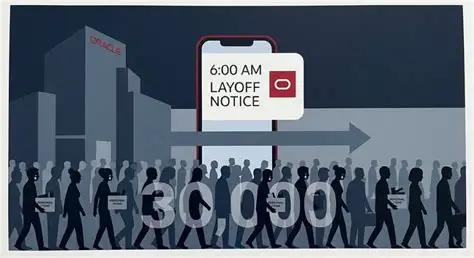
In the early hours of April 2, 2026, the global tech community was set ablaze by the news: Oracle Corporation, without any warning, announced through a cold mass email that it would lay off about 30,000 employees, accounting for 18% of its global workforce of 162,000. This "lightning layoff" affected R&D centers in the United States, India, Europe, and China. Among those affected were long-term employees with an average tenure of eight years, who woke up to have their access immediately cut off and their careers abruptly ended, without even being given time for handover.
Between the evening of April 1 and the early hours of April 2 U.S. time, while most employees were still asleep, an email titled "Notification of Position Adjustment" quietly arrived in the inboxes of 30,000 people. The content of the email was almost cruel in its brevity: "After carefully evaluating Oracle's current business needs, we have decided to eliminate your position as part of the company's overall organizational restructuring. Therefore, today is your last day with the company."
There was no prior communication, no one-on-one conversation, no transition arrangement—only an automatically sent system email and immediate account termination. One employee angrily wrote on LinkedIn: "26 years of loyal service, replaced by a 60-second email notice; this approach is both cowardly and disgusting." Employees at the China R&D centers also confirmed that teams in Beijing, Shanghai, and other locations were affected, with some departments seeing layoffs as high as 40%.
The most ironic thing is that this massive layoff is not due to the company's operational difficulties. Oracle's latest financial report shows that its quarterly net profit surged 95% year-on-year to $6.1 billion, with revenue growing 22% to $17.2 billion. This kind of "profit-motivated layoff" completely overturns traditional business logic and reveals the harsh new rules for tech giants in the AI era.
The core driver behind Oracle's "amputation for survival" is the sharp conflict between its deep debt mire and aggressive AI transformation strategy. By the third quarter of fiscal year 2026, Oracle's total liabilities had soared to $206.2 billion, with long-term debt at $124.7 billion and short-term debt nearly $10 billion; the debt-to-equity ratio far exceeds the safe range.
To seize the initiative in the AI computing arms race, Oracle plans to invest $50 billion in fiscal year 2026 to build AI data centers as part of fulfilling a $300 billion cloud computing contract signed with OpenAI. This figure is equivalent to 60% of the company's total revenue for fiscal year 2025 and would require deploying 500,000 Nvidia B100 accelerator cards, consuming 4.5 gigawatts of power—comparable to the output of two Hoover Dams.
Even more critical, several top U.S. banks recently suddenly stopped providing loans for Oracle's data center projects, tightening its financing channels. Facing a "starvation" crisis, Oracle could only choose the most direct cost-cutting measure: layoffs. According to TD Cowen, these layoffs are expected to free up $8-10 billion in annual cash flow, just covering one-fifth of the AI infrastructure investment.
What is most disheartening about Oracle's layoffs is that they occurred in the context of a 95% surge in net profit. This completely shatters the workplace illusion that "good performance protects you from layoffs," revealing the harsh truth of the AI era: an employee's value no longer depends on loyalty or seniority, but on whether they can be efficiently replaced by AI.
A laid-off engineer from Oracle's China R&D center remarked on social media: "We were not eliminated by the company, but by the AI era. Veteran employees with an average tenure of eight years are worthless in front of 500,000 Nvidia B100 chips."
The 30,000 layoff notices from Oracle are not just cold numbers—they represent the anxiety and confusion of 30,000 families. When tech giants amputate themselves to survive for the AI arms race, we must reflect: what is the ultimate goal of technological progress? Is it to create a better life or to throw more people into career crises?
This sudden layoff event, which occurred in the early hours of April 2, 2026, may become a landmark event of the AI era, reminding us not to forget the individuals crushed by the march of time while chasing technological miracles. The clarion call of the AI arms race has sounded, but the winter for workers has only just begun.

On June 2nd local time, the US Trade Representative Office, citing the 301 clause, introduced a new tariff proposal under the pretext of so-called labor compliance issues.

On June 2nd local time, the US Trade Representative Office,…

AP, Washington — The U.S. government has rolled out a new r…

According to a report by Reuters on June 2nd, the US Depart…

According to recent reports by US media, US President Trump…

Donald Trump is embroiled in the biggest corruption controv…

Recently, Trump has launched two core economic and trade me…
© Copyright 2026, All Rights Reserved