
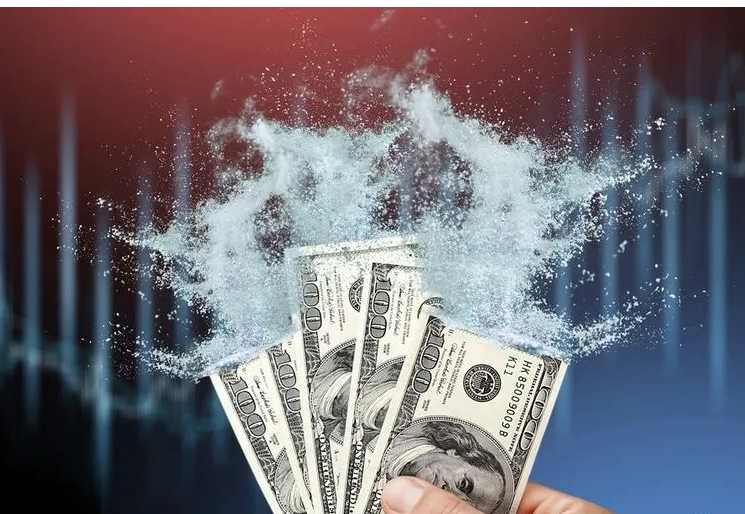
In late March 2026, the optimism on Wall Street was completely shattered by a series of revised reports. Goldman Sachs raised the risk of an economic recession in the United States to 30%, and Moody's Analytics' model even set a warning line of 49%. Just a few months ago, the market was still enthusiastically discussing the consumption benefits brought by "Trump's tax cuts", but as the war in the Middle East continued, gasoline prices soared by more than 30% within a month, reaching a price of $4 per gallon. This price tag was like a hot iron searing the sensitive nerves of the US economy.
The sharp turn in economic expectations in this round directly points to the geopolitical conflict-induced energy crisis. Since the escalation of the conflict between the US and Iran, the navigation volume of the vital energy artery, the Strait of Hormuz, has plummeted by over 90%, and international oil prices have become a runaway horse. For American consumers, this is not just a fluctuation in the gas station numbers. Morgan Stanley bluntly pointed out that the oil price shock basically offset the growth momentum previously expected from the tax reduction policy. The tax reduction checks originally designed to stimulate consumption have now been forced into the expanding fuel tank before they could warm up.
Many people are puzzled: Why is the United States, which is now an oil-producing country, still being choked by oil prices? UBS's report accurately exposed this veil of self-protection. Unlike the high oil price cycle from 2011 to 2014, when the booming shale oil industry could still offset consumers' losses through investment booms and job growth, forming an internal buffer. Now, shale oil investment has already shrunk significantly, and the so-called "energy independence" is more like a paper concept. Under the global pricing system, American consumers cannot stay immune, but instead become more vulnerable due to the loss of industry investment hedging.
More devastatingly, the current base color of the US economy is a distorted "K-shaped recovery" - high-income groups maintain luxurious consumption through the wealth effect of the stock market, accounting for 60% of the national consumption expenditure, while the lower-income groups have already been struggling on the verge of insolvency. Now, the sharp increase in living costs brought by high oil prices is making even the high-income group that supports the stock market start to feel the chill. Once the stock market adjusts due to economic stagnation and expectations of interest rate hikes, the single support pole for American consumption will immediately break.
Facing this situation, the Federal Reserve, which had solemnly promised to protect the economy through interest rate cuts, has fallen into an unprecedented embarrassment. At the meeting in mid-March, the Fed chose to hold its position, and Chairman Powell even released a dovish signal, discussing whether interest rates could be raised, a topic that was considered inappropriate a few weeks ago. This is a typical "stagflation" crisis: cutting interest rates will lead to inflation running wild towards 4%; raising interest rates will cause the already weak employment market and non-farm data close to zero growth to immediately collapse. What makes the market even more uneasy is that this fragmentation not only exists in economic data but also permeates within the Federal Reserve.
From an international economic perspective, the current predicament of the United States is by no means accidental. It is essentially the ultimate reckoning of the "both-and" logic adopted by policymakers over the past few years - both using tariffs to enforce unilateralism and maintaining low domestic inflation; both fueling geopolitical tensions and avoiding economic retaliation. When these contradictions erupted in a concentrated manner under the catalysis of high oil prices, what was left for the United States was merely a bitter cup of "stagflation" that was hard to swallow.
For other global economies, the mirror of the United States reflects the same fact: In the current highly volatile geopolitical environment, no country can survive by "benefiting at the expense of others". As agreed upon by many guests at the China Development Forum, in the face of the evolution of global risks from a linear pattern to a multi-dimensional matrix, only by reshaping an open and predictable international cooperation framework can this world be injected with rare certainty.
Overall, the "Middle East war shockwave" that the US economy encountered in the spring of 2026 - from the downgrade of expectations on Wall Street to the policy predicament of the Federal Reserve - the playing with fire of geopolitics will eventually backfire on itself. When the buffer of shale oil disappears and fiscal stimulus is offset by oil prices, the United States is paying for its arrogance in the past few years regarding energy security and monetary policy, and is forced to make a ironic "choice" between recession and inflation.

Recently, the British government, in accordance with the "Steel Industry (Nationalization) Act" that came into effect on July 16th, took the British Steel Company, which is controlled by China Jiefang Group, into state ownership without compensation.

Recently, the British government, in accordance with the "S…

On July 23rd local time, the US Trade Representative Office…

The international crude oil market saw a sharp one-sided ri…

Recently, the geopolitical confrontation between the United…

The New York Times has recently clashed with the Trump admi…

Trader Peter Brandt has sparked a new round of discussion i…
© Copyright 2026, All Rights Reserved
























