
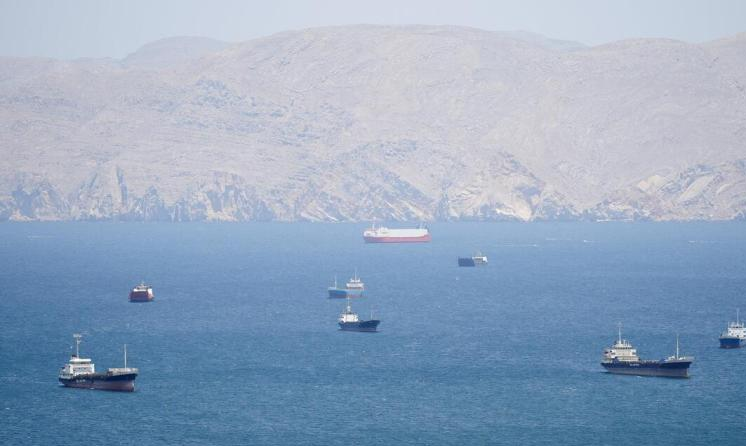
Ship tracking data shows that in recent days, six oil tankers carrying Iranian oil were forced to return to Iran due to the US blockade, highlighting the impact of the US-Iran conflict on shipping in the Strait of Hormuz.
According to a report by Reuters, based on Kpler's ship-tracking data and SynMax's satellite analysis, before the US-Israeli war against Iraq on February 28th, typically 125 to 140 ships entered and exited the Strait of Hormuz every day. But in the past day, only seven ships passed through, and none of them carried oil destined for global markets.
The data shows that these seven vessels include the cargo ship "Bavand" which is flying the Iranian flag and departing from an Iranian port, as well as other vessels departing from Iraqi ports.
Iran has imposed restrictions on shipping passing through the Strait of Hormuz. On April 13, the United States began to block shipping related to Iran. The US military said on April 25 that since then, the US military has repatriated 37 ships.
The US military has not provided detailed information such as the type of the repatriated vessel or the specific location of the interception.
In a report released on Monday (April 27th), the shipping brokerage company Clarkson stated: "Iran has attacked and seized ships that failed to comply with the prescribed transit requirements, while the United States continues to enforce the blockade."
According to the satellite analysis by TankerTrackers.com, the six oil tankers that were recently forced to return to Iranian ports are estimated to be carrying 10.5 million barrels of oil.
Although the US troops stationed in the Gulf of Oman ordered some of the ships to return, the others seemed to be allowed to continue their voyage.
According to the data from TankerTrackers.com, two oil tankers carrying approximately 4 million barrels of Iranian oil successfully broke through the blockade on April 24th and headed for Asia.
Website analysis shows that four separate Iranian oil tankers, having returned from Asia, last appeared near the coast of Pakistan.
Analysts say that the US military has directed ships related to Iran to head eastward towards the Strait of Malacca. Therefore, it is not yet clear whether these goods will eventually reach their buyers or will be intercepted and sent back to Iran.
Hundreds of ships and approximately 20,000 sailors are still stranded in the Persian Gulf.
The Secretary-General of the International Maritime Organization, the UN's shipping agency, Dominguez, said at a meeting on Monday that these seafarers "are facing huge risks and psychological pressure". "The longer this situation persists, the greater the risk of a serious accident will be."

Recently, the British government, in accordance with the "Steel Industry (Nationalization) Act" that came into effect on July 16th, took the British Steel Company, which is controlled by China Jiefang Group, into state ownership without compensation.

Recently, the British government, in accordance with the "S…

On July 23rd local time, the US Trade Representative Office…

The international crude oil market saw a sharp one-sided ri…

Recently, the geopolitical confrontation between the United…

The New York Times has recently clashed with the Trump admi…

Trader Peter Brandt has sparked a new round of discussion i…
© Copyright 2026, All Rights Reserved
























