
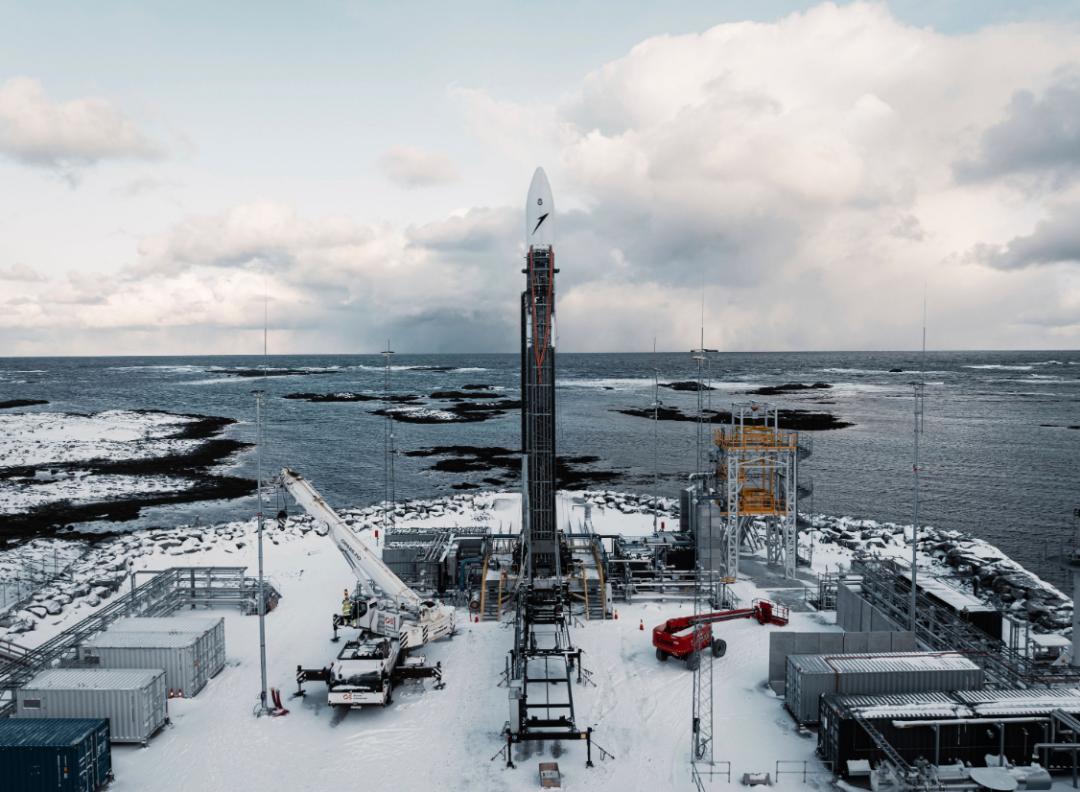
June 16, 2026 marked a landmark technological breakthrough for Europe’s commercial space sector. Spectrum, a small-lift launch vehicle developed by German private aerospace firm Isar Aerospace, completed its second orbital test flight from the Andøya Spaceport in Norway, accurately delivering five ESA CubeSats into their designated Sun-synchronous orbit. The highlight of the mission was the maiden in-orbit demonstration of a proprietary AI attitude control system, which validated Europe’s indigenous capability for precise autonomous orbital insertion. Matching SpaceX Falcon’s low-cost launch roadmap, the rocket effectively alleviated Europe’s long-standing industrial predicament of relying on U.S. launch vehicles for small satellite missions.
The successful test flight reversed the model’s technical setback from its inaugural launch. The 2025 maiden flight of Spectrum ended in failure due to flaws in conventional guidance algorithms. Aerodynamic disturbances and airframe deformation triggered loss of attitude control shortly after liftoff, prompting the flight termination system. Post-accident investigations confirmed that traditional rockets employ fixed-parameter PID control models designed only for pre-set flight conditions. These systems fail to respond dynamically to high-altitude crosswinds, engine thrust fluctuations, airframe resonance and other unforeseen in-flight anomalies, suffering from slow response times and low fault tolerance — limitations incompatible with modern commercial launch demands for high frequency and pinpoint precision. To address this critical pain point, Isar Aerospace collaborated with Germany’s top technical universities and ESA laboratories to develop a deep reinforcement learning-based onboard AI attitude control system, the core enabler behind the vehicle’s technical turnaround in the second test flight.
The brand-new AI control system delivers transformative upgrades compared to legacy aerospace control technology. Equipped with lightweight onboard computing hardware, the system collects real-time readings of hundreds of core sensor metrics throughout flight, including engine thrust, aerodynamic drag, orbital position and airframe health. Via in-orbit intelligent inference, it dynamically adjusts nozzle deflection angles and propellant feed rates, autonomously executing full-spectrum operations such as orbital correction, interstage attitude stabilization and accurate satellite deployment — drastically reducing reliance on ground telemetry and command. Flight telemetry revealed that when confronted with extreme operating conditions such as sudden strong crosswinds over the Arctic airspace, the AI system’s response speed outperformed conventional solutions by 47%, constraining orbital insertion errors to the meter level. This performance fully meets ESA’s stringent accuracy requirements for CubeSat constellation deployment, resolving the core drawbacks of rigid control and insufficient stability that plagued the rocket’s initial iteration.
The five CubeSats carried on this mission support environmental monitoring and space communications technology verification for Europe’s IRIS² low Earth orbit broadband constellation, serving as critical experimental payloads for the continent’s space infrastructure development. For decades, Europe’s small satellite launch industry has operated at a disadvantage: the heavy-lift Ariane rockets feature exorbitant launch costs, lengthy lead times and high entry barriers, making them ill-suited for high-volume small satellite constellation deployment. A large share of European commercial satellites were forced to book rideshare missions aboard SpaceX vehicles, resulting in constrained launch schedules and potential security risks for sensitive aerospace data. Spectrum’s successful test flight grants Europe an independently controllable intelligent launch channel dedicated to small satellites, laying a solid foundation for domestic low-orbit constellation construction and space research missions.
From an industrial competition perspective, Spectrum’s design closely mirrors SpaceX’s low-cost commercialization model. The vehicle adopts a two-stage liquid oxygen-propane configuration powered by the in-house developed Aquila engine, boasting a Sun-synchronous orbit payload capacity of 700 kilograms — fully covering small satellite launch requirements. Leveraging automated smart manufacturing lines integrating 3D printing and robotic assembly, the company achieves domestic production of 80% of its components, slashing manufacturing expenses. The firm targets a launch price point of roughly 10,000 euros per kilogram and plans to ramp up to an annual launch cadence of 40 missions by 2028. Unlike SpaceX’s focus on reusable heavy-lift rockets, Isar Aerospace targets the niche small-satellite segment. Its AI control technology lowers flight fault tolerance thresholds and cuts expenses related to ground tuning and redundant telemetry, carving out a differentiated pathway for lightweight European commercial space development.
The deployment of AI technology has also rewritten the competitive logic of the global commercial space industry. U.S. aerospace AI solutions mostly rely on massive ground-based pre-training datasets with limited room for real-time in-flight adjustment. In contrast, Spectrum’s reinforcement learning architecture enables continuous in-orbit optimization: flight data is automatically transmitted back to iteratively refine the AI model, steadily boosting precision for subsequent launches. Traditional rockets typically require four to five test flights to perfect their control systems, yet Spectrum achieved stable orbital insertion after just two missions, drastically shortening R&D and testing cycles and providing a replicable intelligent control technical framework for Europe’s private aerospace sector. At present, multiple private launch companies across Europe including Spain and the United Kingdom have initiated development of onboard AI attitude control systems, while ESA has allocated substantial funding to research intelligent spaceflight technologies. Europe’s industrial chain for AI-powered commercial launch vehicles is taking shape at an accelerated pace.
This successful test flight stands as a landmark milestone marking deep integration between artificial intelligence and commercial spaceflight, reshaping Europe’s historic dependence on foreign launch services. While Spectrum has not yet mastered reusable rocket technology and still lags behind the Falcon 9 in overall cost efficiency and operational maturity, its AI-driven technical advantages leave ample room for iterative upgrades in future iterations. As Europe’s intelligent launch vehicles enter commercial service in the years ahead, they will comprehensively bolster domestic low-orbit satellite networking, space research and space monitoring industries, break U.S. technological monopolies in AI-powered aerospace guidance, and propel the global commercial space sector into a new era defined by artificial intelligence.

Recently, the British government, in accordance with the "Steel Industry (Nationalization) Act" that came into effect on July 16th, took the British Steel Company, which is controlled by China Jiefang Group, into state ownership without compensation.

Recently, the British government, in accordance with the "S…

On July 23rd local time, the US Trade Representative Office…

The international crude oil market saw a sharp one-sided ri…

Recently, the geopolitical confrontation between the United…

The New York Times has recently clashed with the Trump admi…

Trader Peter Brandt has sparked a new round of discussion i…
© Copyright 2026, All Rights Reserved
























