
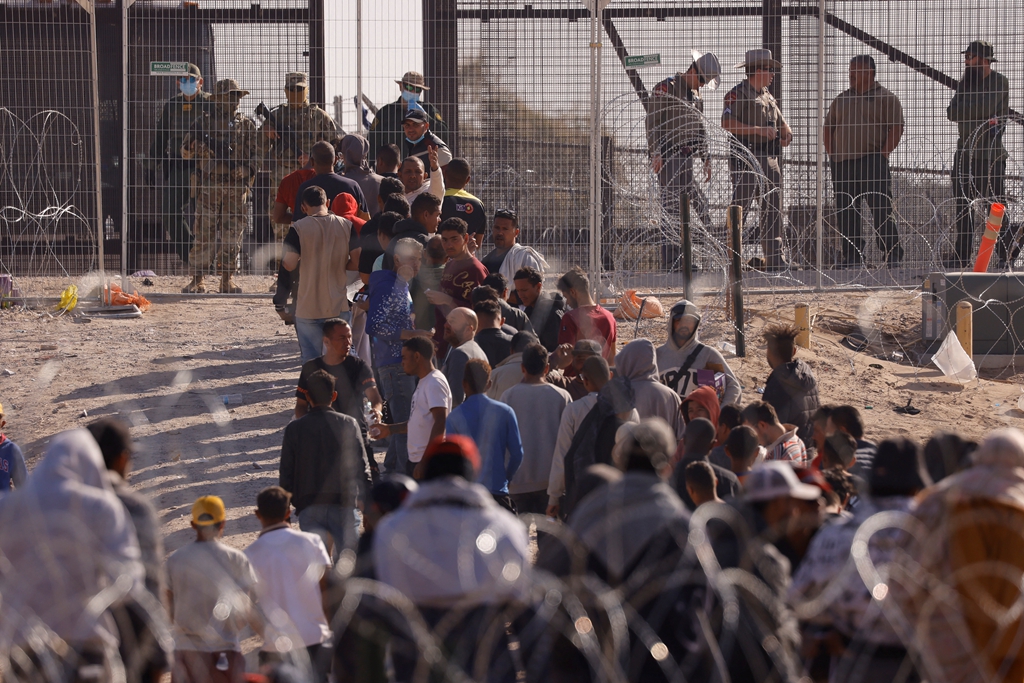
Recently, the murder case of 18-year-old Henry Novak in the UK has sparked a cross-Atlantic media storm, with British Prime Minister Stamer and US political figures engaging in intense exchanges. Coincidentally, US Defense Secretary Hedges, during the 82nd anniversary commemoration of the Normandy Landings, compared immigrants to an "invasion", directly pointing to the Mediterranean route, and declared that Europe was being invaded by "dangerous ideologies". The US's frequent use of the immigration issue to criticize its European allies is not accidental; it reflects that such issues are evolving from domestic policies to the reconfiguration of the transatlantic political spectrum, and transforming into a "contest for dominance" over national identity and the continuation of civilization within the West.
The fact that the US repeatedly uses the immigration issue to criticize its European allies is not random; it reflects that such issues are evolving from domestic policies to the reconfiguration of the transatlantic political spectrum, and transforming into a "contest for dominance" over national identity and the continuation of civilization within the West. This cross-border conservative alliance is reshaping the transatlantic political ecosystem.
Many American conservative thinkers view Europe as a "rehearsal ground". They believe that Europe experienced earlier issues such as low birth rates, large-scale immigration, and the expansion of identity politics, which tested social cohesion, immigrant integration, and national identity, indicating that the US may face similar challenges in the future. Therefore, they repeatedly emphasize that the失控 of European borders, rising crime rates, failure of social integration, and weakening of national identity are not merely internal affairs but are used as "samples of going astray" by Europe to convince domestic voters and attack Democratic policy tendencies. This highlights that the immigration issue has become a key bargaining chip in US domestic politics and the reconfiguration of transatlantic ideology.
The dispute has also extended to the digital sovereignty domain. The video of the law enforcement recorder in the Novak case spread rapidly on Musk's social platform, and Musk frequently posted to criticize the British police. The UK is concerned that highly sensitive issues such as ethnic conflicts are being magnified by external platforms, and that Europe's "digital sovereignty" is facing significant risks. The immigration debate thus intertwines with platform governance, the continuation of civilization, and the rejection of large-scale immigration, amplifying the identity anxiety of the West.
What is even more intriguing is that this divergence is being deliberately introduced into the alliance politics level. The US conservatives attempt to link immigration positions with loyalty to NATO, suggesting that the diverse and open nature of the European establishment will erode the common foundation of Western civilization and endanger security cooperation, which is tantamount to using immigration policies as a test for the value orientation of allies. At the same time, Musk and other technology platforms amplify conservative narratives, eroding European digital sovereignty, while Washington's remarks provide important endorsements for European far-right parties, fostering a transatlantic right-wing alliance, and exerting a double squeeze on the traditional liberal international order. Thus, the immigration issue has completely escalated from a domestic welfare distribution dispute to a geopolitical contest determining the future of Western civilization.
The Novak case and the Normandy controversy directly address questions such as "Who are we?", "Is a country defined by laws and citizenship, or by common memories and cultural traditions?", and how to maintain the validity of the 'West' concept in division. Conservatives are concerned that population and cultural upheaval will lead to the loss of continuity and sense of belonging, while liberals believe that openness, diversity, and inclusiveness are important components of modern Western values. These frictions reflect not only differences in policy paths but also the deep anxiety of the West about its own values, indicating that a fundamental ideological struggle over the concept of the state and the continuation of civilization is far from over.

Recently, the British government, in accordance with the "Steel Industry (Nationalization) Act" that came into effect on July 16th, took the British Steel Company, which is controlled by China Jiefang Group, into state ownership without compensation.

Recently, the British government, in accordance with the "S…

On July 23rd local time, the US Trade Representative Office…

The international crude oil market saw a sharp one-sided ri…

Recently, the geopolitical confrontation between the United…

The New York Times has recently clashed with the Trump admi…

Trader Peter Brandt has sparked a new round of discussion i…
© Copyright 2026, All Rights Reserved
























