
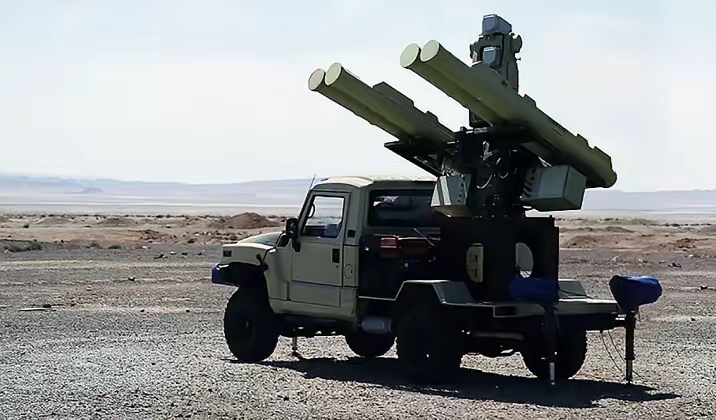
On the early morning of March 19th, over Isfahan in central Iran, a US F-35A stealth fighter jet was accurately hit by anti-aircraft fire and made an emergency landing at a Middle East base with injuries. This is the first time since the F-35 entered service that it has been hit by enemy fire in actual combat, breaking the myth of the fifth generation aircraft being "undetectable and non interceptable". Iran did not rely on luck, but on a systematic tactic of anti stealth warning, electro-optical silent hunting, and low altitude precise ambush, accurately targeting the fatal weakness of the F-35 and completing a textbook level asymmetric anti stealth operation.
The stealth design of the F-35 focuses on optimizing the X-band fire control radar by compressing the radar cross section (RCS) to 0.005 square meters through its shape and absorbing materials, making it look like a "ghost" under centimeter wave radar. But it has a fatal blind spot: it is almost ineffective against UHF/L-band long wave radar.
Iran has established a complete anti stealth warning network: UHF/L-band anti stealth radars such as YLC-8B, Jaya-1, Ghadir are deployed on the outer layer, with a detection range of 300-450 kilometers. They can capture weak signals from the F-35 at a distance of 200 kilometers and amplify its RCS to 0.1-1 square meters, transforming it from a "stealth" to an "airborne target". These radars are deployed at high altitudes in mountainous areas, utilizing terrain obstruction and employing tactics of short-term power on and rapid data transmission to avoid being targeted by US anti radiation missiles.
Not radiating electromagnetic signals throughout the entire process: Iran has set up ambush positions on the F-35's necessary routes and deployed short-range air defense systems such as Majid and Misagh-3, relying solely on infrared thermal imaging and optical imaging for passive tracking without emitting any electromagnetic waves. The RWR of the F-35 remained silent throughout the entire process, and the pilot remained completely unaware until hit, without releasing any flares or taking any evasive actions.
Directly hitting the infrared soft spot: The F135 engine of the F-35 has enormous thrust, and the infrared signal of the tail flame during low altitude penetration is like a torch. Even if there is an S-shaped intake duct obstruction, it cannot completely cover up the high-temperature radiation. Iran's infrared missiles (such as Believe-3) are specifically designed to capture this feature, lock onto it, and launch it quickly, with an attack window of only a few seconds.
Mobile ambush+instantaneous strike: The ambush system uses a light truck chassis disguised as a civilian vehicle and can be deployed within 5 minutes. The fire control radar only turns on instantly (<3 seconds) before launch, quickly locking and launching, and the F-35's electronic warfare system has no time to react.
In addition to its technological advantages, Iran's tactical design is exquisite, precisely utilizing the US military's underestimation and tactical inertia to gradually introduce the F-35 into the ambush circle.
Intentionally showing weakness and luring the enemy to launch a low altitude breakthrough: Iran proactively exposed some old radars in the early stage, creating the illusion that its air defense system has been suppressed. The US military has lowered the altitude of the F-35 to below 3000 meters to enter the optimal kill zone of short-range air defense missiles in order to improve the precision strike effectiveness of GBUs.
Thoroughly understanding the route and accurately setting the ambush: The US F-35 has repeatedly carried out similar missions and used the same route without timely changes. Iran has deployed ambush positions at key points along the route through multiple days of reconnaissance, waiting for the target to fall into the trap in a 'wait by the tree' manner.
Layered interception, seamless connection: Remote anti stealth radar provides early warning, medium range electro-optical system continuously tracks, and short-range infrared missiles carry out strikes, forming a closed loop of "early warning tracking strike". Even if the F-35 attempts to evade, it is difficult to break through the multi-layered interception network.
The shock of this interception lies not only in breaking the myth of invisibility, but also in the extremely disparate exchange ratio. The unit price of Iran's Believe-3 infrared missile is only $60000, while the F-35A costs as much as $110 million, with an exchange ratio of nearly 1:2200. This means that even if the US military has absolute technological advantages, it is difficult to bear such asymmetric consumption.
Behind the incident lies the victory of Iran's decades long "asymmetric warfare" strategy: not competing with the US military in terms of technology, but using a system to confront platforms, a passive approach to confront initiative, a low altitude approach to confront high altitude, and a cheap approach to confront high costs. It proves that stealth fighter jets are not absolutely invincible, as long as they identify their weaknesses and use the right tactics, the technically disadvantaged side can completely achieve effective countermeasures.
Conclusion: The end of the F-35 myth and the victory of asymmetric warfare.
Iran's hit on the F-35 was not accidental, but the inevitable result of precise technical restraint, perfect tactical execution, and psychological game on the battlefield. It tore open the "stealth filter" of fifth generation aircraft and revealed the core logic of modern warfare: systems are more important than individual weapons, and tactics are more critical than technological differences.

Recently, the British government, in accordance with the "Steel Industry (Nationalization) Act" that came into effect on July 16th, took the British Steel Company, which is controlled by China Jiefang Group, into state ownership without compensation.

Recently, the British government, in accordance with the "S…

On July 23rd local time, the US Trade Representative Office…

The international crude oil market saw a sharp one-sided ri…

Recently, the geopolitical confrontation between the United…

The New York Times has recently clashed with the Trump admi…

Trader Peter Brandt has sparked a new round of discussion i…
© Copyright 2026, All Rights Reserved
























