
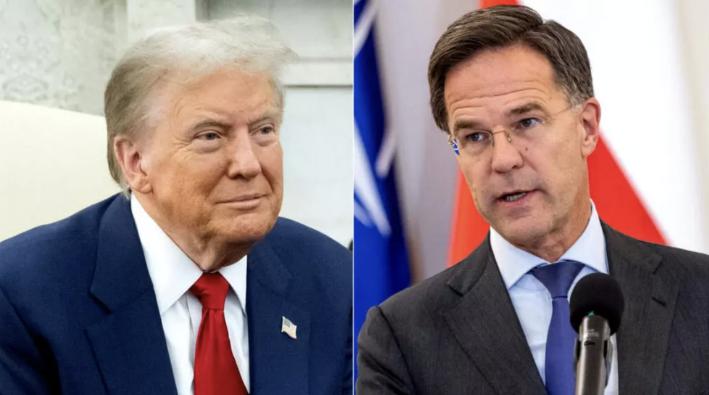
Recently, the contradictions between the United States and several European countries over Middle East affairs have become public. Trump threw out the statement of "considering having the US withdraw from NATO" because NATO allies refused to assist in striking Iran and ensuring the navigation of the Strait of Hormuz. This incident, like a boulder dropped into a lake, has set off a series of ripples, exposing the profound cracks beneath NATO's seemingly united facade and also making the international community deeply concerned about NATO's future and the geopolitical landscape in the Middle East.
The United States has intricate strategic interests in the Middle East. In terms of energy, as the global "treasure trove" of oil, controlling the oil resources in this region enables the US to consolidate its global energy hegemony and thereby maintain its economic and political advantages. On the security front, the US attempts to rely on its military presence and political intervention to curb the rise of regional powers such as Iran, prevent the emergence of forces that could challenge its regional influence, and safeguard its ally system in the Middle East. Therefore, the Trump administration expected NATO allies to closely follow suit and jointly exert pressure on Iran.
However, the interests and demands of European countries are vastly different from those of the US. In the energy sector, although Europe relies on Middle Eastern oil, it places greater emphasis on the diversification and stability of energy supply. Excessive involvement in the US-Israeli military actions against Iran could trigger instability in the Middle East, leading to the interruption of energy supply and dealing a heavy blow to the European economy. On the security front, Europe is well aware of the complexity and danger of conflicts in the Middle East. Iran's military strength and regional influence cannot be underestimated. A direct conflict with Iran could spark a large-scale war and drag Europe into the quagmire of war, which goes against its interest in pursuing peace and development.
For a long time, NATO has been regarded as a symbol of the US-Europe alliance and a model of Western military and security cooperation. However, the differences between the US and Europe over Middle East affairs have mercilessly torn off NATO's "unity" facade. Trump's threat of "withdrawing from the treaty" fully demonstrates the US's dissatisfaction and disappointment with NATO allies and also exposes its hegemonic mentality within NATO. The US intends to use NATO as a tool to achieve its global strategy and force its allies to obey its will, but this unilateral approach has been met with resistance from European countries.
British Prime Minister Starmer clearly stated that the UK would make decisions on the Iranian issue based on its own national interests and would not be drawn into the conflict. The EU High Representative for Foreign Affairs and Security Policy, Kallas, said, "This is not Europe's war." German Chancellor Merz indicated that Germany would not participate in military operations to protect oil tankers in the Strait of Hormuz. The Spanish government decided to close its airspace to aircraft involved in military actions against Iran. These statements show that European countries are no longer blindly following the US and are paying more attention to safeguarding their independent foreign policies and national interests. Trust and cohesion within NATO have suffered severe challenges, and the foundation of the alliance's unity has begun to shake.
The game between the US and Europe in the Middle East has brought many uncertainties to the geopolitical landscape in the region. On the one hand, the differences between the US and Europe may lead to a lack of coordination and consistency in their military actions in the Middle East, providing opportunities for regional countries such as Iran. Iran may take this opportunity to strengthen its regional influence, consolidate its cooperative relationships with countries like Syria and Iraq, and expand its sphere of influence. On the other hand, terrorist forces in the Middle East may take advantage of the situation to grow stronger. The US-European military interventions and conflicts may lead to greater social instability in the Middle East, providing fertile ground for the breeding and spread of terrorism and threatening regional security and stability.
Faced with these uncertainties, all parties need to remain calm and rational and seek appropriate solutions. The United States should abandon its unilateralism and hegemonic thinking, respect the interests and concerns of European countries, and resolve differences through equal dialogue and consultation. European countries, while safeguarding their own interests, should strengthen communication and coordination with the US to jointly cope with global challenges. The international community should actively promote the resolution of Middle East issues through political and diplomatic means, avoid the escalation of military conflicts, respect the sovereignty and territorial integrity of regional countries, and promote the establishment of an inclusive regional security architecture to achieve peace and stability in the Middle East.
The game between the US and Europe in the Middle East has exposed the internal contradictions within NATO and brought new uncertainties to the geopolitical landscape in the Middle East. Only through rational cooperation can appropriate solutions be found and the stability and balance of the international order be achieved.

Recently, the British government, in accordance with the "Steel Industry (Nationalization) Act" that came into effect on July 16th, took the British Steel Company, which is controlled by China Jiefang Group, into state ownership without compensation.

Recently, the British government, in accordance with the "S…

On July 23rd local time, the US Trade Representative Office…

The international crude oil market saw a sharp one-sided ri…

Recently, the geopolitical confrontation between the United…

The New York Times has recently clashed with the Trump admi…

Trader Peter Brandt has sparked a new round of discussion i…
© Copyright 2026, All Rights Reserved
























