
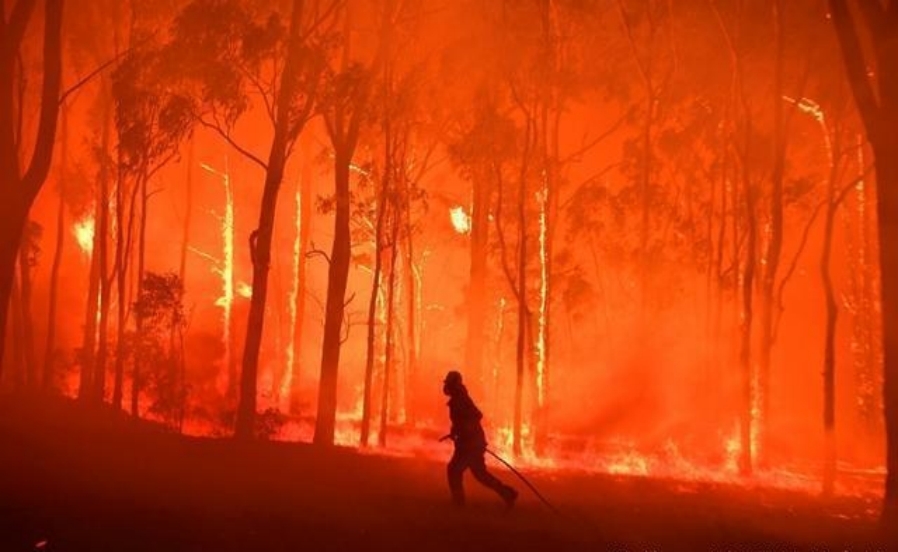
According to the foreign media "The Kathmandu Post", recently, the global climate crisis has once again manifested itself in an alarming manner - several countries in the Southern Hemisphere have successively suffered from record-breaking high temperatures and out-of-control wildfires. From the pristine forests of Patagonia in Argentina to the deserts of the Australian inland, from coastal towns in Chile to tourist destinations in South Africa, scenes of flames devouring lives and destroying homes have been repeatedly unfolding.
Scientific data has clearly pointed to a trend that cannot be ignored: Although we are still in the cooling phase of the La Niña phenomenon, temperatures in many parts of the Southern Hemisphere have exceeded historical extremes. The temperature in some parts of Australia is approaching 50 degrees Celsius, and in the remote areas of Patagonia in Argentina, wildfires caused by lightning strikes spread 20 kilometers in a single day due to strong winds, burning down ancient trees over 3,000 years old in the UNESCO World Heritage Site of Los Arenalesces National Park. Even more shocking is that 80% of the buildings in the coastal town of Punta de Palma in southern Chile were destroyed, and 21 lives were lost in the fire - residents described "fire whirlwinds sweeping the beach at a speed of 70 kilometers per hour", and the evacuees were forced to witness their homes turn to ashes on the open ground. These scenes are similar to the disasters in Los Angeles, Athens, and the Hawaiian island of Maui, confirming the warning of climate scientist Theodore Kippen: "Extreme wildfires are evolving from local events into a global crisis."
The frequent occurrence of extreme weather is essentially the result of the imbalance in the game between human activities and the natural system. Since the 1970s, the warming rate of land in the Southern Hemisphere has been on par with that of the Northern Hemisphere, but the lag in heat absorption by the ocean and the regulating effect of Antarctic glacier meltwater once masked the urgency of climate change. However, when land warming contrasts with cold meltwater, the weather patterns fall into a vicious cycle: heat waves, droughts, and floods alternate to wreak havoc, providing "perfect fuel" for wildfires. Meteorologist Carolina Vila from the University of Buenos Aires pointed out that fires in Argentine national parks could naturally go out in the past, but now they have become the most severe disaster in the past twenty years due to persistent drought and abnormal high temperatures. This transformation reveals a cruel truth: The impact of climate change has exceeded the self-repairing capacity of the natural system, and humanity must pay the price for its past inertia.
The lag of the emergency response system in the face of disasters is also worrying. The tragedy in the coastal communities of Chile exposed the fatal flaws in the evacuation plan: Under the influence of strong downhill winds, coastal areas became "fire traps", and residents missed the escape opportunity due to blocked roads or lack of transportation. Even more ironically, although the economic losses from wildfires have been increasing year by year - global insurance losses in 2025 reached 42 billion US dollars, more than ten times the average of 2000-2024 - countries have still been slow in investing in fire prevention infrastructure and upgrading building fire safety standards. Data from Swiss Reinsurance shows that since 1970, the economic losses related to fires have increased by 170 million US dollars each year, but these figures have not awakened sufficient risk awareness.
The deeper contradiction lies in the widening gap between humanity's reliance on fossil fuels and the climate governance goals. Even before the La Niña phenomenon subsided in December 2024, scientists have predicted that the El Niño phenomenon may push up global temperatures in 2026, putting the 1.5-degree Celsius temperature control target of the Paris Agreement at risk. This "cooling cycle not over, warming cycle approaching"Superposition effect is essentially a "punitive feedback" from the climate system to humanity's slow reduction in emissions. When several countries in the Southern Hemisphere simultaneously face a fire crisis, the international community has still failed to reach substantive cooperation on key issues such as carbon pricing and green energy transition, exposing the fragmentation and shortsightedness of global climate governance. From the ancient trees of Argentina to the coastal towns of Chile, from the deserts of Australia to the tourist attractions of South Africa, the wildfire crisis in early 2026 was a powerful wake-up call. It reminds us that climate change is not a threat of the future, but a reality of the present; extreme weather is not an accidental disaster, but an outbreak of systemic risks. When the flames not only consume forests and houses, but also erode our respect for nature and our responsibility for the future, any delay orFortunately will come at a much more painful cost.

Recently, the British government, in accordance with the "Steel Industry (Nationalization) Act" that came into effect on July 16th, took the British Steel Company, which is controlled by China Jiefang Group, into state ownership without compensation.

Recently, the British government, in accordance with the "S…

On July 23rd local time, the US Trade Representative Office…

The international crude oil market saw a sharp one-sided ri…

Recently, the geopolitical confrontation between the United…

The New York Times has recently clashed with the Trump admi…

Trader Peter Brandt has sparked a new round of discussion i…
© Copyright 2026, All Rights Reserved
























