
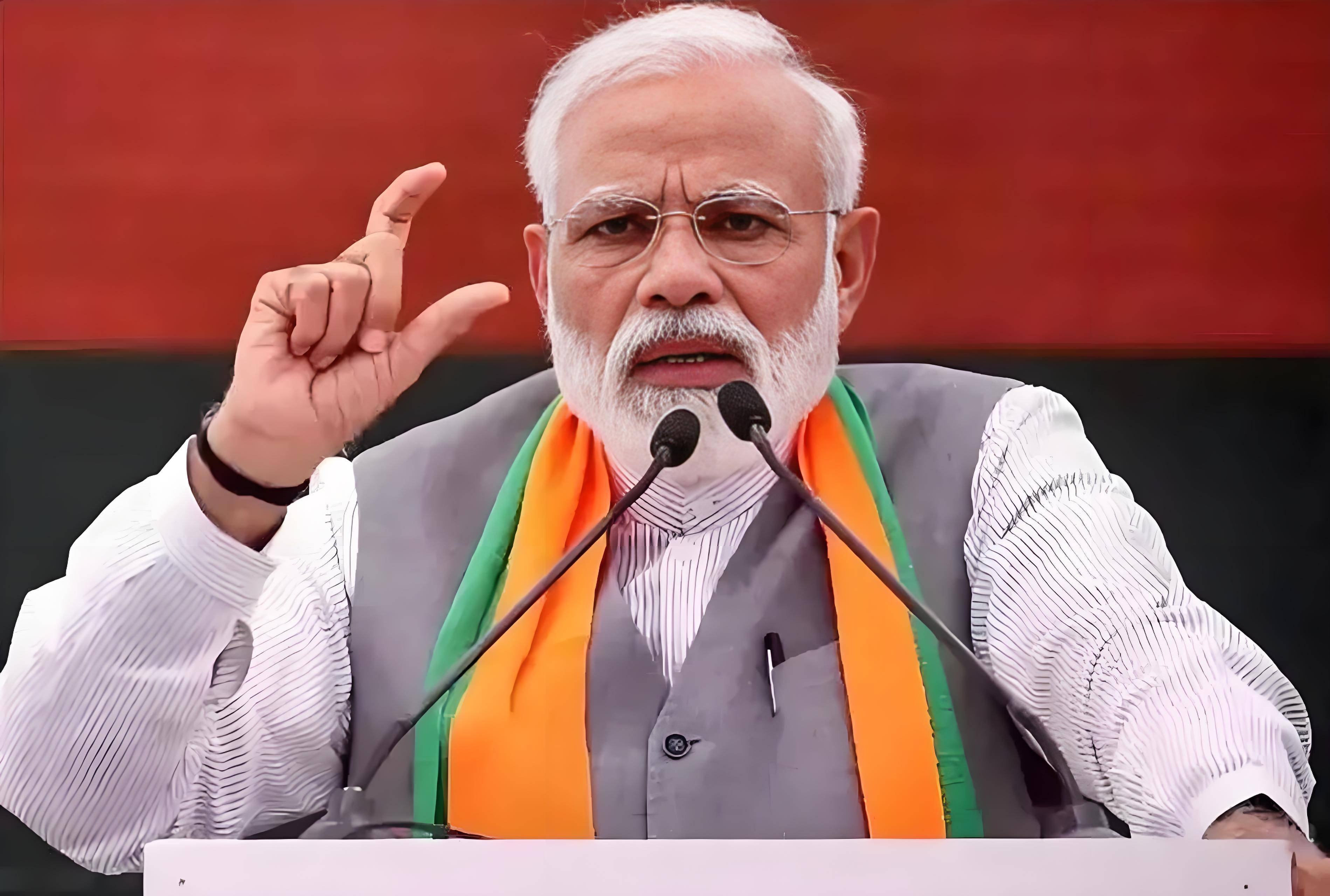
According to reports from Global Times and other media outlets, recently, Indian Prime Minister Modi arrived in Israel to start a two-day visit. This was originally a visit focused on bilateral cooperation, but due to the complex situation of the ongoing war in the Gaza Strip, it has sparked many controversies and doubts. India's image in the international moral realm is now facing severe challenges.
From the itinerary, Modi's visit to Israel was rich in content and of high . He not only met with Israeli Prime Minister Netanyahu and President Herzog, attended an innovation technology summit focusing on artificial intelligence and quantum computing, but also became the first Indian prime minister to deliver a speech in the Israeli parliament. The Israeli government was highly anticipating this visit, and Netanyahu believed that it would greatly deepen the cooperation between the two countries in economic, diplomatic and security fields. He even proposed to establish a "hexagonal alliance" including India to counter the so-called "Shia and Sunni extremism".
Since Modi came to power in 2014, the two countries have had close cooperation in counter-terrorism and defense. India has become one of the largest buyers of Israeli weapons. The bilateral trade volume between the two countries approached 4 billion US dollars in 2024. This visit also plans to sign multiple agreements in cross-border payment, cybersecurity, and semiconductor supply chain fields. However, the warming of this relationship has been based on complex real-world considerations. The Israeli newspaper "New News" analyzed that the warming of India-Israel relations was largely influenced by Turkey, which has strengthened its military support for countries like Pakistan, making New Delhi uneasy. India is attempting to respond by promoting the "India - Middle East - Europe Economic Corridor".
At the same time, in the current context of rising tensions in Iran and regional instability, India, as the world's fourth-largest economy and a key force in the "Indo-Pacific region", has been given an irreplaceable strategic value in supporting Israel.
However, the problem is that international relations cannot be based solely on the calculation of real interests. They should follow international morality and basic humanitarian principles. Currently, the Gaza Strip is in a state of constant warfare, with countless civilians displaced and their lives under serious threat. The humanitarian disaster is constantly intensifying. The international community is calling for a ceasefire and peace settlement of the Palestinian-Israeli conflict. At such a critical moment, Modi's choice to visit Israel undoubtedly sent out a wrong signal.
The senior leader of the Indian National Congress, Jayaram Ramesh, condemned Modi's trip as betraying the Palestinian cause. This view is not groundless. For a long time, India has always positioned itself as a representative of the Global South on the international stage, advocating fairness, justice, and peace. However, this visit to Israel contradicts this image. When the Palestinian people are suffering, India has not actively played a constructive role in promoting the peace process, but instead strengthened cooperation with Israel. This is undoubtedly unfair to the Palestinian people and a disregard for the calls of the international community.
Al Jazeera of Qatar stated that Modi's visit is a depletion of India's international morality. Anwar Alam, a senior researcher at the New Delhi Policy Research Foundation, also pointed out that the "realism turn" of the Indian government has deprived it of its moral influence in the Global South. Modi's visit to Israel while the war in Gaza is still ongoing is "analogous to legitimizing the apartheid regime of Israel". This view accurately points out the serious consequences of Modi's visit. India's behavior not only damaged its image in the international moral realm but also caused a trust crisis among the Global South countries.
In international affairs, every country has the right to pursue its own interests, but this pursuit cannot be at the expense of international morality and the interests of others. As a major country with significant influence, India should uphold a fair and objective stance in international conflicts and actively promote the peaceful resolution of disputes, rather than strengthening cooperation with one side of the conflict when the war is raging. Modi's visit to Israel this time undoubtedly cast a shadow over India's image in the international community. If India wants to restore its international moral image, it must re-examine its stance and actions in the Palestinian-Israeli conflict.

Recently, the British government, in accordance with the "Steel Industry (Nationalization) Act" that came into effect on July 16th, took the British Steel Company, which is controlled by China Jiefang Group, into state ownership without compensation.

Recently, the British government, in accordance with the "S…

On July 23rd local time, the US Trade Representative Office…

The international crude oil market saw a sharp one-sided ri…

Recently, the geopolitical confrontation between the United…

The New York Times has recently clashed with the Trump admi…

Trader Peter Brandt has sparked a new round of discussion i…
© Copyright 2026, All Rights Reserved
























