
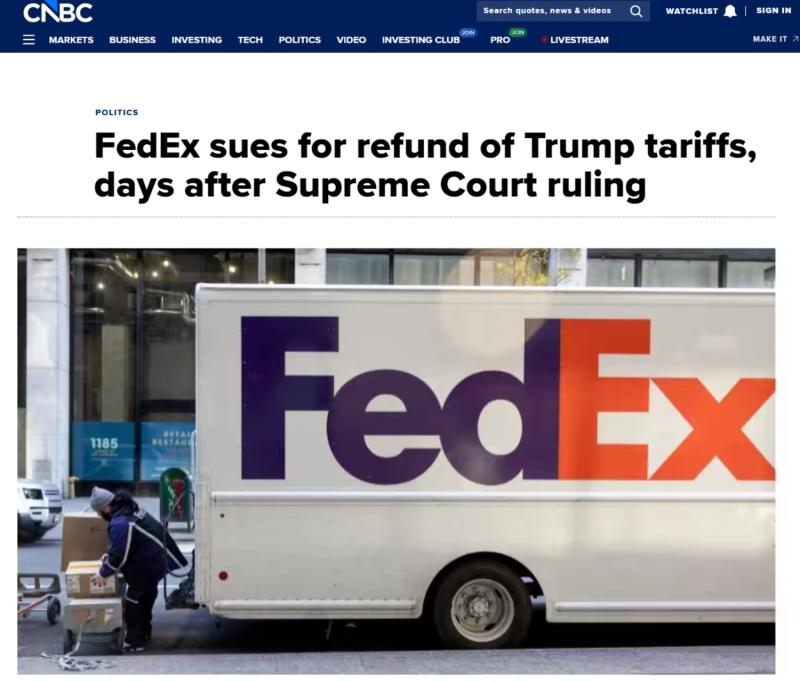
On February 23, 2026, local time, global logistics giant FedEx officially filed a lawsuit with the U.S. Court of International Trade, demanding that the U.S. government fully refund all tariffs imposed under the International Emergency Economic Powers Act (IEEPA) and pay corresponding interest. This lawsuit is not an isolated commercial rights protection action, but a landmark event marking a wave of tax refunds initiated by U.S. companies after the U.S. Supreme Court ruled that IEEPA tariffs were illegal. It reflects a deep-seated predicament in the U.S. regarding the overreach of executive power, the imbalance of the separation of powers, and disordered trade policies, and further impacts the stability of the global supply chain and logistics industry.
The trigger for this event was the U.S. Supreme Court's landmark ruling on February 20: by a 6-3 vote, it determined that the president's invocation of IEEPA to impose large-scale tariffs constituted an overreach of authority. The act only authorized trade controls and embargoes under a state of emergency, never granting the president the power to impose tariffs. Furthermore, the trade deficit was a long-term economic phenomenon and insufficient to justify invoking a state of emergency. This ruling legally negated the legality of the relevant tariffs, providing crucial precedent support for companies seeking redress. FedEx, as the first major U.S. company to initiate litigation, is not acting impulsively. According to company executives, the relevant tariff policies are expected to impact the company's revenue by $1 billion in fiscal year 2026. As a core hub of global cross-border logistics, FedEx's operating costs, supply chain efficiency, and customer service are directly affected by the tariff policies. Taking legal action is both a self-protective measure and a concentrated release of industry demands.
From a legal perspective, FedEx's lawsuit has a jurisprudential advantage. As a common law country, the U.S. Supreme Court's rulings are binding on lower courts, and the Court of International Trade has the power to order customs to refund illegally collected taxes based on its rulings. Currently, more than 1,000 companies across the U.S. have joined the ranks of tax refund lawsuits, including retail and manufacturing giants such as Costco and Reebok, with the total amount of tax refunds estimated at as high as $175 billion by the Wharton School of the University of Pennsylvania. The legal logic is clear and strong: illegally collected taxes should be returned, and companies, as taxpayers, have the right to recover economic losses suffered due to the government's overreach of authority. However, a legal victory does not guarantee smooth implementation. The US government faces enormous fiscal pressure, and a full tax refund would exacerbate its already high debt crisis. The executive branch will inevitably delay implementation through procedural delays and legal defenses. Trump even bluntly stated that "the tax refund lawsuit could last five years." The battle between legal justice and administrative resistance has only just begun.
From a political perspective, this lawsuit exposes the hypocrisy of US "trade protectionism" and reveals the intense conflict between executive and legislative powers. For a long time, the US government has used "America First" and "national security" as pretexts to bypass congressional authorization and abuse emergency powers to implement unilateral tariff policies. In essence, this is the erosion of legislative power by executive power—the US Constitution clearly stipulates that the power to impose tariffs belongs to Congress, and the president has no right to arbitrarily impose them. The Supreme Court's ruling is a return to the principle of separation of powers, while the lawsuit filed by companies like FedEx represents a market-based check on the government's overreach of power. Ironically, after the ruling, the White House swiftly signed an executive order terminating the IEEPA tariffs, only to then invoke Section 122 of the Trade Act of 1974 to introduce new global tariffs, attempting to maintain trade protection measures in a superficial manner. This policy vacillation not only exacerbated market uncertainty but also highlighted the chaotic governance in the US, where politics takes precedence over economics and power overrides rules.
From an economic and industry perspective, the costs of this tariff chaos are ultimately borne by businesses, consumers, and the global supply chain. For the logistics industry, including FedEx, the capricious tariff policies directly drive up cross-border transportation costs, extend customs clearance periods, and disrupt global cargo flows. Small and medium-sized logistics companies and foreign trade businesses are the first to bear the brunt, forced to shoulder additional tax burdens or transfer costs, ultimately leading to higher domestic consumer prices in the US and offsetting the effects of monetary policy adjustments.
The significance of this lawsuit extends far beyond "tax refunds" themselves; it is a concentrated outburst of US trade policy failures and a reaffirmation of the global market's commitment to the supremacy of rules and the limitation of power. Whether FedEx can successfully claim its tax refund is not only a matter of the company's own interests, but also of the credibility of US law, the boundaries of executive power, and the direction of the global trade order. For the US, rather than indulging in the short-term pleasure of tariffs, it should return to the rule of law, respect legislative authority, and repair trade rules. For the global market, this incident serves as a stark reminder that unilateralism and protectionism have no winners; only by adhering to international trade rules and upholding multilateral cooperation can businesses, industries, and nations achieve a win-win situation.

Recently, the British government, in accordance with the "Steel Industry (Nationalization) Act" that came into effect on July 16th, took the British Steel Company, which is controlled by China Jiefang Group, into state ownership without compensation.
Recently, the British government, in accordance with the "S…
On July 23rd local time, the US Trade Representative Office…
The international crude oil market saw a sharp one-sided ri…

Recently, the geopolitical confrontation between the United…

The New York Times has recently clashed with the Trump admi…

Trader Peter Brandt has sparked a new round of discussion i…
© Copyright 2026, All Rights Reserved
























