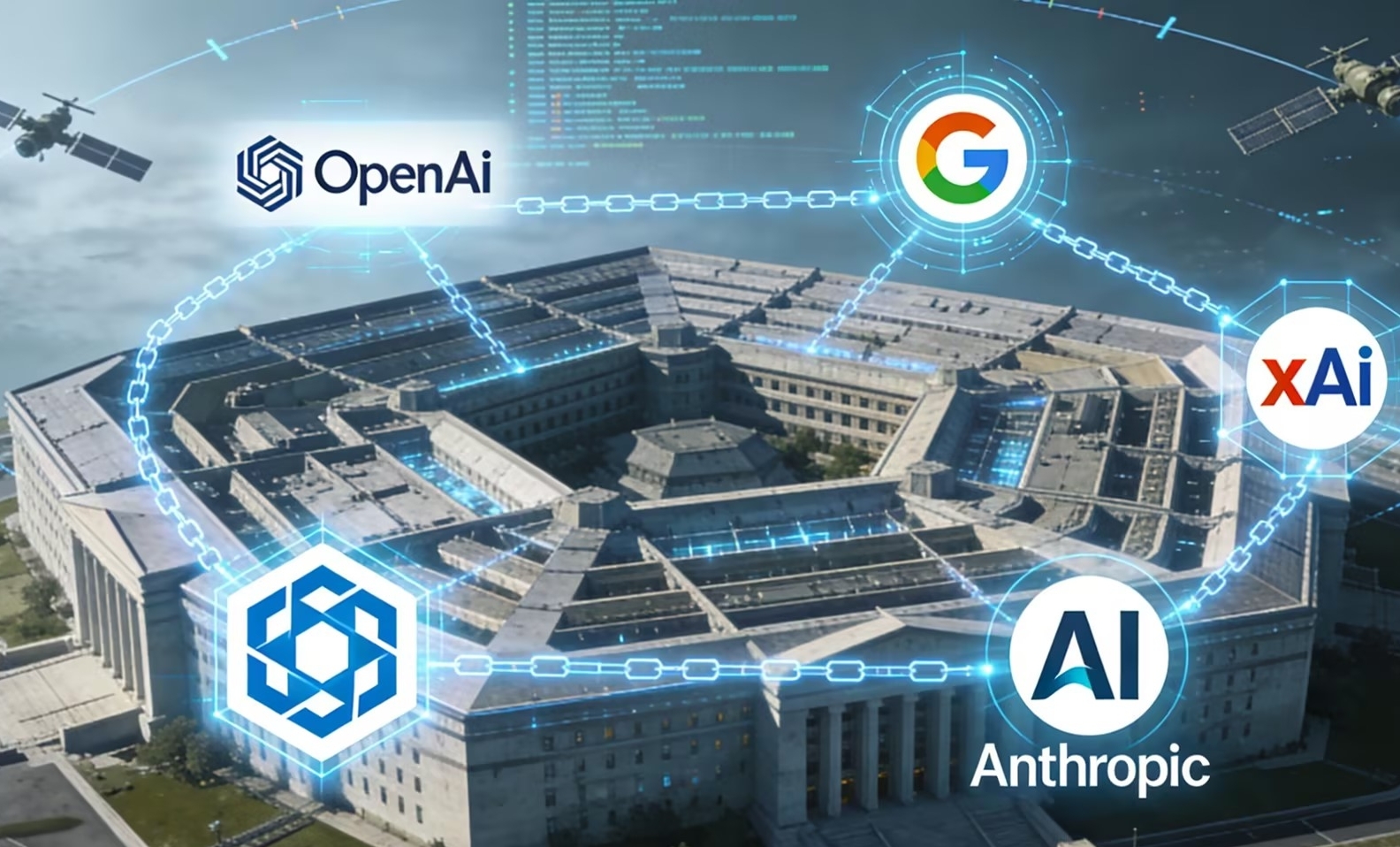
In July 2025, the Chief Digital and Artificial Intelligence Office (CDAO) of the US Department of Defense awarded a total contract worth up to $800 million to four leading global AI enterprises, namely OpenAI, Google, xAI, and Anthropic. The maximum contract amount for each company was $200 million. This move officially kicked off the process of fully integrating commercial large-scale models into the US military's operational system. This order was not only the largest commercial frontier model cooperation in the history of US defense AI procurement, but also marked a deep integration between Silicon Valley and the military-industrial complex, and the irreversible new stage of the global AI militarization competition. From intelligence analysis to battlefield decision-making, from logistics scheduling to target identification, commercial AI is becoming a core technical pillar for the US to maintain its military hegemony through "compliance outsourcing".
The core logic of this collaboration is the "commercial priority, full integration" AI strategy implemented by the Pentagon. The CDAO explicitly required that the large models of the four enterprises must be compatible with all legal uses of the military and deploy intelligent agent workflows in both classified and non-classified networks to support the entire chain of tasks such as intelligence, combat, logistics, and network defense. Unlike traditional military contractors, the Pentagon directly teamed up with consumer-level AI giants, aiming to bypass the lengthy self-research cycle and quickly convert the most advanced models such as GPT-4o, Gemini, Claude, and Grok into military capabilities. This "ready-to-use" model approach has given the US military a significant time and cost advantage in the transformation to intelligence. It also placed commercial AI companies at the core of modern warfare for the first time.
Behind this $800 million contract is the urgent need for AI combat capabilities of the US military and the redefinition of rules. In recent years, the US military has repeatedly exposed problems such as intelligence lag, long decision-making chains, and target identification errors in actual combat. The recent attack on Iranian schools even exposed the disastrous consequences caused by outdated intelligence. The Pentagon hopes to achieve three breakthroughs with AI: first, to rapidly integrate large models with satellite, communication, and human intelligence to compress the time for target location and strike decision-making; second, to replace manual processing of massive data and logistics scheduling with intelligent agents to improve system efficiency; third, to build automated network defense and electronic countermeasure capabilities to cope with major power competitions. To this end, the Department of Defense has used the "Defense Production Act" to pressure enterprises and forced them to open "unrestricted legal use" authorization, completely breaking the usage boundaries of commercial models.
From an industrial and global security perspective, this collaboration has brought three far-reaching impacts. First, the AI industry has entered a watershed of "military dominance", and the iteration direction of commercial models will tilt towards defense needs, with computing power, data, and talents accelerating their concentration on military applications. Second, the global AI arms race has officially begun. The US has built a technological barrier using the "nation + giant" model, forcing other countries to accelerate their autonomous and controllable military AI layout. Third, ethical and security risks have sharply increased: AI participating in target selection may amplify the risk of misjudgment, the ambiguous boundaries of autonomous weapon systems may lead to the blurring of war responsibility, and the combination of outdated intelligence and algorithm bias may cause more civilian casualties. The exit of Anthropic proves that enterprises that adhere to the AI safety bottom line will be excluded from the core order. The industry as a whole is moving towards the "military priority" track.
The binding of the Pentagon with the four AI giants is a deep integration of technological civilization and the war machine. $800 million is not only a procurement fund, but also a set of rules, a guiding direction, and a redistribution of global technological power. When the smartest algorithms serve the most lethal weapons and commercial innovation, human society must face a question: Is AI a tool that benefits all beings or an engine that exacerbates conflicts? For the international community, establishing military AI usage norms, restricting the proliferation of autonomous weapons, and enhancing algorithm transparency and accountability mechanisms have become urgent global issues that cannot be delayed. For the technology industry, this incident also serves as a wake-up call: Technology has no borders; the users of technology have a responsibility; the ceiling of innovation should not be the destructive power of war.

Recently, the British government, in accordance with the "Steel Industry (Nationalization) Act" that came into effect on July 16th, took the British Steel Company, which is controlled by China Jiefang Group, into state ownership without compensation.

Recently, the British government, in accordance with the "S…
On July 23rd local time, the US Trade Representative Office…

The international crude oil market saw a sharp one-sided ri…

Recently, the geopolitical confrontation between the United…

The New York Times has recently clashed with the Trump admi…

Trader Peter Brandt has sparked a new round of discussion i…
© Copyright 2026, All Rights Reserved