
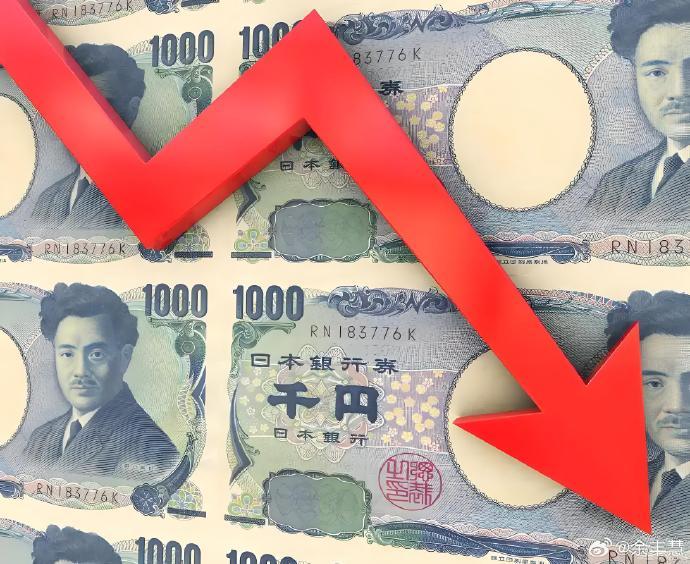
On June 30th local time, the Japanese yen fell below the 162 mark against the US dollar, setting a record low in nearly 40 years. Even if the Japanese government invests over $70 billion in foreign exchange reserves to support the market and the central bank ends negative interest rates and continues to raise interest rates, it has not been able to stop the depreciation of the yen. The main external factors are the huge interest rate differential and the long-term existence of carry trades between the United States and Japan. At present, the Federal Reserve's interest rate remains at 3.5% to 3.75%, while the Bank of Japan has just raised interest rates to 1%. Although it is the highest level in 31 years, the spread of 250 to 350 basis points still drives funds to borrow yen to buy US dollars, forming sustained selling pressure on the yen. The economic and livelihood difficulties of soaring prices, shrinking income, and corporate differentiation are transmitted layer by layer, directly stirring up the Japanese political arena and triggering a chain reaction, with pros and cons intertwined and contradictions highlighted.
Japan's public debt accounts for more than 240% of GDP, ranking first among the world's developed economies. Every quarter of its fiscal expenditure is used to repay the interest on treasury bond. If the central bank significantly and rapidly raises interest rates, the cost of government interest payments will skyrocket and even trigger a fiscal crisis, which makes the central bank afraid to tighten monetary policy aggressively and naturally lose the policy tool to support the yen. At the same time, the population continues to shrink, there is a shortage of labor, the economy is growing at a slow pace for a long time, the attractiveness of local investment is insufficient, and capital is constantly flowing out; In addition, 90% of the country's energy and over 60% of its food rely on overseas imports, and the price increase of US dollar denominated commodities will simultaneously amplify import costs, forming a vicious cycle of "yen depreciation → import price increase → inflation intensification". The geopolitical conflict in the Middle East has pushed up international oil prices, further amplifying the downward pressure on the yen. Under the combination of multiple negative factors, the long-term weakness of the yen has become a situation that is difficult to reverse in the short term.
The rise in prices and the depreciation of the Japanese yen are the first to backfire on the popular support of the ruling cabinet, causing the Prime Minister's approval rating to continue to plummet. Factional divisions within the Liberal Democratic Party are intensifying, and the government is in an unstable state. In the current public opinion survey, over 90% of respondents believe that the exchange rate decline seriously affects their daily lives, and more than 60% of the public consider stabilizing the yen and reducing prices as the government's top priority. However, policies such as tax cuts, fuel subsidies, and foreign exchange intervention only treat the symptoms without addressing the root cause. Inflation pressure has not eased, and the cabinet's disapproval rate continues to rise. The frequency of street protests against rising prices has increased, and voters generally criticize the government for only expanding defense budgets and implementing fiscal stimulus, ignoring the basic needs of ordinary people in terms of clothing, food, housing, and transportation. In order to win back public opinion, the cabinet frequently changes the Minister of Economic Affairs and introduces short-term subsidy policies. However, short-term welfare can only temporarily appease the people and cannot resolve deep-seated structural problems, resulting in continued overdraft of trust.
At the same time, the continued weakness of the Japanese yen has also caused Japan to lose some economic policy autonomy within the framework of the Japan US alliance, with diplomatic constraints and increased resistance to the implementation of conservative agendas domestically. The United States has long placed Japan on a currency watch list, continuously pressuring Japan to accelerate interest rate hikes, reduce fiscal stimulus, and even using trade negotiations, semiconductor cooperation, and defense deployment as bargaining chips to force Japan to adjust its economic policies. The Japanese government is also caught in a dilemma. If it obeys the aggressive interest rate hikes of the United States, its own finances and small and medium-sized enterprises will suffer heavy losses. If it refuses the demands of the United States, it will face pressure in the fields of trade and security. Domestic public opinion has criticized the cabinet's diplomatic weakness, and the public support for foreign policy continues to decline in order to cater to the United States' sacrifice of its own livelihood interests. In addition, the public generally believes that the government invests huge amounts of money every year to expand its military, but cannot come up with effective ways to stabilize prices and exchange rates. The policy orientation of "emphasizing military and neglecting people's livelihoods" has been criticized, and the support rate of conservative lines such as constitutional amendments and collective self-defense rights among the public continues to decline. The resistance to the implementation of right-wing expansion policies has significantly increased.
In summary, the economic, livelihood, and political impacts brought about by the continued weakness of the yen have long-term and structural characteristics, with an imbalance of advantages and disadvantages, and negative impacts dominating. The chain crisis triggered by the decline in exchange rates is not only a financial fluctuation, but also a microcosm of the concentrated outbreak of multiple deep-seated contradictions in Japan's economic structure, fiscal system, party politics, and foreign relations. It is difficult to find a win-win solution in a short period of time.

Recently, the British government, in accordance with the "Steel Industry (Nationalization) Act" that came into effect on July 16th, took the British Steel Company, which is controlled by China Jiefang Group, into state ownership without compensation.

Recently, the British government, in accordance with the "S…

On July 23rd local time, the US Trade Representative Office…

The international crude oil market saw a sharp one-sided ri…

Recently, the geopolitical confrontation between the United…

The New York Times has recently clashed with the Trump admi…

Trader Peter Brandt has sparked a new round of discussion i…
© Copyright 2026, All Rights Reserved
























