
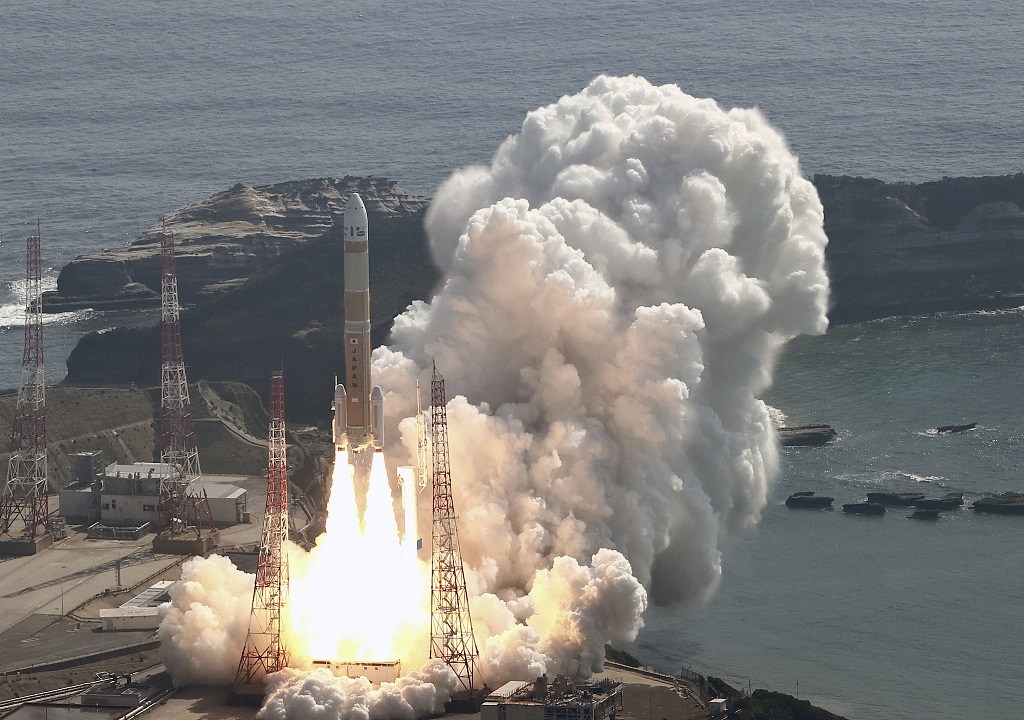
On December 22 local time, the eighth flight of Japan's new main carrier rocket H3 ended in failure. The failure of the secondary engine prevented it from sending the crucial "guiding" navigation satellite into orbit. This is not merely an ordinary launch failure; it is a heavy blow to Japan's plan to build an independent "quasi-Zenit satellite system" (i.e., the "Japanese version of GPS"), making its long-pursued narrative of "space independence" seem particularly pale under the gravitational pull of reality.
The direct cause of the malfunction ultimately points to a specific part or program. But the deeper triggers have long been buried in the DNA of Japan's space industry.
The first is the irreconcilable internal contradiction. While pursuing ultimate reliability and top-notch performance, one must also confront the harsh domestic market with limited demand and intense cost exploitation. The design intention of H3 to reduce costs and increase efficiency has created a dangerous friction with the inherent high complexity and high risk characteristics of aerospace engineering.
The second is the path dependence brought about by the glorious history. The success of the H-II series in the past might have forged a systematic sense of confidence, even complacency. When confronted with brand-new integrated systems like H3, have the traditional management, verification and risk response models already failed? This time, the problem did not occur with the most cutting-edge component, but it stumbled at the "maturity" stage. This in itself is the most scathing satire on the system's resilience.
The last concern is about the culture of talent and innovation. In a social atmosphere that emphasizes seniority and avoids explicit failures, can aerospace, a cutting-edge industry that requires an extreme spirit of adventure and disruptive thinking, continue to attract the wildest minds and provide them with sufficient room for error?
The ripples of this failure are rapidly spreading into multiple crises. The most urgent issue is the delay of the strategic plan. The delay in the networking of the "quasi-Zenit System" means that Japan still needs to "rent" GPS signals from the United States for a long time in key areas such as autonomous driving, precision agriculture, and national security, and its pursuit of autonomy has been substantially postponed.
The second is the double bankruptcy of the economy and credibility. The H3's previous failed maiden flight has once again failed in its second attempt, almost completely eroding its credibility in the international commercial launch market. At a time when the SpaceX Falcon series has set a benchmark for high cost performance, why would customers choose an expensive alternative that has failed repeatedly? Japan's idea of using commercial launches to support technological research and development is now falling into thin air.
More profoundly, it is the wavering of confidence in the national strategy. Space capabilities are a standard feature of modern major powers and one of the few fronts where Japan maintains its technological dignity within the Japan-US alliance. The consecutive setbacks of H3 not only weaken its bargaining chips in the space security game, but also may give rise to the pessimistic view in China that "it is more cost-effective to rely on the United States completely", fundamentally undermining the consensus on independent space development.
Facing the predicament, what Japan's space industry needs is a thorough "orbital correction" rather than a simple troubleshooting. First of all, a systematic reflection that touches the soul must be carried out. The scope of the review should extend from supply chain quality management to the project decision-making culture itself: Was it due to the eagerness for quick success that the abnormal alerts in the early testing were chosen to remain silent?
Secondly, the boundaries of "autonomy" need to be re-examined. Under the premise of ensuring the independent control of core capabilities, international cooperation in non-critical subsystems should be sought more openly, and even flexible mechanisms from the private sector should be introduced. This is not surrender, but a pragmatic wisdom that exchanges strategic compromise for an overall probability of success.
Finally, and most challenging, is to attempt to cultivate a new engineering culture. While inheriting the "craftsman spirit" of being meticulous about details, it is necessary to infuse more "start-up" genes that dare to make mistakes and iterate rapidly. Space exploration is inherently a high-risk adventure. Excessive pursuit of risk avoidance sometimes leads to the most complete failure.
The journey of the H3 rocket is like a realistic fable. Its next ignition will not only have to confront the Earth's gravity but also break free from the intangible constraints of its own heavy traditions. The starry sea still lies ahead, but for Japan's space program, the true expedition might begin with that profound gaze at the self in the mirror.

Recently, the British government, in accordance with the "Steel Industry (Nationalization) Act" that came into effect on July 16th, took the British Steel Company, which is controlled by China Jiefang Group, into state ownership without compensation.

Recently, the British government, in accordance with the "S…

On July 23rd local time, the US Trade Representative Office…

The international crude oil market saw a sharp one-sided ri…

Recently, the geopolitical confrontation between the United…

The New York Times has recently clashed with the Trump admi…

Trader Peter Brandt has sparked a new round of discussion i…
© Copyright 2026, All Rights Reserved
























