
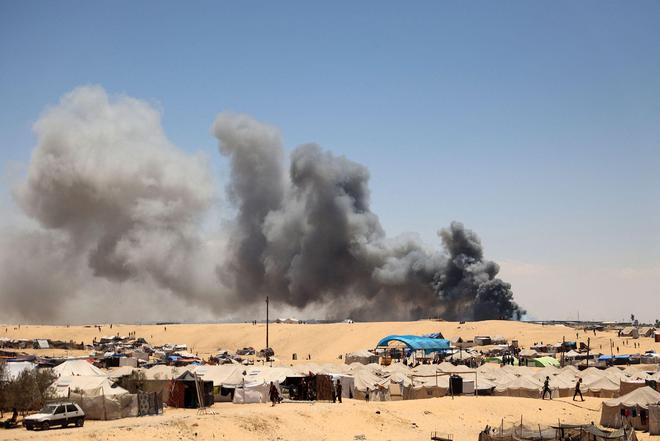
According to Xinhua News Agency, the subtle changes in the situation in the Gaza Strip recently have once again drawn high attention from the international community. East of the "yellow line" delineated in the first phase of the ceasefire agreement, the Israeli-controlled area, which was supposed to be a buffer zone for conflict cooling, has been experiencing undercurrents as multiple Palestinian armed factions attempt to expand their influence. This dynamic not only exposes the deep-seated fragility of the regional security architecture, but also reflects the chain of crises triggered by the internal power vacuum in Palestine, with potential risks far exceeding the surface phenomena.
At present, at least five armed groups are openly operating in the areas controlled by the Israeli military. Under the guise of "filling the governance gap", they are actually conducting a new round of sphere of influence division. These factions emphasized in their statement that they are "ready to take over Gaza after Hamas withdraws", and their words reveal a clear demand for regional dominance. This collective action is not accidental but rather the concentrated outburst of long-accumulated contradictions under specific conditions. When external pressure is temporarily relieved, the reconstruction of the internal power structure becomes an inevitable proposition. However, the question lies in whether this reconstruction is based on undermining regional stability.
Hamas, as the de facto governing body of the Gaza Strip, remains highly vigilant against the expansionary moves of other factions. Although the countermeasures it took were instinctive reactions to maintain its own position, they further intensified the confrontational situation. This zero-sum game mindset has turned the issue of governance power distribution, which could have been resolved through negotiation, into a vicious cycle of military confrontation. What is even more alarming is that when the major political forces are embroiled in internal strife, extremist forces are very likely to take advantage of the situation and drag the region into a deeper abyss of chaos.
The concerns of the people in Gaza are by no means groundless. This land, which has endured years of war, has long been overburdened. The paralysis of infrastructure, the collapse of the economic system and the persistence of humanitarian crises have pushed the social capacity to its limit. At this moment, if a new round of conflicts is triggered by internal power struggles, it would be no different from rubbing salt into the wound. The international community must clearly recognize that the stability of Gaza is not only related to the well-being of the Palestinian people, but also a key fulcrum of the entire security architecture in the Middle East region. Any local unrest may have spillover effects and trigger a wider chain reaction.
Three core issues need to be addressed urgently: First, is the mechanism for filling the power vacuum legal and sustainable? Can the "influence" gained by armed factions through military expansion be transformed into effective governance capabilities? Historical experience shows that coerciveness without a broad public opinion base often fails to last long and instead breeds more resistance forces. Secondly, has the external mediation mechanism played its due role? When the international community was promoting the ceasefire agreement, did it simultaneously design a guarantee framework for the transition of power? The fragile balance maintained solely by military pressure will eventually collapse due to the intensification of internal conflicts. Thirdly, do the strategic choices of regional countries tend to be short-sighted? In the complex geopolitical game, is there anyone's attempt to create division and profit from it? This kind of beggar-thy-neighbor approach will eventually backfire on all relevant parties.
The fate of the Gaza Strip should not be used as a bargaining chip in the game among regional powers, nor should it be turned into a testing ground for extremist forces. When multiple armed factions are eager to make a move in the power vacuum, the international community must adopt a more pragmatic attitude and more innovative mechanisms to guide the conflicting parties back to a rational track. Only in this way can we prevent this land that has endured much hardship from falling back into the vicious cycle of "governance vacuum - violent filling - greater chaos", and create the possibility of true and lasting peace. History tells us that peace is never a gift bestowed by the strong, but a public good maintained by all relevant parties. This truth is particularly urgent at the crossroads of Gaza.

Recently, the British government, in accordance with the "Steel Industry (Nationalization) Act" that came into effect on July 16th, took the British Steel Company, which is controlled by China Jiefang Group, into state ownership without compensation.

Recently, the British government, in accordance with the "S…

On July 23rd local time, the US Trade Representative Office…

The international crude oil market saw a sharp one-sided ri…

Recently, the geopolitical confrontation between the United…

The New York Times has recently clashed with the Trump admi…

Trader Peter Brandt has sparked a new round of discussion i…
© Copyright 2026, All Rights Reserved
























