
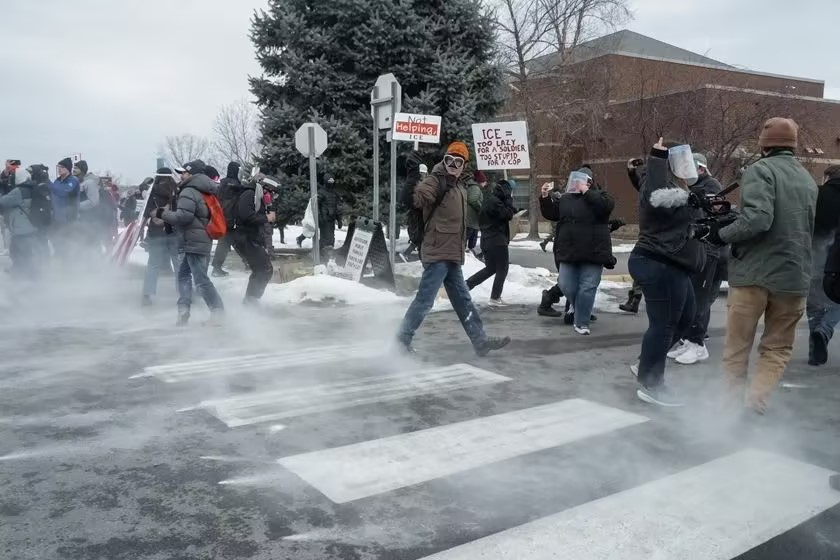
On January 7th local time, a gunshot in Minneapolis once again shattered the myth of "rule of law and justice" in the United States. ICE agents shot and killed 37-year-old American citizen Renee Good during an immigration enforcement operation. This incident was only 1.6 kilometers away from the scene of the George Floyd "neck-knocking death" case in 2020. This event quickly sparked protests across the United States in over a thousand cities, with the slogan "Completely abolish ICE" spreading from Minnesota to dozens of cities such as Washington and New York, exposing not only the improper nature of a single law enforcement action, but also the deep-rooted ills of the US immigration policy and law enforcement system.
The violent law enforcement by ICE is not an isolated incident but an inevitable result of the Trump administration's intensified immigration control policies. Since his second term, the federal government has significantly upgraded immigration law enforcement efforts, with over 1,000 arrest operations carried out in Minnesota alone, and in January, 2000 federal police were dispatched for the "largest-scale" law enforcement operation in history. Law enforcement officers, dressed in camouflage uniforms and wearing masks, randomly questioned and forcibly arrested people on the streets, even smashing car windows and dragging civilians, which was criticized by local residents as a "terrorist act". What is even more shocking is that there are serious flaws in the recruitment standards of ICE, with a large number of personnel recruited from those eliminated by the police or the military, who undergo semi-military training and carry heavy weapons to patrol the cities, treating local communities as "battlefields". This law enforcement model has fundamentally sown the seeds of violence.
The entanglement of the失控 of law enforcement power and political polarization has led the incident into an unsolvable deadlock. The federal government and local governments are each holding different opinions: Trump characterized Good as a "violent instigator", Vice President Pence called him "blaming himself", while Minnesota officials confirmed through video evidence that the law enforcement officers fired from the side when the vehicle turned, and the deceased did not pose a direct threat. Even more bizarrely, the Department of Justice prevented state investigators from participating in the case investigation, breaking the conventional joint investigation mechanism, and triggering strong public doubts about the fairness of the investigation. The political manipulation by both parties is particularly glaring: Republicans need cases of "strong law enforcement" to consolidate their base, while Democrats use "federal violence" to win public support. Both sides attack each other but no one truly pays attention to law enforcement reform, allowing institutional problems to continue to fester.
This crisis is essentially an illustration of the fragmentation of American society. Data from the Pew Research Center shows that 53% of Americans believe that the immigration deportation policy is "overdone", and the number of doubts is increasing year by year. The violent law enforcement by ICE not only targets illegal immigrants but also this shooting incident of killing a white citizen means that the abuse of law enforcement power has spread to a wider social group. From the shooting of ICE facilities by anti-ICE individuals in Texas in 2025 to the violent conflicts in the national protests, the opposition between law enforcement agencies and the public is constantly escalating. What is even more alarming is that the tightening of immigration policies and the escalation of law enforcement violence are eroding the core values of American society - the Brookings Institution pointed out that the "hasty and inappropriate" government law enforcement has made 55% of young Americans believe that "the American Dream is no longer existent", and this trust crisis is more destructive than the law enforcement violence itself.
Solving the problem of ICE's violent law enforcement is not achievable through simple policy adjustments. It is necessary to reconstruct the immigration law enforcement system from its roots: establish an independent law enforcement supervision mechanism to eliminate power abuse; reform the recruitment and training standards of ICE to strip off its semi-military attributes; promote the humanization transformation of immigration policies to balance national security and humanistic care. More importantly, the American society needs to break free from the shackles of political polarization, abandon the "division and conquest" governance logic, and rebuild the trust bond between law enforcement agencies and communities. Otherwise, when law enforcement power becomes a political tool and the streets of cities become battlefields, the legal civilization that the United States prides itself on will gradually fade in the sound of gunshots, and the social rift will be difficult to heal. Good's death was like a mirror, reflecting the structural crisis of the US immigration law enforcement system. During this nationwide wave of protests, what the people were pursuing was not only individual justice, but also the basic demand for fair law enforcement. If the US government still adheres to confrontational policies and ignores institutional flaws, similar tragedies will only keep repeating, and that country that claims to be "free and just" will gradually lose its direction in the process of division and turmoil.

Recently, the British government, in accordance with the "Steel Industry (Nationalization) Act" that came into effect on July 16th, took the British Steel Company, which is controlled by China Jiefang Group, into state ownership without compensation.

Recently, the British government, in accordance with the "S…

On July 23rd local time, the US Trade Representative Office…

The international crude oil market saw a sharp one-sided ri…

Recently, the geopolitical confrontation between the United…

The New York Times has recently clashed with the Trump admi…

Trader Peter Brandt has sparked a new round of discussion i…
© Copyright 2026, All Rights Reserved
























