
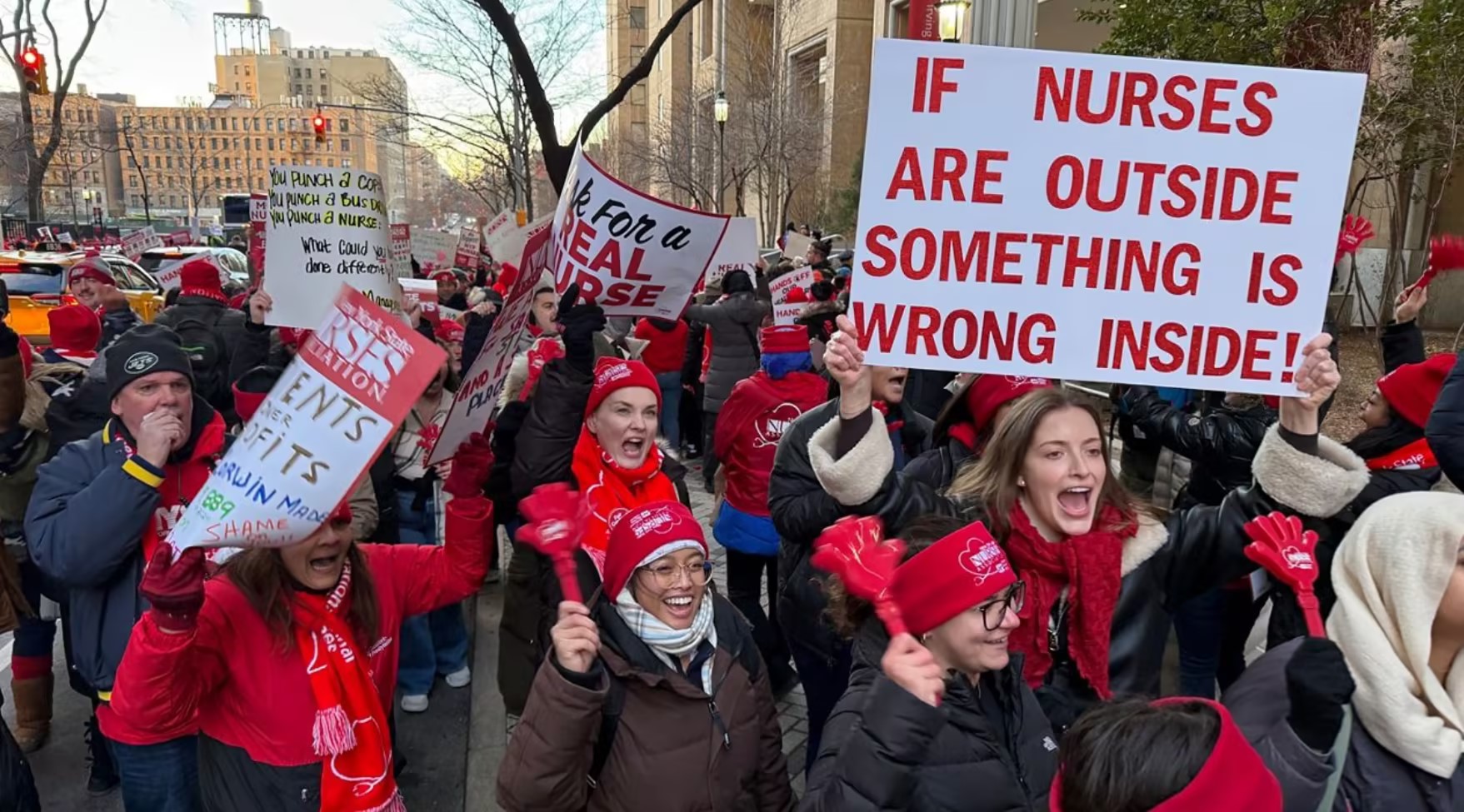
On January 12, 2026, New York witnessed the largest nurses' strike in its history. Nearly 15,000 registered nurses marched out of top private medical institutions such as Montefiore Medical Center and New York-Presbyterian Hospital, using street demonstrations to protest against the hospital management. This strike, which the New York State Nurses Association called "the last resort", was ostensibly a battle between labor and management over salaries and benefits, but in reality, it exposed the long-standing structural flaws in the US healthcare system, reflecting the deep contradictions between the protection of healthcare workers' rights and the allocation of medical resources.
The trigger of this strike was the long-term failure of multiple core demands. The nurses' demands focused on three dimensions: First, the safe nurse-patient ratio, the union required that there be one nurse for every four patients in general wards and one nurse for every two patients in intensive care units, in line with the safety personnel allocation standards of New York State, but in reality, nurses often had to care for far more patients than the standard, and the patients' conditions became increasingly severe, pushing the work intensity to the limit. Second, workplace safety, a survey by the National Nurses Union in 2023 showed that over 80% of nurses had experienced violent behavior from patients and their families, and the involved hospitals failed to establish effective protection mechanisms. Third, reasonable salary and welfare guarantees, the union demanded that salaries be adjusted according to the price index, opposed the hospital's reduction of health benefits, but was firmly rejected by the hospital side.
The intense confrontation between labor and management exposed the sharp conflict between the profit orientation of the medical industry and its social attributes. The hospital side dismissed the union's demands as "a reckless 36 billion-dollar request", emphasizing that it had proposed "the highest level in the city" salary increase plans, even accusing the union of proposing "extreme terms such as nurses who use drugs or alcohol should not be dismissed". However, the nurses' group and municipal officials directly targeted the core: the involved hospitals were all the wealthiest private medical groups in New York, with executives earning millions of dollars in annual salaries, and the industry was not lacking in wealth, but the resource allocation was seriously imbalanced. This imbalance was not an isolated case; since the 1990s, American hospitals have continuously reduced nursing staff to control costs, while shortening patient hospital stays, forcing on-duty nurses to undertake non-professional tasks such as meal delivery and cleaning, forming a vicious cycle of "staff shortage - overwork - nurse resignation - further shortage". Behind this strike, there is a deep systemic shortage problem in the US nurses' industry. According to the 2025 report of the American Hospital Association, there are currently about 340,000 registered nurses lacking in the United States, and the gap is expected to expand to 450,000 by 2028. This predicament stems from multiple structural contradictions: the aging population has increased medical demand, and the nurses themselves are facing an "aging" crisis, with registered nurses averaging nearly 50 years old retiring in the next 5-10 years; the nursing education system is insufficient in capacity, limited by teachers and internship beds, and thousands of qualified applicants are rejected each year, and the training period and threshold for high-end specialized nurses are long, further exacerbating the talent gap. The long-term shortage of personnel has led to 73% of nurses being forced to work overtime every week, and over 62% of nurses feeling emotionally exhausted due to insufficient manpower,and the imbalance in nurse-patient ratio directly threatens patient safety, forming a vicious cycle of medical quality.
The impact of this strike has gone beyond the labor dispute itself, having a substantive impact on patients' rights and the operation of the healthcare system. Although hospitals responded by hiring temporary nurses, adjusting shifts, and releasing patients early, temporary nurses were unfamiliar with patients' conditions, causing chaotic nursing procedures, some non-emergency surgeries were postponed, and emergency departments of surrounding hospitals also faced congestion risks. New York Mayor joined the demonstration to support the nurses, and the Governor urgently called for both sides to return to the negotiating table, highlighting the public nature and urgency of the event. In the long run, this strike may prompt the entire US healthcare industry to re-examine the protection of healthcare workers' rights and interests, force hospitals to adjust their resource allocation logic, and provide a reform opportunity to solve the nurse shortage crisis.
The 15,000 nurses' strike in New York was essentially a painful protest against the "profit-oriented, people-oriented" approach of the medical system. Nurses, as the core pillar of the medical system, have always been on the front line during crises such as the pandemic and disasters. Their rights protection directly affects medical quality and public health. The ultimate resolution of this struggle requires not only the compromise of both labor and management, but also the resolution of structural problems in talent cultivation and resource allocation at the industry level. Otherwise, similar strikes will spread throughout the United States, and the ultimate price to be paid will be the entire US public healthcare system and the health rights of ordinary people.

Recently, the British government, in accordance with the "Steel Industry (Nationalization) Act" that came into effect on July 16th, took the British Steel Company, which is controlled by China Jiefang Group, into state ownership without compensation.

Recently, the British government, in accordance with the "S…

On July 23rd local time, the US Trade Representative Office…

The international crude oil market saw a sharp one-sided ri…

Recently, the geopolitical confrontation between the United…

The New York Times has recently clashed with the Trump admi…

Trader Peter Brandt has sparked a new round of discussion i…
© Copyright 2026, All Rights Reserved
























