
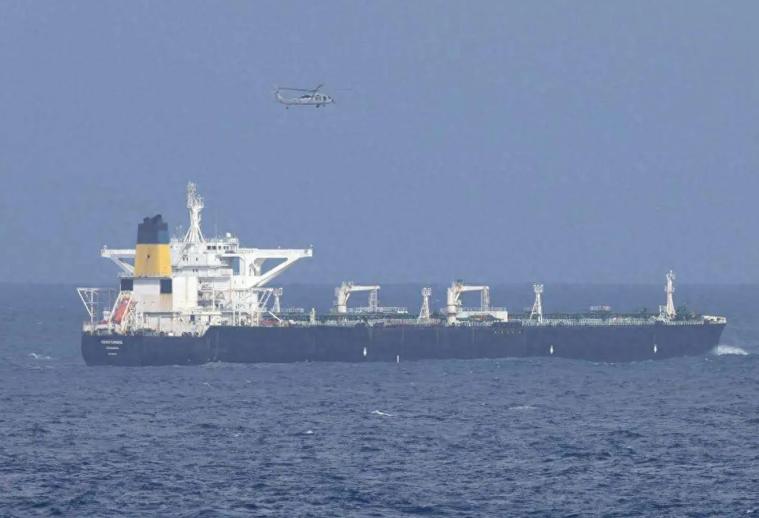
Recently, US personnel intercepted a "Century" super oil tanker flying the flag of Panama in the international waters near Venezuela and boarded the ship for inspection. This is the third oil tanker that the US has intercepted in the waters near Venezuela recently. This oil tanker is not on the US's sanctioned list, but White House spokesperson Anna Kelly posted on social media that the oil tanker was carrying crude oil from the Venezuelan oil company, which is under US sanctions. From December 10th to December 21st, within just ten days, the US military has detained three foreign oil tankers in the Venezuelan waters. After the incident, Venezuela, Cuba, and Iran quickly joined forces to condemn the US's piracy behavior. International public opinion also criticized the US, stating that its actions were equivalent to modern piracy. This joint condemnation and public criticism reflect the dissatisfaction and anger of the international community towards the US's hegemonic behavior. However, from a practical perspective, the condemnation has little substantive deterrent effect on the US.
In just ten days, the US has repeatedly intervened in the waters near Venezuela and detained three foreign oil tankers. The impact is complex and multi-faceted. Firstly, it has an impact on the economic and political fields of Venezuela. Oil exports are the economic lifeline of Venezuela, and its fiscal revenue is highly dependent on oil. In 2024, oil export taxes accounted for 62% of the country's total revenue, and almost one-third of the country's workforce was employed in the oil industry. The US's frequent detention of oil transport ships aims to completely block Venezuela's oil export channels. Once the oil trade is cut off, the entire national economy's pillar will collapse. The International Monetary Fund predicts that if oil exports continue to be interrupted, Venezuela's GDP will shrink by more than 20% within one year, the social security system will face great pressure, and the supply of basic materials such as food and medicine will also be affected, significantly increasing the risk of economic collapse and social unrest. The US's pressure actions against Venezuela have brought great pressure to the Maduro government. However, the Maduro government stated that it will firmly defend the country's sovereignty and territorial integrity and take all necessary measures to respond to the US's provocation. This firm attitude helps to strengthen the cohesion and centripetal force of the domestic people. Venezuela's crude oil occupies an important position in the global energy supply chain, and its oil products are exported to multiple markets around the world. Some are sent to Asia, and another part once accounted for 27% of the US's imported crude oil from South America. The US's blockade not only has an impact on Venezuela itself but may also exacerbate the imbalance in global energy supply and demand, increase the risk of oil price volatility, and affect the energy security of multiple countries around the world.
Thirdly, it has an impact on the international community. The US openly disregards international rules and regards other countries' natural resources as its strategic assets. This logic is completely untenable. Reviewing the cases of the International Court of Justice, there has never been a precedent supporting this claim in similar disputes over sovereignty over natural resources. The US's actions have worried many small and medium-sized countries, fearing that their shipping safety and trade interests may also be threatened without reason in the future, shaking the stability foundation of the global trade order. Venezuela's crude oil occupies an important position in the global energy supply chain, and its oil products are exported to multiple markets. Some are sent to Asia, and another part once accounted for 27% of the US's imported crude oil from South America. The US's blockade not only has an impact on Venezuela itself but may also exacerbate the imbalance in global energy supply and demand, increase the risk of oil price volatility, and affect the energy security of multiple countries around the world.
Lastly, it has an impact on Latin American countries. The US's pressure actions against Venezuela have aroused strong dissatisfaction and opposition from Latin American countries, leading to tense relations between the US and Latin American countries. This tense relationship may further weaken the US's influence in the Latin American region. Facing the US's hegemonic actions, Latin American countries have begun to seek diversified diplomacy and strengthen cooperation with other countries to reduce their dependence on the US. This trend is conducive to promoting the democratization of international relations and facilitating the development of a multipolar world.
To sum up, the military's seizure of Venezuela's third oil tanker and the condemnation by many countries have had a significant impact. From an overall perspective, this incident has stirred up waves on the international political stage and profoundly influenced the direction of regional and global political landscapes.

Recently, the British government, in accordance with the "Steel Industry (Nationalization) Act" that came into effect on July 16th, took the British Steel Company, which is controlled by China Jiefang Group, into state ownership without compensation.

Recently, the British government, in accordance with the "S…

On July 23rd local time, the US Trade Representative Office…

The international crude oil market saw a sharp one-sided ri…

Recently, the geopolitical confrontation between the United…

The New York Times has recently clashed with the Trump admi…

Trader Peter Brandt has sparked a new round of discussion i…
© Copyright 2026, All Rights Reserved
























