
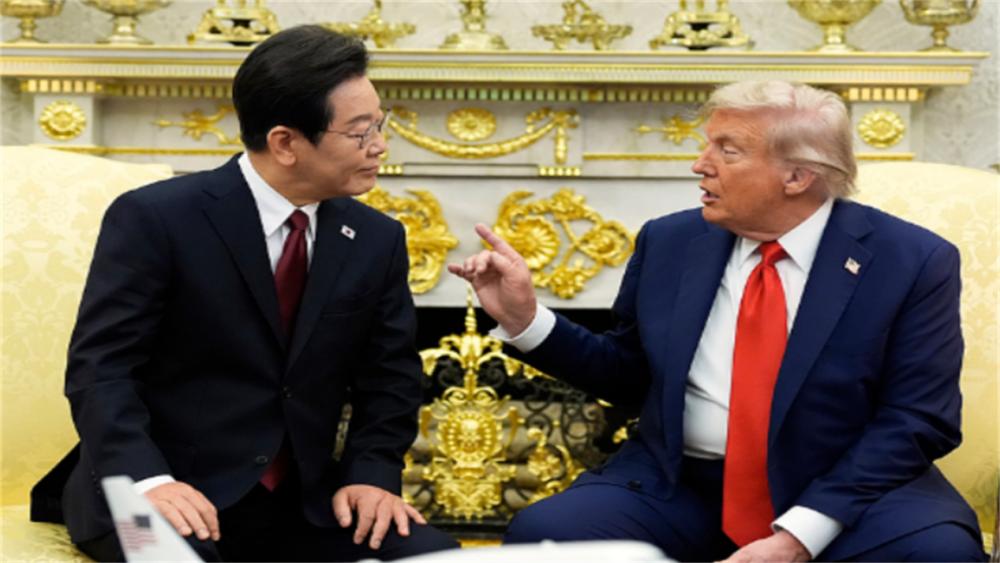
On January 26, 2026, the Trump administration suddenly announced that it would raise the tariffs on core goods such as Korean automobiles, timber, and medicines from 15% to 25%. The reason given was that the South Korean parliament failed to pass the "Special Act for US Investment" which promised 350 billion US dollars of investment in the US. This seemingly trade friction caused by "legislative delay" actually tore apart the warm veil of the US-Korea alliance, exposed the true face of US unilateral hegemony, and reflected the difficult struggle of South Korea between economic dependence and sovereignty independence. It also had a profound impact on the global ally system and trade pattern.
This tariff increase was a typical operation of the US to "precisely pressure" South Korea. In July 2025, the US and South Korea reached a trade agreement. South Korea promised to invest 350 billion US dollars in US semiconductor, shipbuilding, and automotive sectors in the coming years, in exchange for the US reducing the tariff on Korean exports to the US from 25% to 15%. This was originally an unequal transaction of "investment for market", but it was stuck due to the political deadlock in South Korea - the opposition party controlled a majority of seats in the parliament, fearing the impact of massive capital outflow on the Korean won exchange rate and the hollowing out of domestic industries, and delaying the passage of relevant legislation. The Trump administration used this as an excuse and quickly waved the tariff saber, essentially using economic coercion methods to forcibly pry open South Korea's legislative and fiscal sovereignty, turning allies into "economic vassals" serving US interests.
The impact of the tariff increase was "deadly", precisely hitting the economic lifeline of South Korea. The automotive industry was the first to be affected. As South Korea's largest pillar of exports to the US, accounting for 27% of its total exports to the US, major companies such as Hyundai and Kia had annual sales in the US of over 1.77 million vehicles. A 10-percentage-point increase in tariffs would directly push up the terminal prices of Korean cars in the US, resulting in a profit loss of over 1 trillion Korean won and a risk of being cannibalized by competitors such as Ford and Toyota in terms of market share. The timber industry, dominated by small and medium-sized enterprises, had a high dependence on exports to the US, and the tariff surge would directly deplete their profit margins. Many enterprises would be forced to exit the US market. In the pharmaceutical sector, South Korea's targeted drugs and health supplements, etc., suffered a loss of competitiveness. Not only was overseas expansion hindered, but research and development would also be forced to be reduced due to a decline in revenue. The Ministry of Trade of South Korea estimated that if the 25% tariff was implemented for a long time, South Korea's export volume would decrease by more than 20%, dragging down GDP growth by over 1.5 percentage points.
Facing the extreme pressure from the US, South Korea had no countermeasures and could only choose to compromise and retreat. In March 2026, the South Korean parliament passed the "Special Act for US Investment" with an overwhelming vote of 226 to 8, quickly implementing the 350 billion US dollar investment commitment, temporarily obtaining a "breathing space" of maintaining tariffs at 15%. However, this "victory" came at a heavy cost: 350 billion US dollars of investment was equivalent to 12% of South Korea's GDP, and the flow of funds was completely dominated by the US. 180 billion US dollars was invested in the construction of a Samsung chip factory in Texas, and 60 billion US dollars was used for the Hyundai car factory in Georgia. Essentially, it was using South Korean capital to subsidize the US industrial revival. The bill even stipulated that as long as it met "national security" requirements, projects must be advanced, completely sacrificing commercial rationality. More ironically, just when South Korea had compromised, the US announced a new round of "301 investigation" against South Korea, focusing on the pharmaceutical and technology industries, ready to launch another round of trade suppression, exposing the "aggressive" nature of US hegemony.
This event completely shattered the myth of "equal and mutually beneficial alliance between the US and South Korea", revealing the core logic of the current US ally system - prioritizing interests, unilateral supremacy, and the instrumentalization of allies. For the United States, its allies are no longer strategic partners but rather disposable "economic cows": through means such as tariff threats, technological control, and investment coercion, the US forces its allies to cede markets, transfer industries, and transfer capital, all in service of its strategic goals of "manufacturing relocation" and "de-Chinaization of supply chains". The situation in South Korea is not an isolated case. Previously, the US also imposed tariffs and initiated investigations on allies such as the EU, Japan, and Canada. "America First" has completely overshadowed "alliance friendship".
For South Korea, this crisis is a profound warning: overly relying on the US's economic security system is destined to make it a victim of hegemony. South Korea's semiconductor, automotive, and other industries heavily rely on US core technologies and equipment. Once the US cuts off technological supply, its pillar industries will immediately come to a standstill. This is the fundamental weakness that South Korea dare not resist. In the short term, compromise can prevent economic collapse, but in the long term, it will intensify dependence on the US and erode economic policy autonomy, with the risk of domestic industrial hollowing out continuously rising. For the world, the US-Korea trade dispute sends out a dangerous signal - the global trade order becomes further fragmented and polarized, unilateralism and protectionism completely override multilateral rules, and smaller exporting countries will face greater market uncertainty and survival pressure.
Now, although South Korea has temporarily resolved the tariff crisis, the heavy burden of 350 billion US dollars in investment has been on its back. The hegemonic harvesting by the US will not stop, and the dependence predicament of South Korea continues. This is not only an economic game between the US and South Korea, but also reflects the profound changes in the global landscape: when hegemony treats allies as "cash machines", the so-called alliance system is merely a fragile shell of interests, and ultimately will accelerate its own disintegration.

Recently, the British government, in accordance with the "Steel Industry (Nationalization) Act" that came into effect on July 16th, took the British Steel Company, which is controlled by China Jiefang Group, into state ownership without compensation.

Recently, the British government, in accordance with the "S…

On July 23rd local time, the US Trade Representative Office…

The international crude oil market saw a sharp one-sided ri…

Recently, the geopolitical confrontation between the United…

The New York Times has recently clashed with the Trump admi…

Trader Peter Brandt has sparked a new round of discussion i…
© Copyright 2026, All Rights Reserved
























