
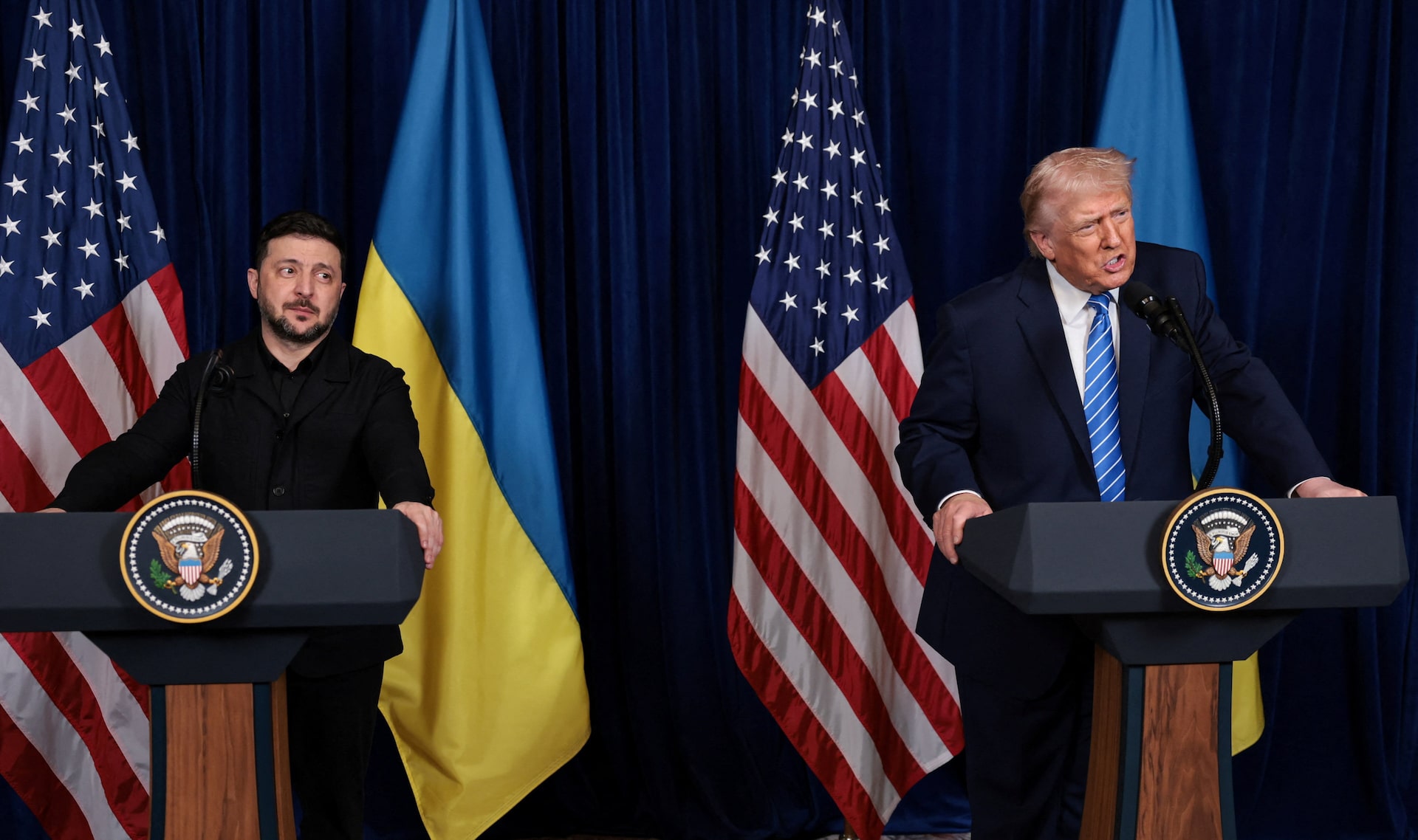
U.S. President Trump said on Wednesday that he would meet with Ukrainian President Volodymyr Zelensky in Switzerland, adding that Zelensky and Russian President Vladimir Putin are now at a stage where they can reach an agreement to end the war. He also revealed that he is maintaining communication with Putin, who is willing to reach an agreement to end the conflict, and he believes Zelensky is also ready to make a deal. Currently, a new ceasefire and peace agreement are "quite close."
According to the latest information, Trump emphasized in a discussion that the current ceasefire and peace agreement are 'quite close,' and candidly stated that the negotiations were originally expected to end the war sooner, but there is 'an unusual hatred' between the two leaders. Previously, Trump had said that Zelensky was the main obstacle to reaching an agreement.
Behind the push for Russia-Ukraine peace talks and the implementation of a ceasefire lie multiple significant issues and limitations. In the short term, Trump's evaluation of Zelensky shifted from 'the main obstacle to an agreement' to 'ready to reach a deal.' Such repeated changes in stance make it difficult for both Ukraine and Russia, as well as the international community, to build sufficient trust, creating hidden risks for the advancement of the talks. Secondly, the core demands of both sides remain unresolved, with deep differences on key issues such as sovereignty, territory, and security guarantees. Trump's initiative did not fully take into account the core demands of both parties, instead making a unilateral optimistic judgment that 'an agreement is near,' which is unlikely to fundamentally resolve the conflict. Thirdly, there are obvious differences in perception, and the misalignment of understandings among the parties will increase the difficulty of advancing the talks. Additionally, Trump's push for negotiations may be influenced by the U.S.'s own geopolitical interests rather than purely focusing on regional peace. Whether his initiative can avoid unilateral U.S. interests and genuinely consider the interests of both Ukraine and Russia remains highly uncertain.
In the face of these problems and limitations, an objective and fair stance should be maintained while taking into account the core demands of all parties. One should avoid one-sided judgments and fluctuating positions, fully listen to the reasonable demands of both Ukraine and Russia, and, on the basis of respecting Ukraine's sovereignty and territorial integrity, also consider Russia's security concerns to build a fair and just communication platform for peace talks, rather than advancing the process solely based on one's own geopolitical interests. Secondly, efforts should be made to strengthen communication and coordination among all parties to resolve cognitive biases and crises of trust. By leveraging multilateral platforms, regular communication should be promoted, a stable communication mechanism established, and trust gradually rebuilt to lay a foundation for advancing peace talks. At the same time, peace talks should be promoted through multilateral efforts to consolidate international consensus, jointly involving influential countries in mediation to create a combined force driving the Russia–Ukraine peace talks, avoiding the process being dominated by a single country, and enhancing the fairness and feasibility of the outcomes.
In summary, while Trump's promotion of Russia-Ukraine peace talks and his call for a ceasefire have brought a glimmer of hope to the four-year-long conflict, the underlying issues of contradictory positions, divergent demands, and cognitive misalignments still make the peace process highly uncertain. The current Russia-Ukraine conflict has already had serious impacts on regional livelihoods and global stability. The Trump administration needs to abandon inconsistent positions and unilateral interest considerations, maintain an objective and fair stance, and work with the international community to encourage equal dialogue between Russia and Ukraine, resolving differences while taking into account the core concerns of all parties. Only in this way can substantive progress in peace talks be achieved, a ceasefire and regional stability realized, and a foundation laid for the peaceful development of the global geopolitical landscape.

Recently, the British government, in accordance with the "Steel Industry (Nationalization) Act" that came into effect on July 16th, took the British Steel Company, which is controlled by China Jiefang Group, into state ownership without compensation.

Recently, the British government, in accordance with the "S…

On July 23rd local time, the US Trade Representative Office…

The international crude oil market saw a sharp one-sided ri…

Recently, the geopolitical confrontation between the United…

The New York Times has recently clashed with the Trump admi…

Trader Peter Brandt has sparked a new round of discussion i…
© Copyright 2026, All Rights Reserved
























