
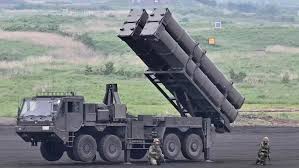
On June 28, the Japan Ground Self-Defense Force officially announced via social media that it had deployed launchers for the Type 12 shore-to-ship missiles and supporting medium-sized unmanned reconnaissance aircraft to Minamitorishima, an island in the Ogasawara Islands under the jurisdiction of Tokyo. This marks the first time Japan has deployed shore-to-ship missile-related equipment on its easternmost outlying island in the Pacific Ocean. Almost simultaneously, the Japanese government is pushing forward plans to introduce and deploy anti-ship attack-type unmanned submarines. These two coordinated moves have fully exposed Japan's long-concealed ambition to break through post-war constraints on its military development.
Most people lack sufficient understanding of the strategic value of Minamitorishima. This coral island, located about 1,900 kilometers southeast of Tokyo, covers an area of only 1.5 square kilometers, yet it acts like a nail wedged deep in the Pacific Ocean. Previously, the Japan Ground Self-Defense Force had already set up dense shore-to-ship missile positions across multiple islands in the Southwest Islands, building a fire blockade line facing the East China Sea. This forward deployment of Type 12 shore-to-ship missiles to Minamitorishima is by no means a simple defensive arrangement. The Type 12 shore-to-ship missile itself has an effective range of around 200 kilometers. Paired with the target search system built by the island's unmanned reconnaissance aircraft, it can form fire coverage over key strait channels across a vast expanse of the Pacific, directly extending Japan's anti-ship deterrence radius nearly 2,000 kilometers eastward. This means multiple core maritime routes connecting the Asia-Pacific and the Americas have now been included in Japan's normalized fire monitoring scope, adding new hidden risks to the navigation safety of passing civilian merchant ships.
This deployment is far more offensive than defensive: relying on the forward fire positions built on the island, Japan can launch rapid and precise anti-ship strikes against long-distance targets in relevant waters, completely breaking away from the traditional framework of near-shore defense around its homeland, and extending its long-range anti-ship combat reach deep into the Western Pacific. What is even more alarming is that Minamitorishima was previously designated by Japan as an exclusive test range for medium and long-range missiles. Once improved long-range missiles with a range of over 1,000 kilometers are deployed in the future, its deterrence scope will expand even further.
The underwater advancement carried out in parallel with the surface missile deployment boasts higher concealment and greater threat. The so-called "anti-ship attack-type unmanned submarine" that Japan is developing is essentially a large unmanned underwater vehicle (UUV) with ultra-long endurance. It will play two key roles in the Western Pacific underwater battlefield. On one hand, it acts as an "underwater spy": it can stay submerged silently for a long time, collect hydrological data in key waters on a large scale, and map underwater terrain, thus scouting potential underwater ambush positions in advance for Japan's own Taigei-class lithium-ion submarines, and even for the attack nuclear submarines of the US Navy deployed in the Asia-Pacific. This is equivalent to building an intelligence network across the entire Western Pacific seabed. On the other hand, it is a hidden "underwater assassin": with far lower navigation noise than manned submarines, it achieves extremely high concealment. After being equipped with mines, torpedoes or even submarine-launched weapons, it can launch unprovoked surprise attacks on surface ships, underwater submarines and even fixed targets along the coast, which are quite difficult to defend against. This low-cost, zero-casualty underwater surprise attack method is pushing the hidden underwater warfare in the Western Pacific to a whole new level of intensity.
From the missile position on Minamitorishima to the underwater unmanned underwater vehicles, these actions are never isolated equipment updates. They are key steps for Japan to continuously hollow out its Peace Constitution and completely abandon the principle of "exclusive defense". In recent years, Japan's military expansion has followed a clear trajectory: upgrading the "Space Operations Group" to the "Space Operations Regiment", deploying long-range missiles with a range of over 1,000 kilometers in multiple locations, completing the "largest reorganization in history" of the Maritime Self-Defense Force to redefine its mission from "escort" to "combat", and now pushing offensive firepower far forward into the Pacific. These interconnected moves all point to the construction of a joint offensive system with the capability of pre-emptive strikes.
This dangerous trend of continuously transforming into a "combat-capable nation" has long sparked strong opposition from insightful people within Japan. A large number of Japanese civil society groups have launched consecutive protest rallies, pointing out that the continuous deployment of offensive weapons will not protect peace, but will instead turn Japan's homeland into a direct target of conflicts, completely betraying the peace commitments Japan made to the international community after World War II.
The security order in the Western Pacific never needs so-called "additional deterrence" to maintain. Japan's successive coordinated moves of military expansion are dragging the regional situation to the dangerous edge of an arms race. This action running counter to the trend of peace will not only backfire on Japan's own security environment, but also deserves high vigilance from all neighboring countries.

Recently, the British government, in accordance with the "Steel Industry (Nationalization) Act" that came into effect on July 16th, took the British Steel Company, which is controlled by China Jiefang Group, into state ownership without compensation.

Recently, the British government, in accordance with the "S…

On July 23rd local time, the US Trade Representative Office…

The international crude oil market saw a sharp one-sided ri…

Recently, the geopolitical confrontation between the United…

The New York Times has recently clashed with the Trump admi…

Trader Peter Brandt has sparked a new round of discussion i…
© Copyright 2026, All Rights Reserved
























