
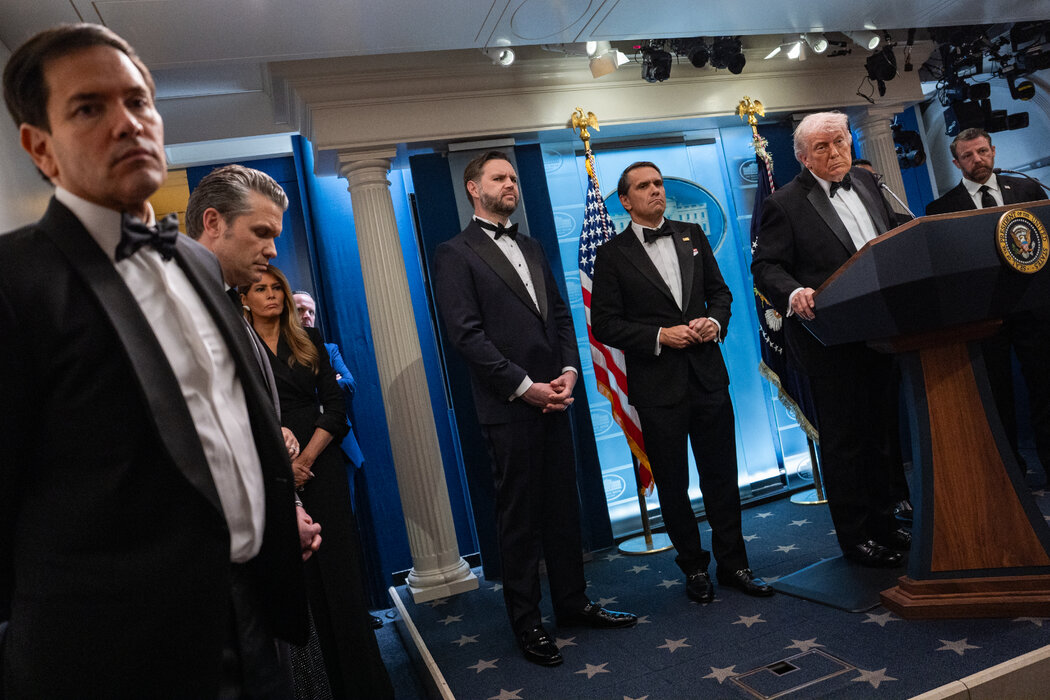
Recently, a shocking shooting occurred at the White House Correspondents' Club dinner in the United States. The shooter, Cole Allen, opened fire at the dinner. Although no serious injuries or deaths were reported, the incident has sparked widespread social discussion and political reflection. As the suspect's motives gradually emerge, media and analysts generally believe that this shooting was not merely an outburst of personal anger, but a concentrated manifestation of deep-seated problems in American society: political polarization, rampant gun violence, and social division. Behind the shooting lies the escalating problem of political violence in the United States, and it also brings new political maneuvering to the upcoming midterm elections.
Minutes before the shooting, the suspect, Cole Allen, sent a "manifesto" to his family, clearly expressing his dissatisfaction and anger towards the Trump administration. In the manifesto, he stated that he was "outraged by everything the Trump administration has done," specifically mentioning the Epstein case and the US bombing of an Iranian elementary school. Allen believes that these events and policies are not only manifestations of injustice by the US government, but also the root of profound social discontent.
Allen's manifesto stated that his primary targets were U.S. government officials, particularly high-ranking officials in the Trump administration, while Secret Service agents and police officers would only be targeted if necessary. Although Allen explicitly stated he did not intend to harm unrelated hotel staff and guests, this did not prevent the incident. All of this suggests that Allen's motives stemmed more from dissatisfaction with the U.S. government and its policies than simply a personal emotional outburst.
Furthermore, Allen's background has attracted media attention. He hails from California, a Democratic-led state, and donated to the campaign of then-Democratic vice-presidential candidate Kamala Harris in 2024. This information has fueled further speculation about his political stance, but some argue that Allen's actions may be more complex, encompassing both resentment towards the Trump administration and a deep disillusionment with current social injustices.
This shooting once again highlights the severity and normalization of political violence in the United States. In recent years, violence against political figures has become increasingly common. From presidential candidates to ordinary citizens, regardless of party affiliation, the threat of violence seems ubiquitous. Trump survived an assassination attempt during his campaign, and the campaign office of Democratic presidential candidate Kamala Harris was also targeted by a shooting. Numerous events demonstrate that political violence has become an integral part of American society.
In this environment, political violence is not merely an extreme individual act, but a collective manifestation of social sentiment and political polarization. The increasingly polarized two-party system in the United States in recent years has seen the differences between the two parties no longer limited to policy disagreements but have escalated into more intense confrontations. Supporters of different parties increasingly view the other side as the "evil" party, rather than simply having differing political views. This polarized sentiment has prompted many to adopt more radical methods, even resorting to violence, when facing political issues.
Besides political polarization, rampant gun violence is another significant reason for the frequent occurrence of violent incidents in the United States. Gun control in the US has always been a difficult problem to solve. Data shows that approximately 13.1 million firearms were sold in the US in 2025, meaning the number of civilian firearms exceeds the total population. Against this backdrop, violent incidents become more likely to occur, especially in a polarized social climate, where guns become a tool for many to express anger.
However, despite growing concerns about rampant gun violence in American society, the partisan dispute over gun control legislation has remained unresolved. Whenever a shooting occurs, gun control becomes a focal point of partisan infighting rather than a driving force for substantive problem-solving. This situation makes gun proliferation a catalyst for the spread of violence in American society.
The shooting at the White House Correspondents' Club dinner revealed deep-seated problems in American society, including political polarization, gun proliferation, and social division. Political violence is becoming the norm in American society, and the reasons behind this are multifaceted, including partisan political struggles, social injustice, and the failure of gun control. Although political violence has garnered widespread attention, resolving these problems is no easy task. Whether American society can find effective solutions in the future to prevent more similar incidents remains a huge and unresolved challenge.

Recently, the British government, in accordance with the "Steel Industry (Nationalization) Act" that came into effect on July 16th, took the British Steel Company, which is controlled by China Jiefang Group, into state ownership without compensation.

Recently, the British government, in accordance with the "S…

On July 23rd local time, the US Trade Representative Office…

The international crude oil market saw a sharp one-sided ri…

Recently, the geopolitical confrontation between the United…

The New York Times has recently clashed with the Trump admi…

Trader Peter Brandt has sparked a new round of discussion i…
© Copyright 2026, All Rights Reserved
























