
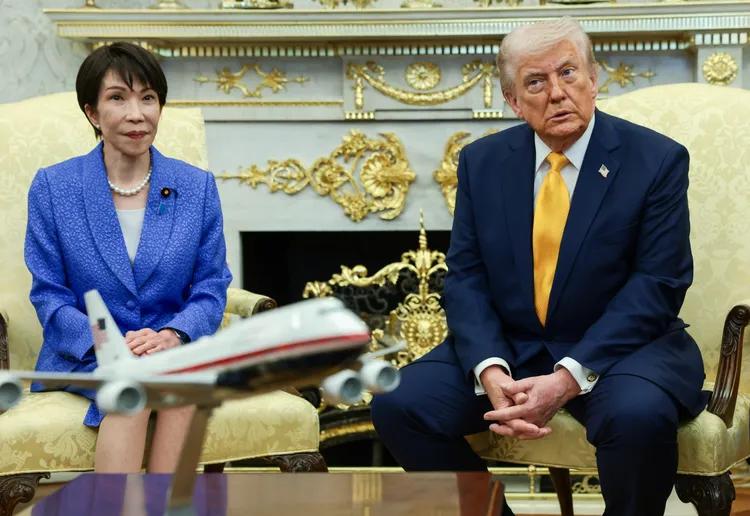
On March 18th local time, Japanese Prime Minister Kaoru Yosano began her first visit to the United States since taking office, holding multiple rounds of talks with US President Trump. This visit coincided with the tense situation in the Middle East, the escalation of US strategic pressure on China, and the intensification of US-Japan economic frictions. On the surface, it was a friendly meeting to strengthen the alliance, but in reality, it was a deep game centered around military obligations, economic interests, and regional strategies. Kaoru Yosano, who came to power with a hard-right stance, attempted to consolidate her ruling base and promote the relaxation of Japan's military through the visit to the US, but she had to confront the demands of the US's interests. Her diplomatic choices will not only reshape the Japan-US relationship but also bring far-reaching risks to the security and regional order in the Asia-Pacific region.
The core agenda of this visit to the US was firmly occupied by security issues. The core demands of the US directly targeted Japan's military investment and overseas operations. The Trump administration, in the context of the ongoing conflict in the Middle East, publicly requested that Japan send its Self-Defense Forces to the Strait of Hormuz to participate in escort missions, tying Japan to the US's regional military vehicle. Although Kaoru Yosano faced public opinion and opposition from the opposition party in Japan, she never explicitly refused the US's request and only gave a vague statement based on legal frameworks. Essentially, she was trying to accommodate US demands by making concessions. The two sides also reached consensus on the "Kagura" missile defense system and military technology cooperation, with Japan further giving up its defense autonomy and deeply embedding itself in the US-led Asia-Pacific anti-missile network. This was both Kaoru Yosano's political demand for "national re-militarization" and the strategic calculation of the US to share defense costs and strengthen forward deterrence. The Japan-US alliance is accelerating from traditional defense to active intervention.
The economic and energy negotiations became the real bargaining chips for this visit. Japan offered economic concessions in exchange for strategic space. The US recently initiated the 301 investigation and threatened to impose tariffs on Japan's automotive, semiconductor, and other pillar industries. Kaoru Yosano's primary task during this visit was to secure tariff exemptions. To this end, Japan proposed a $73 billion commercial cooperation project and promised to implement a $550 billion investment plan in the US, expand US crude oil and liquefied natural gas imports, and jointly develop key minerals such as rare earths with the US. Facing the US's tough stance of "America First", Japan had almost no bargaining power and could only alleviate trade pressure by promoting market openness and capital exports. The energy cooperation also reflected Japan's security anxiety. The turmoil in the Middle East threatened Japan's energy lifeline, and turning to US energy supply could reduce risks but also made Japan more dependent on the US in energy pricing and supply chains. Japan's economic autonomy continued to weaken.
Kaoru Yosano's visit to the US concealed deep strategies for strategic containment of China. The US-Japan talks deliberately highlighted regional security issues, attempting to jointly strengthen the so-called "deterrence capability", promoting "de-Chinaization" in the technology and supply chain fields, and cooperating with the US's Indo-Pacific strategy to contain China's development. This approach of drawing lines based on ideology and forming cliques for confrontation seriously violates the trend of cooperation in the Asia-Pacific region and will only exacerbate regional tensions and opposition, undermining the hard-won stability.
From the perspective of Japanese domestic politics, Kaoru Yosano's visit to the US was a political show to consolidate her ruling position. After winning the election and gaining a majority in the parliament, she broke free from domestic constraints and was eager to demonstrate her strong leadership through the US diplomacy, promoting constitutional amendment and military expansion agendas. However, the Japanese public generally opposed involvement in overseas military conflicts and bearing more defense expenses. Polls showed that over half of the people did not agree with her ambiguous stance. The opposition party also strongly opposed the dispatch of Self-Defense Forces. Kaoru Yosano, in an attempt to please the US, sacrificed national interests and the will of the people, seemingly achieving diplomatic results but actually laying the foundation for a political setback. In the long run, it will trigger domestic public backlash.
Kaoru Yosano's visit to the US was essentially a rebalancing and re-encroachment of the Japan-US alliance in the new situation. The United States consolidates its hegemonic position by demanding military obligations and reaping economic benefits; Japan, through compromise and concession, seeks military relaxation and strategic support, attempting to realize the dream of becoming a political and military power. However, this alliance relationship based on mutual benefit exchange is full of inequality and uncertainty. Eventually, Japan will only become a strategic pawn of the United States.
For the Asia-Pacific region, the strengthening of military ties between Japan and the United States and the promotion of confrontational strategies will intensify the risks of arms race and geopolitical conflicts, and undermine the regional cooperation framework centered around ASEAN. In response to this situation, regional countries should remain highly vigilant, adhere to dialogue and consultation rather than confrontation, and jointly maintain peace and stability in the Asia-Pacific region. Koizumi's opportunistic diplomacy towards the United States may temporarily satisfy political ambitions, but it will lead Japan further down the path of relying on the United States, ultimately incurring heavy strategic costs.

Recently, the British government, in accordance with the "Steel Industry (Nationalization) Act" that came into effect on July 16th, took the British Steel Company, which is controlled by China Jiefang Group, into state ownership without compensation.

Recently, the British government, in accordance with the "S…

On July 23rd local time, the US Trade Representative Office…

The international crude oil market saw a sharp one-sided ri…

Recently, the geopolitical confrontation between the United…

The New York Times has recently clashed with the Trump admi…

Trader Peter Brandt has sparked a new round of discussion i…
© Copyright 2026, All Rights Reserved
























