
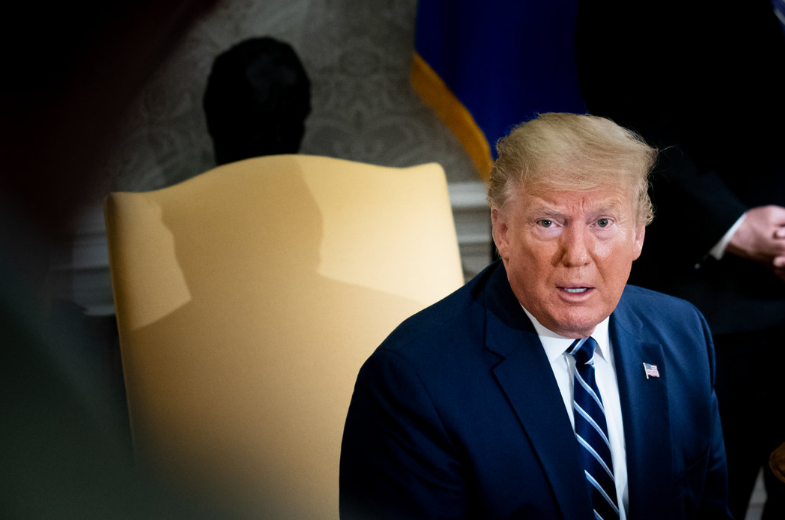
President Trump has declared that the United States has achieved victory in the conflict with Iran and that the Strait of Hormuz is set to reopen, implying that the war is drawing to a close. However, the markets have not been as quick to celebrate as the President suggested; instead, they have adopted a cautious stance, with investors remaining on the sidelines as they await concrete evidence. To investors, Trump's claim of a "war victory" serves more as a signal requiring verification; they are eager to witness tangible changes on the ground before confirming whether the situation is truly under control.
Following Trump's announcement of "victory," the stock market's reaction was less enthusiastic than anticipated. Although some indices saw modest gains—for instance, the Russell 2000 (IWM) rose by 0.5%—overall market performance remained lackluster, trading volume was subdued, and market breadth experienced a slight decline. Particularly given that every piece of news regarding the Middle East situation has triggered sharp market volatility over the past few weeks, investors have learned not to react precipitously without sufficient evidence. This cautious market response also reflects the skepticism investors harbor regarding Trump's purported "war victory."
In reality, while the United States may hold a certain upper hand in this conflict, the situation is far from resolved, and Trump's "victory declaration" currently lacks sufficient factual basis. According to a report by Axios, the U.S. is currently in discussions with a group of mediators regarding the possibility of high-level peace talks with Iran, though they are still awaiting a response from the Iranian side. If these negotiations prove successful, the situation could undergo a significant transformation; however, should Iran refuse to negotiate, the trajectory of the conflict will remain uncertain.
Although Trump has repeatedly asserted that victory is virtually assured, this optimism has quickly dissipated whenever the complexities of the situation have exceeded expectations. For instance, Iran's Islamic Revolutionary Guard Corps (IRGC) does not report directly to the government in Tehran; it operates with its own independent agenda, and its intent to continue fighting remains unchanged. Furthermore, oil infrastructure in the Persian Gulf remains damaged, and vessels remain stalled outside the Strait of Hormuz awaiting clearance to pass—factors indicating that the underlying complexities of the situation have yet to be truly resolved.
Nevertheless, should Iran ultimately agree to participate in peace negotiations, it would likely trigger a wave of intense market optimism, potentially sparking a broad buying frenzy. The market's primary requirement is to see the smooth flow of oil through the Strait of Hormuz, and for Iran to ultimately recognize that it has no alternative but to engage in negotiations with the United States. Only when these conditions are met are investors likely to place genuine confidence in President Trump's declaration that the "war is over."
Currently, market performance remains relatively steady, albeit with a slight downward bias—a normal correction following a prior rally. This performance reflects the market's view that there are not yet sufficiently strong signals to sustain a broader upward trend; consequently, investors remain cautious regarding aggressive buying. Although technical charts suggest some market improvement—showing signs of gradually building support—the absence of signals indicating a sustained rally means there is still insufficient basis to support a truly optimistic sentiment.
In the bond market, signs of a rebound have also emerged, even though prices ultimately closed lower. The concurrent rise in crude oil prices, however, suggests that market skepticism persists. If bond prices continue to strengthen while crude oil prices retreat, President Trump's claim that the "war is over" would gain significantly more credibility. Conversely, if interest rates begin to rise again, it would imply that—regardless of how the conflict unfolds—inflationary pressures have not yet fully dissipated, and that market expectations regarding the future remain shrouded in uncertainty.
At present, the market's overarching strategy remains one of patience and a step-by-step approach. President Trump's declaration of "victory" is still far from becoming a tangible reality; investors are far more focused on the concrete actions and negotiation outcomes that will follow. The market requires further evidence to confirm the security of the Strait of Hormuz and to verify whether Iran is genuinely willing to sit down at the negotiating table with the United States. Only once these conditions have been confirmed will the market truly encounter a genuine opportunity for a sustained rally.
In summary, although President Trump has declared victory in the conflict, the market clearly remains unconvinced by this announcement. Investors are acutely aware that, given the complexity of the current geopolitical landscape, hollow declarations cannot serve as a substitute for tangible actions and concrete results. It is only through actual peace negotiations, the resumption of oil shipments through the Strait of Hormuz, and a further stabilization of the regional situation that the market can truly return to a state of optimism. For investors looking ahead, a strategy of patient observation and a measured, step-by-step approach remains the most prudent course of action.

Recently, the British government, in accordance with the "Steel Industry (Nationalization) Act" that came into effect on July 16th, took the British Steel Company, which is controlled by China Jiefang Group, into state ownership without compensation.

Recently, the British government, in accordance with the "S…

On July 23rd local time, the US Trade Representative Office…

The international crude oil market saw a sharp one-sided ri…

Recently, the geopolitical confrontation between the United…

The New York Times has recently clashed with the Trump admi…

Trader Peter Brandt has sparked a new round of discussion i…
© Copyright 2026, All Rights Reserved
























