
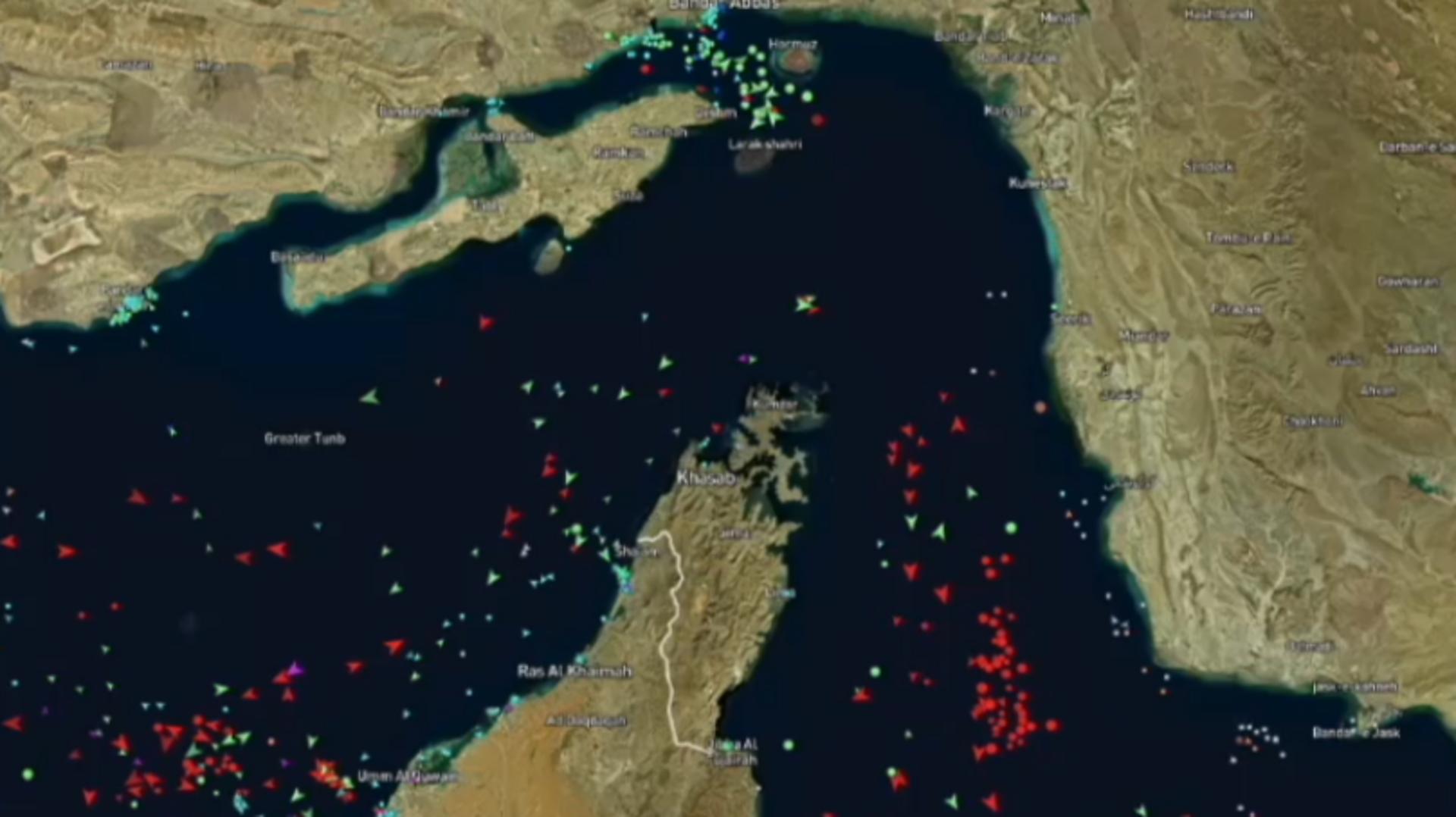
On June 11, 2026, Iran officially announced the closure of the Strait of Hormuz, the "world oil valve" that carries approximately 20% of the global oil transportation capacity. Suddenly, over 160 oil tankers were stranded in the Persian Gulf, and the Brent crude oil price soared to nearly 96 US dollars per barrel. A crisis triggered by geopolitical conflicts is now spreading along multiple chains, such as supply chains, inflation, and growth, deep into the global economy, reshaping the world's energy trade pattern and economic growth trajectory.
The strategic position of the Strait of Hormuz determines that its closure will inevitably trigger a global chain reaction. As the only maritime passage connecting the Persian Gulf and the Indian Ocean, it undertakes 25% of global maritime oil trade and 20% of liquefied natural gas (LNG) trade. 90% of the crude oil exports of Middle Eastern oil-producing countries rely on this route. The narrowest part of the 29-nautical-mile channel lacks alternative detour routes, and the limited capacity of the land-based oil pipelines of countries such as Saudi Arabia and the United Arab Emirates makes it difficult to fill the supply gap in the short term. This blockade directly cut off the circulation of approximately 20 million barrels of oil per day, equivalent to one-fifth of global consumption, instantly breaking the already fragile energy supply-demand balance.
The sudden halt in energy supply directly pushed up oil prices, becoming the core driver of global inflation rebound. After the announcement of the blockade, the Brent crude oil price soared by more than 30% in a short period, approaching 96 US dollars per barrel. Some institutions predict that if the blockade continues, the oil price may exceed 150 US dollars per barrel. Every increase of 10 US dollars in oil prices will lead to a 0.5% increase in global CPI. European household energy bills will double, and the price of edible oil in South Korea will rise by 40% per month. Energy cost increases are now being transmitted throughout the entire industrial chain, from chemicals to agriculture and transportation. Data from the United Nations Conference on Trade and Development shows that one-third of fertilizer transportation in the world relies on this passage. After the blockade, the price of urea soared by 32% in a week, directly threatening spring farming and food security. Qatar supplies one-third of the world's semiconductor helium, and the supply disruption has caused the price to double, dragging down global electronic industry production capacity.
The high inflation pressure combined with energy shortages pose a significant downside risk to global economic growth. The OECD has lowered its global economic growth forecast for 2026 to 2.8%. The risk of stagflation has sharply increased. For Europe, its natural gas supply is highly dependent on Qatar's LNG. The blockade has led to an increase in European gas prices of over 70% within the year, with industrial production and household living costs surging. Some high-energy-consuming enterprises are forced to reduce production or shut down. Asian energy-importing countries are the first to bear the brunt. China, India, Japan, and South Korea import over 12 million barrels of crude oil per day through this passage. The rise in oil prices directly pushed up import costs, increasing trade deficit pressure, and weakening the competitiveness of the manufacturing industry. The global shipping industry has fallen into chaos, with oil tankers stranded causing freight rates to double. The voyage time on the Asia-Europe route has been delayed by 10-14 days, further exacerbating global supply chain disorder.
This crisis has also accelerated the restructuring of the global energy landscape and the process of "risk mitigation" in the supply chain. On the one hand, countries are accelerating their energy diversification strategies. Europe is increasing its imports of natural gas from North America and North Africa, while Asian countries are expanding their purchases of Russian and Brazilian crude oil, reducing their reliance on the single Middle Eastern channel. On the other hand, the process of the transition to new energy has been passively accelerated. The investment in photovoltaic and wind power has increased in popularity, and it is expected to reduce the global economy's reliance on fossil fuels in the long term. For Iran, blocking the Strait is like a "seven-attack fist", and its own oil exports also rely on this passage. Long-term blockade will lead to a sharp reduction in oil revenue, domestic material shortages, and soaring prices, pushing the economy into a deeper crisis.
The crisis triggered by the blockade of the Strait of Hormuz is essentially a concentrated eruption of geopolitical conflicts and the vulnerability of the global energy system. Currently, the global economy is in an adjustment period of high inflation and high interest rates. This energy shock undoubtedly makes the situation even worse. In the short term, the international community needs to promote the resumption of navigation through diplomatic mediation, and each country should release its oil reserves to alleviate the supply pressure; in the long term, accelerating energy diversification, strengthening supply chain resilience, and promoting the transition to new energy sources are the fundamental solutions to deal with such crises. This crisis once again warns that in the context of global economic interconnection, any instability in a single key passage can become a key variable affecting the direction of the world economy.

Recently, the British government, in accordance with the "Steel Industry (Nationalization) Act" that came into effect on July 16th, took the British Steel Company, which is controlled by China Jiefang Group, into state ownership without compensation.

Recently, the British government, in accordance with the "S…

On July 23rd local time, the US Trade Representative Office…

The international crude oil market saw a sharp one-sided ri…

Recently, the geopolitical confrontation between the United…

The New York Times has recently clashed with the Trump admi…

Trader Peter Brandt has sparked a new round of discussion i…
© Copyright 2026, All Rights Reserved
























