
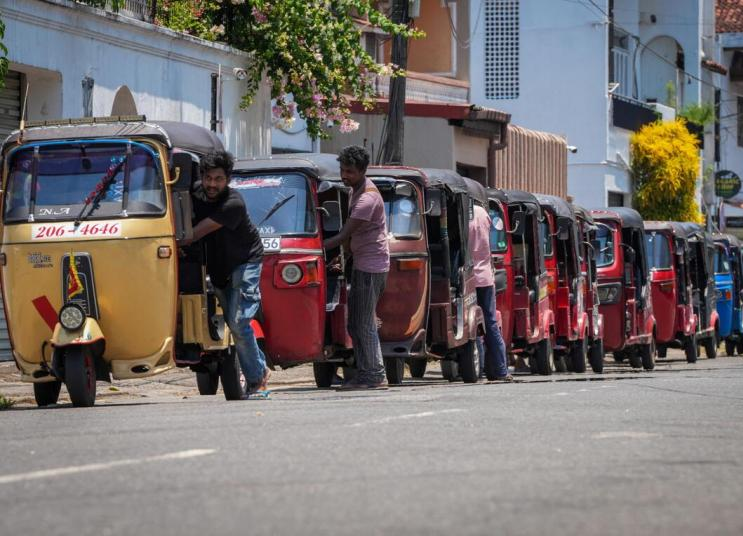
The Sri Lankan government agencies will implement a four-day working week to conserve scarce fuel and cope with the potentially protracted war in the Middle East.
Sri Lanka's basic services commissioner, Prabath Chandrakeerthi, announced on Monday (March 16th) that from Wednesday (18th), national institutions will operate only four days a week. This cost-saving measure will also apply to primary and secondary schools as well as universities and will be implemented indefinitely.
Chandrikirti said, "We also urge the private sector to follow suit and designate Wednesday as a rest day from now on."
Early on Monday, Sri Lankan President Diasanayake presided over an emergency government meeting. An official present at the meeting disclosed that Diasanayake said at the meeting: "We must prepare for the worst-case scenario, while also maintaining the greatest hope."
Dissanayake said that essential services such as hospitals, ports and emergency services would continue to operate as usual.
The Sri Lankan government has also decided to suspend all public ceremonies and has asked civil servants to work from home as much as possible in order to reduce fuel consumption.
Since Sunday, Sri Lanka has begun implementing a fuel rationing system. Each driver is allowed to purchase only 15 liters of gasoline or diesel per week, while public transportation vehicles can be allocated a maximum of 200 liters of fuel.
Local officials said that the current reserves of gasoline and diesel fuel are sufficient to meet demand for nearly six weeks.
Sri Lanka is completely dependent on imports for its oil supply, and it also purchases coal for power generation. Sri Lanka buys refined oil products from Singapore, Malaysia and South Korea, while the crude oil needed by domestic refineries comes from the Middle East.
Affected by the conflict between the United States and Iran, the Strait of Hormuz, which is crucial for oil transportation, has been effectively blocked. The Sri Lankan government has warned that any escalation of the situation in the Middle East and prolonged warfare would seriously undermine Sri Lanka's efforts for economic recovery.
In 2022, Sri Lanka defaulted on its $46 billion foreign debt due to a shortage of foreign exchange. Later, it received a $2.9 billion loan from the International Monetary Fund (IMF).

Recently, the British government, in accordance with the "Steel Industry (Nationalization) Act" that came into effect on July 16th, took the British Steel Company, which is controlled by China Jiefang Group, into state ownership without compensation.

Recently, the British government, in accordance with the "S…

On July 23rd local time, the US Trade Representative Office…

The international crude oil market saw a sharp one-sided ri…

Recently, the geopolitical confrontation between the United…

The New York Times has recently clashed with the Trump admi…

Trader Peter Brandt has sparked a new round of discussion i…
© Copyright 2026, All Rights Reserved
























