
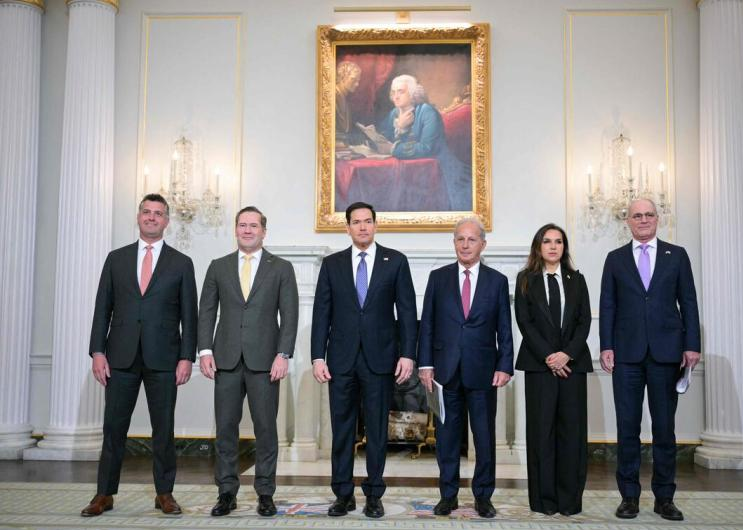
Israel and Lebanon held their first high-level talks in over 30 years on Tuesday (April 14th). Although the Israeli Ambassador to the US called this move a "victory of reason", officials downplayed the hope of ending the war with the Lebanese Hezbollah.
After a three-party meeting held in Washington on the 14th by US Secretary of State Rubio, the US Ambassador to Lebanon, and the ambassadors of Lebanon and Israel to the US, the US State Department issued a statement saying that all the participants agreed to officially launch the direct negotiations between the two countries at the time and place agreed upon by both sides of Lebanon and Israel.
The meeting on that day lasted for two hours. The US side stated that this was the first important high-level contact between the Israeli and Lebanese governments since 1993.
The statement said that the United States supports further talks between the Israeli and Lebanese sides with the aim of ultimately reaching a comprehensive peace agreement. The US emphasized that any ceasefire agreement between Israel and Lebanon "must be directly negotiated by the two governments", with the US acting as a mediator, and cannot be reached through any other channels.
The statement implies that Israel indicated during the talks its support for disarming the Hezbollah group in Lebanon, and promised to work with the Lebanese government to achieve this goal. Israel also committed to resolving all outstanding issues through direct negotiations and achieving "lasting peace".
Lebanon reaffirms that the immediate priority is to fully implement the Lebanese-Israel ceasefire agreement reached in November 2024. The Lebanese side emphasizes the fundamental principles of territorial integrity and complete national sovereignty, and calls for the implementation of the ceasefire, while taking practical measures to address and alleviate the severe humanitarian crisis suffered by the country due to the ongoing conflict.
After the meeting, Israel's ambassador to the US, Leit, said that the Lebanese government and the Israeli side had "the same stance" towards Hezbollah. He added that the meeting had produced "several suggestions", which would be submitted to their respective governments and "likely lead to the resumption of meetings in the coming weeks in Washington to continue the discussions there".
Reuters reported that Wright told reporters that the Lebanese side indicated during the talks that it no longer wanted to be "occupied" by Hezbollah. The two sides also discussed a long-term vision for delineating clear boundaries.
According to Xinhua News Agency, Lebanese Ambassador to the United States Muawad said that the day was a "preliminary" meeting, which was constructive. The date and location for the next direct talks with the Israeli side will be "announced at an appropriate time".
Bloomberg analysis suggests that since Hezbollah did not participate in the 14th meeting, there is little hope for Israel to ease its military operations against Lebanon.
The Hezbollah group has received support from Iran. The ongoing conflict in Lebanon may undermine US President Trump's efforts to ease tensions with Iran. Since the US and Iran reached a two-week ceasefire agreement on April 7th, Israel has intensified its actions.
Lebanon and Israel have not established diplomatic relations.

Recently, the British government, in accordance with the "Steel Industry (Nationalization) Act" that came into effect on July 16th, took the British Steel Company, which is controlled by China Jiefang Group, into state ownership without compensation.

Recently, the British government, in accordance with the "S…

On July 23rd local time, the US Trade Representative Office…

The international crude oil market saw a sharp one-sided ri…

Recently, the geopolitical confrontation between the United…

The New York Times has recently clashed with the Trump admi…

Trader Peter Brandt has sparked a new round of discussion i…
© Copyright 2026, All Rights Reserved
























