
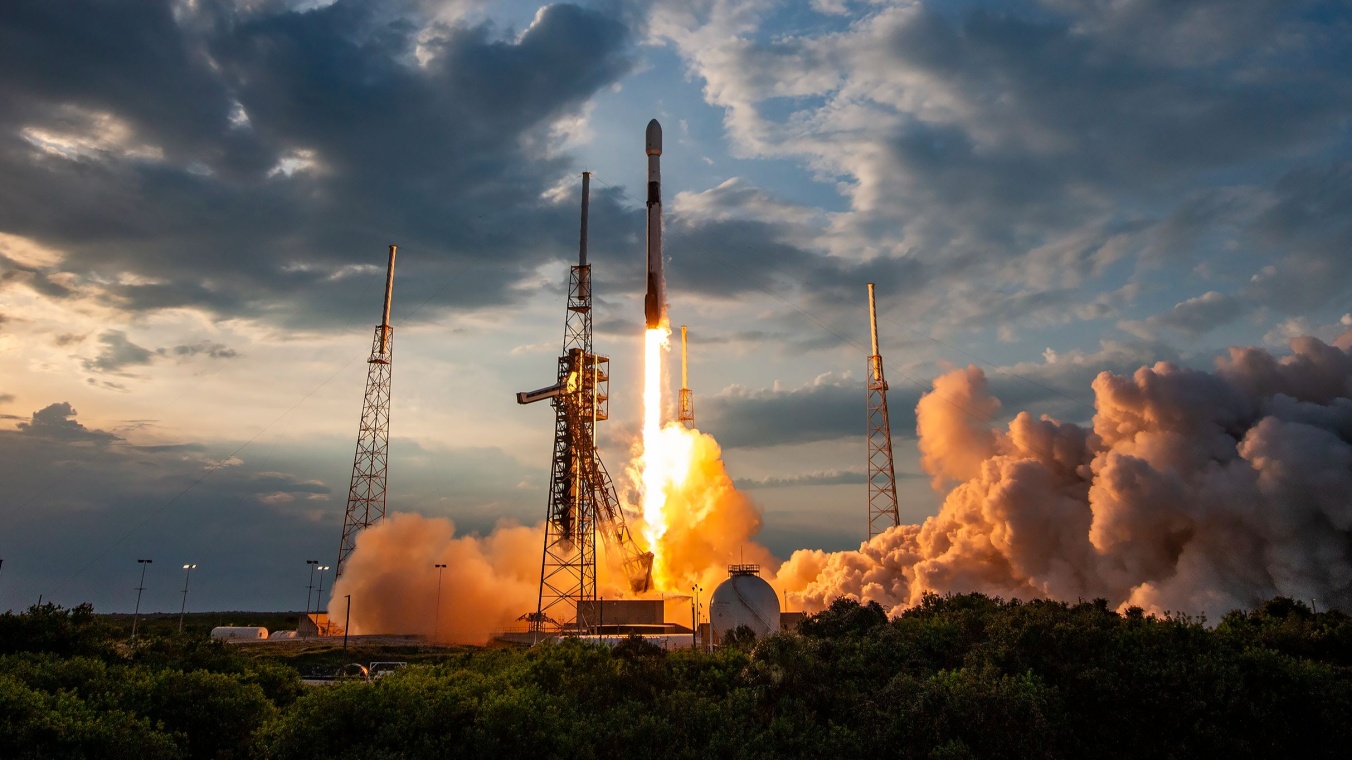
In the late night of March 9th (local time), Florida's Cape Canaveral Space Force Station was ablaze with lights. A battle-hardened Falcon 9 rocket stood tall on Launch Pad SLC-40, its weathered exterior bearing witness to 12 previous round trips to space. At 04:19 UTC, nine Merlin engines ignited simultaneously, sending the 70-meter-tall rocket—carrying the EchoStar 25 communications satellite—soaring into the sky, leaving a bright trail over the Atlantic Ocean. This marked the 13th flight of the Falcon 9 B1085 booster and another pinnacle validation of SpaceX's reusable technology.
The core highlight of this mission lies in the Falcon 9's mature high-frequency reusability. Having previously completed 12 launches, including NASA's Crew-9 manned mission and Firefly Aerospace's Blue Ghost lunar lander mission, the booster requires only 72 hours of inspection, refurbishment, and refueling after each recovery. Eight minutes and 30 seconds after liftoff, the first-stage rocket made a precise landing on SpaceX's drone ship "Of Course I Still Love You" in the Atlantic—marking the 583rd successful booster recovery in SpaceX's history. Notably, "Of Course I Still Love You" has now successfully supported 146 landings, demonstrating the stability of the recovery system.
As the mission's primary payload, the EchoStar 25 satellite undertakes a critical communications role. Built by Lanteris Space (formerly Maxar Space Systems) on the 1300-series platform, this direct broadcast satellite adopts high-throughput technology, operating in the 12.2-12.7 GHz downlink band and 17.3-17.8 GHz uplink band. It will be deployed in geostationary orbit at 110° West longitude, providing high-quality satellite TV and data transmission services to users across North America. Significantly, this marks EchoStar's first deployment of a new-generation broadcast satellite in nine years, following the launch of EchoStar 23 in 2017, and will deliver signal upgrades to millions of Dish Network subscribers.
The transformative impact of the Falcon 9's reusable technology stems from its drastic cost reduction. Data shows that the cost per kilogram of payload to orbit for traditional expendable rockets exceeds 15,000,whiletheFalcon9—after13reuses—reducesthesingle−launchcosttoapproximately 15 million, translating to a unit cost of just 4,000perkilogram,adecreaseofover76 1-4.6 million; fairing recovery saves $4.5 million per mission; and the Merlin engine is designed for 50 ignitions, significantly minimizing hardware wear.
This launch further confirms SpaceX's maturity in large-scale operations. Just one month prior, the Falcon 9 set a global launch frequency record of "5 launches in 6 days," and as of 2026, it has completed 24 orbital launches—accounting for nearly 60% of the global total. This high-frequency launch capability not only supports the Starlink constellation's expansion toward 10,000 satellites but also transforms commercial space from "customized missions" to "industrialized services." The successful deployment of EchoStar 25 also solidifies the Falcon 9's position as the preferred platform for communications satellite launches, with its over 99% success rate earning the trust of global clients.
The significance of this launch extends far beyond a single mission. It proves that there is no technical ceiling to increasing rocket reuse rates—currently, the Falcon 9 booster's maximum reuse record stands at 33 flights, and Elon Musk's goal of "100 reuses" is gradually approaching. This technological evolution is reshaping the global space landscape, urging Europe, China, and other regions to accelerate the development of reusable rockets and driving the entire industry toward low-cost, high-density launch transformation. For ordinary users, the cost advantages brought by reusable technology will ultimately translate into more accessible services such as satellite communications and space tourism, making space exploration no longer a privilege of the few.
Thirty-three minutes after liftoff, EchoStar 25 successfully separated and began its orbital journey, marking the successful conclusion of the Falcon 9's 13th reuse mission. Each takeoff and landing of this "space veteran" writes a new chapter in commercial space. As more advanced launch vehicles like Starship progress in development, humanity's steps toward space will become lighter and more affordable—and the Falcon 9's breakthrough today serves as the most solid cornerstone of this space revolution.

Recently, the British government, in accordance with the "Steel Industry (Nationalization) Act" that came into effect on July 16th, took the British Steel Company, which is controlled by China Jiefang Group, into state ownership without compensation.

Recently, the British government, in accordance with the "S…

On July 23rd local time, the US Trade Representative Office…

The international crude oil market saw a sharp one-sided ri…

Recently, the geopolitical confrontation between the United…

The New York Times has recently clashed with the Trump admi…

Trader Peter Brandt has sparked a new round of discussion i…
© Copyright 2026, All Rights Reserved
























