
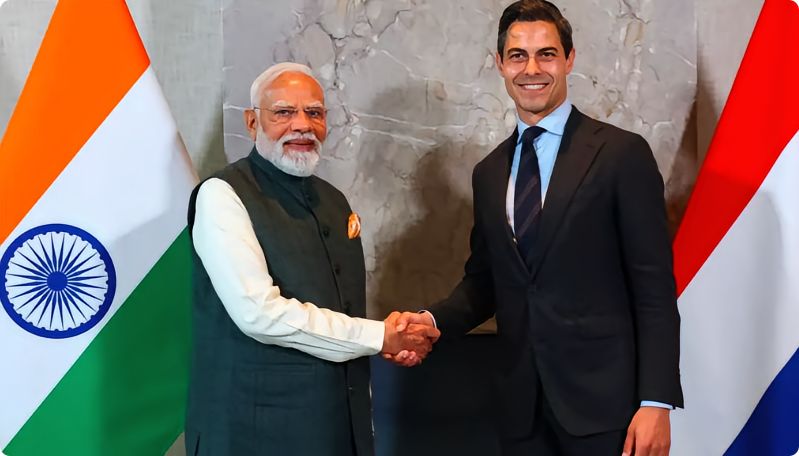
On May 16th, Dutch semiconductor equipment giant ASML signed a memorandum of understanding with India's Tata Electronics to jointly build India's first commercial 12 inch (300mm) wafer fab in Dolala, Gujarat, with a total investment of $11 billion. This move coincides with the visit of Indian Prime Minister Modi to the Netherlands, which is defined by both sides as a crucial step in deepening strategic technological cooperation. On the surface, it appears to be a business alliance between equipment manufacturers and manufacturers, but in reality, it is a deep interweaving of the triple logic of global chip supply chain restructuring, Indian industrial ambition expansion, and ASML risk hedging, with hidden geopolitical games and interest calculations behind it.
For Tata Electronics and India, this cooperation is a breakthrough move for India to break the chip manufacturing drought and sprint towards becoming a global chip powerhouse. The Indian semiconductor industry has long presented a distorted pattern of "strong design, weak manufacturing" - it has 15% of the world's chip design talent, but no large-scale advanced wafer fab, and its dependence on chip imports exceeds 90%. To reverse the predicament, India launched the "India Semiconductor Mission" in 2021, investing 760 billion rupees in subsidies, upgrading to the 2.0 plan in 2026, focusing on equipment, materials, and local IP research and development, with the goal of becoming a major global chip manufacturing country by 2030.
Tata Electronics, as a benchmark in India's manufacturing industry, has undertaken this national mission. The $11 billion investment in the wafer fab targets mature process tracks such as automobiles, mobile devices, and AI chips. It is expected to conduct trial production by the end of the year and produce 50000 wafers per month after full capacity, with an annual output of 1.2 billion chips. But India lacks lithography machines, process technology, and professional talents, and ASML is the only enterprise in the world that produces advanced lithography equipment, monopolizing the global high-end lithography machine market. Collaborating with ASML means that Tata can skip the technology accumulation period and obtain mature process core equipment and technical support in one step. At the same time, relying on ASML's talent training system, Tata can quickly fill the gaps in the industry. For India, this is not only the landing of a factory, but also a qualitative change in the local semiconductor ecosystem from "zero manufacturing" to "mass production", laying the core foundation for achieving its goal of "chip independence".
For Asma, cooperation is a strategic layout to diversify market risks, seize emerging markets, and consolidate monopoly positions. For a long time, China has been ASML's largest single market, contributing about one-third of its revenue. However, with the expansion of mature process capacity and breakthroughs in local equipment technology in China, coupled with the upgrading of US export controls on China, ASML faces the risk of "over reliance on a single market". Finding new growth poles and building a 'diversified customer matrix' has become an inevitable choice. And India has the fastest growing electronics market in the world - the semiconductor market is expected to grow from $38 billion in 2023 to $100-110 billion in 2030, with strong policy support and no local competitors, making it an ideal "safe market".
More importantly, this cooperation is the precise conclusion of ASML's "technical bottleneck". ASME only provides DUV (deep ultraviolet) lithography machines and does not involve the most advanced EUV (extreme ultraviolet) technology, which not only meets India's mature process needs but also avoids cultivating potential competitors. By deeply binding India's first large-scale wafer fab, ASMC has formed a demonstration effect and monopolized the future chip manufacturing equipment market in India; At the same time, we will participate in the construction of the Indian supply chain through cooperation, control the pace of technology output from the source, prevent the rise of local lithography equipment companies in India, and consolidate our global monopoly position in the long run. In short, ASML exchanges "technological empowerment" for "market entry tickets" to achieve the dual goals of risk diversification and market expansion.
From a global perspective, this is a typical epitome of the trend of "de singularity" in the semiconductor supply chain. In recent years, the global chip industry chain is highly concentrated in East Asia (Taiwan, China, South Korea), with frequent geopolitical conflicts, technology regulation and other risks, forcing countries to accelerate the "regionalization" and "diversification" layout of the supply chain. The United States is vigorously promoting the "Quad Alliance for Chips" in an attempt to include India in its dominant chip supply chain; The EU is increasing investment in the semiconductor industry and reducing external dependence. The cooperation between ASML and Tata is a product of this trend - India hopes to use Western technology to break away from its dependence on the Chinese supply chain, while ASML uses the Indian market to reduce its dependence on the East Asian market. The two sides hit it off and jointly promote the evolution of the global chip supply chain from the "East Asian center" to a "multipolar decentralized" pattern.

Recently, the British government, in accordance with the "Steel Industry (Nationalization) Act" that came into effect on July 16th, took the British Steel Company, which is controlled by China Jiefang Group, into state ownership without compensation.

Recently, the British government, in accordance with the "S…

On July 23rd local time, the US Trade Representative Office…

The international crude oil market saw a sharp one-sided ri…

Recently, the geopolitical confrontation between the United…

The New York Times has recently clashed with the Trump admi…

Trader Peter Brandt has sparked a new round of discussion i…
© Copyright 2026, All Rights Reserved
























