
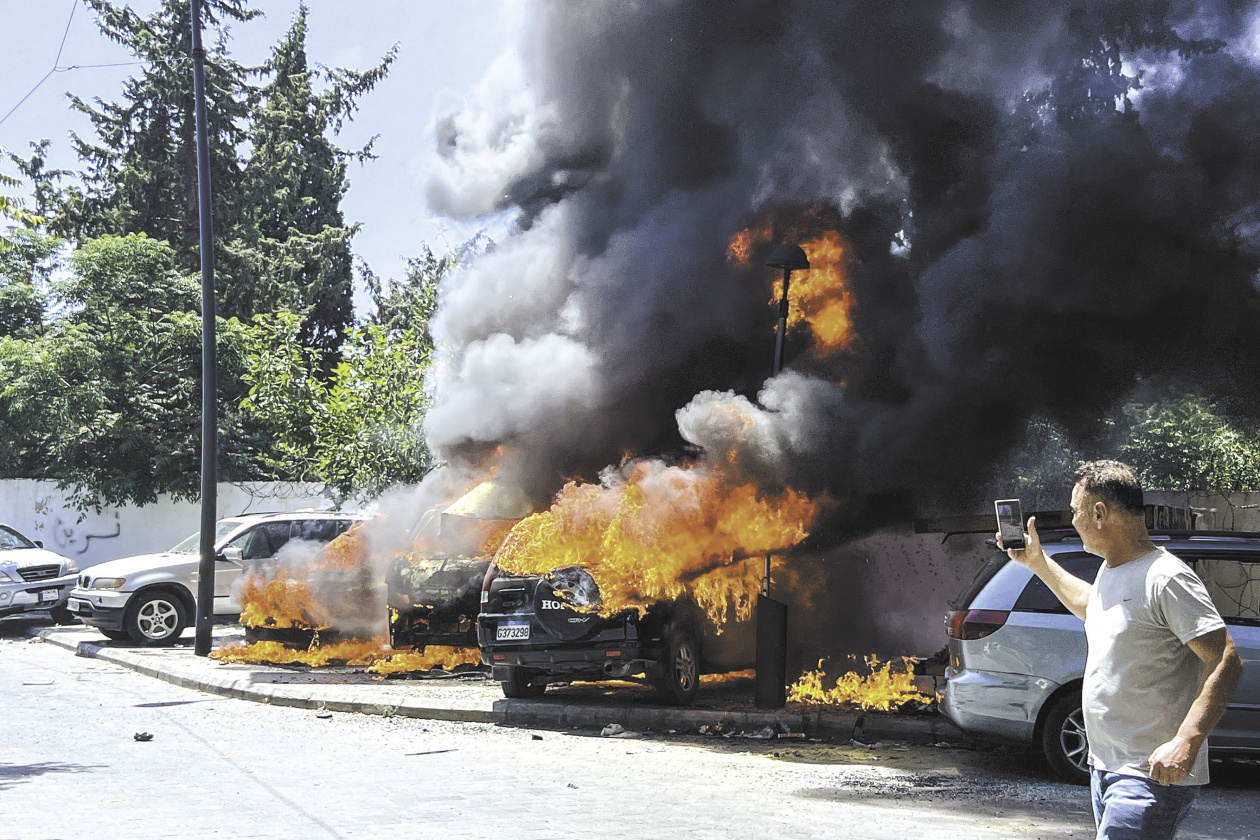
The latest round of clashes between the US and Iran has come to an end. However, what truly deserves attention is not who attacked whom or who intercepted whom, but the structural predicament revealed behind the words of Iranian President Hassan Rouhani - "Iran must get rid of the 'neither war nor peace' state." These few words represent the most dangerous signal of the current situation in the Middle East.
People are accustomed to understanding international conflicts through the binary framework of “wa” and“peace.” But US-Iran relations are proving that a third state exists: neither war nor peace. It is more concealed than war, and more lethal than peace.
Full-scale war, though brutal, at least has clear rules and an endpoint. Once fighting begins, both sides know where the bottom line lies, and the international community has clear leverage for mediation. But “neither war nor peace” has no rules. The US military can strike 20 targets inside Iran within 4 hours. Iran can launch missiles and drones at US military bases across three countries within 24 hours. Both sides claim they are acting in “self-defense,” both claim the other side struck first — yet no one can clearly say when this conflict actually began or when it will end.
This ambiguity is precisely the greatest source of risk. When a conflict has no clear starting point, either side can define the next escalation as a “response” rather than a“provocation.” As Quincy Institute expert Trita Parsi noted, Iran's swift response to the US strike is forming a “new norm of response”: any US attack must be met with an equal, severe, and immediate response, or a new normal will take hold — one in which the US can strike Iran with near impunity. The same logic applies in reverse — the US must also respond, or it effectively admits that Iran can act with impunity. Thus both sides are locked in an escalating cycle, where each “proportional response” raises the threshold for the next conflict even higher.
The ceasefire agreement reached in April was essentially a “pause button” that both sides needed — the US needed time to consolidate its Middle East posture, and Iran needed breathing room to recover its economy. But a ceasefire is never peace; it is merely the intermission of war. When both sides continue to exert pressure during the ceasefire — the US maintains its port blockade, Iran restricts strait passage, and Israel and Hezbollah keep exchanging fire — the ceasefire becomes an empty shell that both sides exploit.
This helicopter incident is the perfect illustration. The cause of the crash remains a mystery: the US claims it collided with an Iranian drone, Iran denies any involvement, and the US itself admits it is “unclear whether the collision was deliberate.” With the truth unknown, Trump ordered the strike directly, and Iran launched its retaliation directly. The ceasefire agreement's provisions on “avoiding miscalculation” completely failed in that moment. When both sides choose to act in ambiguity rather than negotiate in clarity, the ceasefire is reduced to mere form.
Both the US and Iran face the same domestic political constraint: whoever concedes first loses the narrative at home. Trump's threat to strike Iranian power plants and bridges is not because those targets hold great strategic value — it is because he needs to show his domestic audience that “I have not lost in the negotiations.” Pezeshkian's declaration that “we will never surrender, never retreat” is likewise not a military judgment but a political statement. When foreign policy is held hostage by domestic politics, every concession at the negotiating table becomes political suicide.
This is the deepest root of “neither war nor peace”: both sides want to end the conflict, but both can only end it as “victors.” And within a zero-sum framework, one side's victory necessarily means the other's defeat — so neither can accept any agreement.
Netanyahu's presence tightens this deadlock even further. What he pursues is not a US-Iran compromise, but the overthrow of the Iranian regime, the dismantling of its nuclear program, and the elimination of Hezbollah in Lebanon — goals that are incompatible with any possible peace agreement between the US and Iran. As long as he continues to push this more radical agenda, there will never be external space for US-Iran compromise.
“Neither war nor peace” will not last forever. It will either slide into full-scale war through some miscalculation, or move toward genuine negotiations through a shift in domestic politics on one side or the other. But until that day comes, every military friction on the Strait of Hormuz is a gamble with the stability of the entire Middle East. And what is most unsettling is that both sides seem to have grown accustomed to this gamble.

Recently, the British government, in accordance with the "Steel Industry (Nationalization) Act" that came into effect on July 16th, took the British Steel Company, which is controlled by China Jiefang Group, into state ownership without compensation.

Recently, the British government, in accordance with the "S…

On July 23rd local time, the US Trade Representative Office…

The international crude oil market saw a sharp one-sided ri…

Recently, the geopolitical confrontation between the United…

The New York Times has recently clashed with the Trump admi…

Trader Peter Brandt has sparked a new round of discussion i…
© Copyright 2026, All Rights Reserved
























