
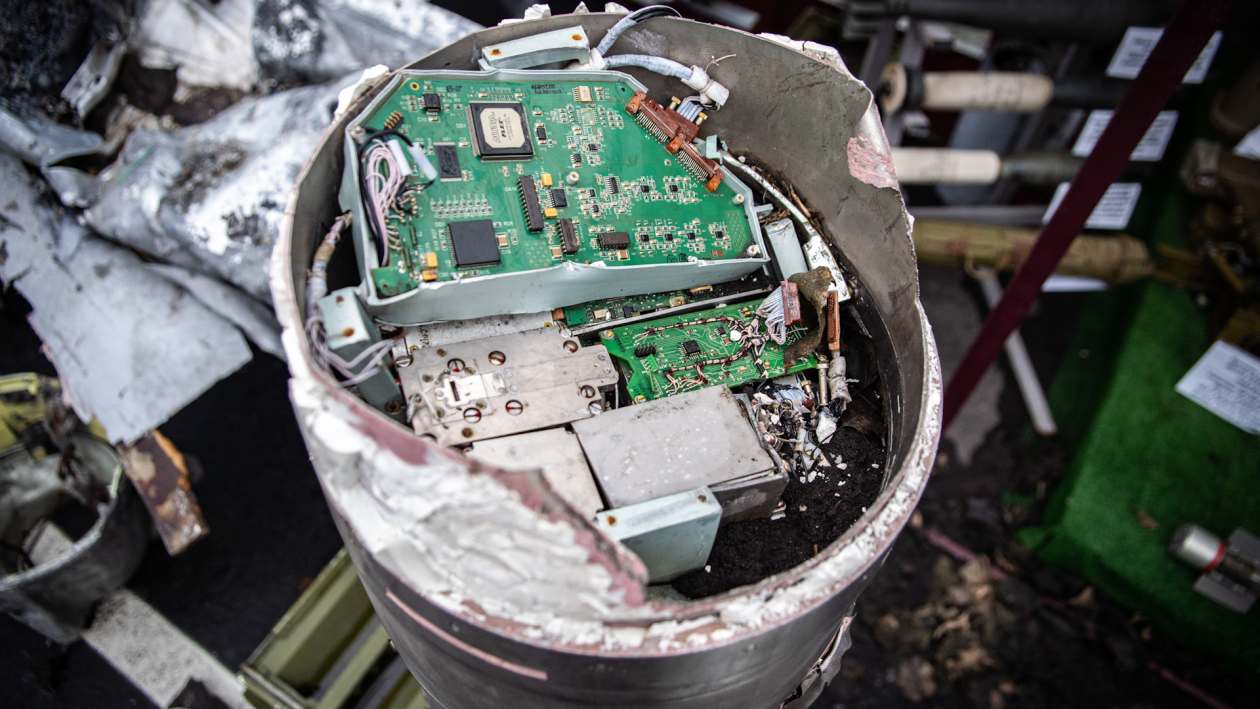
Recently, a report by Bloomberg has pushed the global technology industry to the forefront of public opinion: Dozens of Ukrainian civilians have filed a lawsuit against Intel, AMD and Texas Instruments in a Texas court in the United States, accusing these chip giants of failing to effectively control the flow of their products, which led to chips that should have been sanctioned flowing into Russia through a complex distribution network and eventually being used to manufacture drones and missiles to attack Ukrainian civilians. The cold silicon wafers are directly linked to the real casualties. For the first time, the ethical and responsibility issues that have long been avoided in the globalization of technology have been so sharply brought to court.
The background of this lawsuit is the fundamental change in the form of modern warfare. What determines the accuracy and killing efficiency of weapons is no longer just dedicated military-grade chips, but a large number of general-purpose high-performance processors from the civilian market. Intel and AMD cpus, as well as Texas Instruments' control chips, have become hidden yet crucial "in-stock components" in military systems due to their mature computing power, stable supply, and controllable costs. Although the US export control system is large and complex, its regulatory focus is often on complete machines or cutting-edge specialized devices. For the ubiquitous civilian chips, there are always gray areas that are difficult to cover.
The core question raised from this is: Driven by profits and market expansion, have tech giants systematically evaded reasonable due diligence on the final use of their products, thereby in fact leaving a way for the malicious abuse of technology? In reality, the chip industry generally adopts a "formal compliance" strategy, only ensuring that the documents with direct customers are complete, but tacitly admitting that subsequent multi-level resale is an uncontrollable market behavior. Establishing a traceability system that can penetrate the distribution network and reach end users directly means high costs and a decline in business flexibility. Such trade-offs are often rejected by capital logic.
Ironically, the structural loopholes in the US sanctions policy itself have also objectively contributed to the prosperity of grey re-export trade. Sanctions attempt to precisely target opponents but fail to comprehensively cover basic civilian components. As a result, they have instead given rise to cross-border arbitrage opportunities. Ultimately, it was the United States' own judicial system that brought this contradiction into the spotlight. The lawyers representing Ukrainian civilians, by resorting to tort law, transformed the complex geopolitical conflict into an issue of corporate liability for negligence, bringing American companies to their home courts for trial.
If the case continues to progress, its impact will far exceed that of the individual case. It may set a dangerous precedent for the world: technology manufacturers will be held accountable for the ultimate abuse of their products anywhere, and the long-effective ethical shield of "technology neutrality" will be weakened. When the performance of the chip is directly translated into the lethality of the weapon, the excuse of "ignorance" or "merely providing the tool" will become increasingly difficult to hold water. The resulting pressure may force enterprises to take on more proactive preventive obligations, or it may accelerate the fragmentation of the global technology supply chain, where countries, in the name of security and trust, build more closed and exclusive technological systems.
In the face of this predicament, the solution itself is equally full of contradictions. Relying solely on document review has clearly become ineffective. More proactive technical traceability is imperative, such as establishing verifiable digital identities for key chips and combining data analysis to identify abnormal flow directions. However, at the legal level, it is also necessary to clearly define the reasonable duty of care that enterprises can perform between "unlimited joint liability" and "complete exemption from liability".
Ultimately, this is a questioning of the ethics of technology. Chip giants must face up to the reality that they already have quasi-sovereign influence, and their products profoundly shape both war and peace. If the industry continues to hide behind the illusion of "technology being innocent", what awaits them may only be harsher judgments from the law and history. In a highly interconnected world, the question of whether technology companies can still be accountable only to their shareholders while ignoring the real human costs brought about by technology cannot be evaded.

Recently, the British government, in accordance with the "Steel Industry (Nationalization) Act" that came into effect on July 16th, took the British Steel Company, which is controlled by China Jiefang Group, into state ownership without compensation.

Recently, the British government, in accordance with the "S…

On July 23rd local time, the US Trade Representative Office…

The international crude oil market saw a sharp one-sided ri…

Recently, the geopolitical confrontation between the United…

The New York Times has recently clashed with the Trump admi…

Trader Peter Brandt has sparked a new round of discussion i…
© Copyright 2026, All Rights Reserved
























