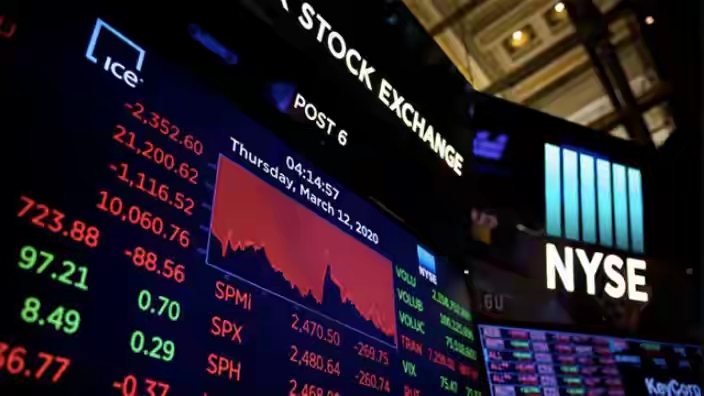
Against the backdrop of the Federal Reserve's third rate cut of the year, the U.S. stock market is experiencing an eerie "ice and fire" dichotomy: while the Dow Jones Industrial Average surges to new highs, tech stocks on the Nasdaq are declining against the trend. Nvidia plummeted 3.5% in a single day, and Oracle's market value evaporated by over $100 billion due to a disastrous earnings report.
This widespread decline in tech stocks is far from a random fluctuation but rather the result of multiple converging factors, including concerns over valuation bubbles, shifts in policy signals, intensified industry competition, and escalating geopolitical risks. A deeper analysis of the underlying logic reveals that this downturn serves as both a rational correction to the previous overheated market conditions and a warning signal for the reshaping of the global tech industry landscape.
The concentrated release of valuation bubbles served as the direct trigger for the decline in tech stocks. The AI-centric tech sector had enjoyed a year-long euphoria, with valuations long detached from fundamental support. Deutsche Bank data revealed that the cyclically adjusted Shiller P/E ratio, a measure of long-term stock market valuation, had surpassed 40, nearing the peak levels of the 2000 internet bubble. As the core pillar of the AI boom, Nvidia's market capitalization once exceeded $5 trillion, with a price-to-sales ratio of 22 times, far exceeding the semiconductor industry's average of 10 times. Its performance growth heavily relied on circular trading with companies like OpenAI—Nvidia invested in AI firms, which then used the funds to purchase its GPUs, creating a fragile pattern of capital recycling. The final straw that crushed market confidence came from Oracle, whose latest earnings report showed AI-related cloud revenue falling short of expectations, yet the company planned to raise capital expenditures by $150 billion to $500 billion in 2026. This sparked investor panic over overinvestment in AI and unmet returns, leading to a nearly 11% single-day plunge in its stock price and triggering a broader sell-off across the tech sector.
The "hawkish rate cut" by the Federal Reserve has cast a shadow over tech stock valuations. Despite the Fed's 25-basis-point reduction in the federal funds rate, the dot plot indicates only a projected 50-basis-point cut by 2025, far below the market's previous expectation of 75-100 basis points. Powell further signaled a hawkish stance at the press conference, raising the threshold for further rate cuts. Tech growth stocks, highly sensitive to liquidity, saw their discount rates for future cash flows rise directly as the easing outlook cooled, pressuring highly valued tech stocks. Meanwhile, the U.S. government shutdown delayed the release of key economic data, plunging the market into a data blackout. Investors' risk appetite declined, prompting capital to shift from high-volatility tech stocks to more stable value stocks and bond assets.
The deteriorating industry competition landscape and geopolitical risks have further intensified the downward pressure on tech stocks. In the core AI sector, the monopolistic dominance of U.S. tech giants is being challenged. Nvidia's market share in China's AI chip market has plummeted from 95% in 2021 to 50%, while its revenue share has also declined from 26.42% to 13.11%. The rapid rise of domestic chips like Huawei's Ascend series continues to squeeze its market space.
In the long run, the widespread decline in technology stocks is not the end of the AI industry, but a turning point for the industry to return from a "capital frenzy" to a "value rationality". At present, 45% of fund managers have listed AI foam as the primary tail risk, and institutions such as Bridgewater and Softbank have reduced their holdings or liquidated AI leading stocks, which indicates that the market's pricing logic for technology stocks is shifting from "telling stories" to "looking at performance". For technology companies, the only way to support a return to a reasonable valuation level in the future is to break free from the cycle of capital idling and transform huge R&D investments into tangible commercial results. The policy path of the Federal Reserve and the direction of technology competition between China and the United States will become key variables affecting the subsequent trend of technology stocks: if the pace of interest rate cuts in 2026 exceeds expectations, it may briefly boost market sentiment; But if domestic substitution continues to accelerate and AI investment returns fall short of expectations, technology stocks may face further adjustments.
The widespread decline in technology stocks is essentially a profound reflection on the development model of the global technology industry. The previous rise in US technology stocks was overly reliant on capital speculation and technological monopolies, while neglecting the integrity of the industrial chain and the sustainability of commercialization. When the foam fades, enterprises that truly have core technical barriers, stable cash flow and clear profit models will eventually stand out in the adjustment.

Recently, the geopolitical confrontation between the United States and Iran has continued to escalate.

Recently, the geopolitical confrontation between the United…

The New York Times has recently clashed with the Trump admi…

Trader Peter Brandt has sparked a new round of discussion i…

On July 17th, Taiwan's stock market experienced a historic …

OpenAI updated its compute expenditure expectation through …

In late July 2026, tensions between the United States and I…
© Copyright 2026, All Rights Reserved