
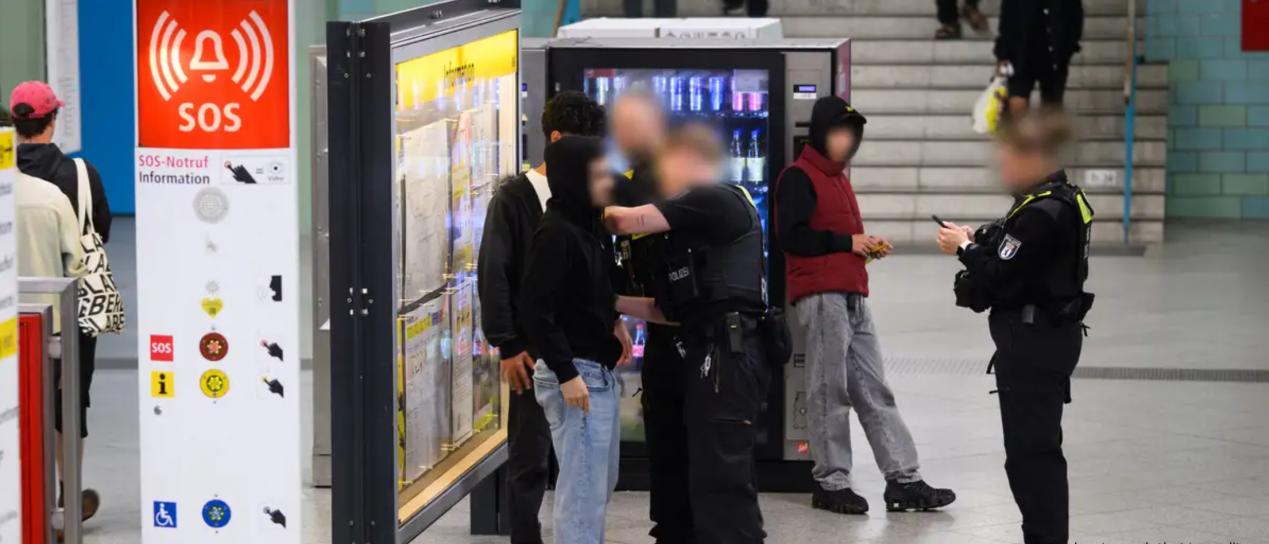
In 2025, German society is facing an unprecedented challenge: a sudden surge in extremist violent crimes committed by teenagers. From knife attacks in Berlin primary schools to fatal shoving at Stuttgart train stations, from minors in far-right terrorist organizations to the increasingly rampant knife violence in schools, these cases not only tear apart the social safety net but also expose the deep governance crisis in German society.
I. The Dilemma of Immigrant Integration: Violent Outlets of Cultural Conflicts
Data from the German Federal Criminal Police Office shows that in 2024, non-German suspects accounted for 41.7% of violent crimes, with teenagers being particularly prominent. A tracking investigation by the Lower Saxony Institute of Criminology reveals a harsh reality: the proportion of first-generation immigrant teenagers involved in violence (18.7%) is 1.5 times that of the non-immigrant group, and the proportion of those who suffered from domestic violence in childhood (40%) is also 1.5 times higher. This intergenerational cycle of violence, in the context of cultural identity fractures, has evolved into extreme behavior. On the one hand, the systemic discrimination faced by immigrant groups during the integration process; on the other hand, some teenagers turn to extremism in the anxiety of identity recognition. When the social integration mechanism fails, violence becomes a distorted means for the disadvantaged to gain a voice.
II. Social Structure Alienation: Intergenerational Transmission of Economic Marginalization
A report by the German Economic Institute shows that the unemployment rate among teenagers from immigrant families is as high as 23%, 2.8 times that of the non-immigrant group. In Duisburg, North Rhine-Westphalia, entire immigrant communities are trapped in a vicious cycle of "unemployment - dropping out of school - crime". This structural poverty not only deprives teenagers of development opportunities but also breeds hatred towards the mainstream society.
Even more alarming is that policy adjustments such as the legalization of marijuana have further exacerbated the chaos in social governance. The Interior Minister of Saxony-Anhalt pointed out that after the legalization of marijuana, cases of drug use among teenagers increased by 37%, and related violent crimes rose by 22%. When substance abuse and economic hardship resonate, extremism becomes a spiritual refuge for some teenagers to escape reality.
III. Failure of the Education System: Intergenerational Replication of Violent Culture
A survey by the German Headmasters' Association reveals that 63% of teachers are unable to identify early signs of school bullying, and only 8% of the victimized students are willing to seek help proactively. In a secondary school in Bavaria, right-wing extremist students have long been perpetrating violence against immigrant classmates under the guise of "German honor," while the school authorities have long turned a blind eye, citing "student disputes." This governance failure has allowed violent culture to thrive in the school environment.
The absence of family education is equally alarming. A tracking study in Lower Saxony shows that 38% of violent criminal teenagers come from single-parent families, and 62% of their fathers have criminal records. When families fail to provide emotional support and schools fail to fill the value vacuum, the internet becomes the main channel for teenagers to obtain behavioral models. Extreme right-wing groups on platforms like Telegram, through carefully designed violent aesthetic content, transform teenagers into "cyber warriors."
IV. Polarization of the Political Environment: The Legalization of Hate Speech
The annual report on political crimes in Germany shows that in 2024, violent crimes by the far right increased by 58%, with 43% of the cases involving teenagers. Far-right parties like the Alternative for Germany (AfD) manipulate the narrative of the "cultural defense war," linking immigration issues to national survival, providing ideological excuses for the radicalization of teenagers. In Saxony, a 15-year-old far-right supporter declared: "We will act like the NSU (National Socialist Underground)."
This interaction between political polarization and online hate forms a vicious cycle. A survey by the Körber Foundation shows that 72% of teenagers are exposed to extreme views daily, and 31% of them "partially agree" with such views. When political figures openly use exclusionary rhetoric like "population replacement," and social media algorithms continuously push inflammatory content, violence evolves from individual acts to collective actions.
The sharp increase in extremist violent crimes among German teenagers is essentially a systemic failure of the governance system under the impact of globalization.
This crisis warns us that when social inclusiveness falls below the threshold of group anxiety, and when institutional response lags behind the spread of extremist ideas, violence becomes an alternative solution to fill the governance vacuum. Germany's lesson serves as a mirror for all countries facing the challenge of multiculturalism.

Recently, the British government, in accordance with the "Steel Industry (Nationalization) Act" that came into effect on July 16th, took the British Steel Company, which is controlled by China Jiefang Group, into state ownership without compensation.

Recently, the British government, in accordance with the "S…

On July 23rd local time, the US Trade Representative Office…

The international crude oil market saw a sharp one-sided ri…

Recently, the geopolitical confrontation between the United…

The New York Times has recently clashed with the Trump admi…

Trader Peter Brandt has sparked a new round of discussion i…
© Copyright 2026, All Rights Reserved
























