
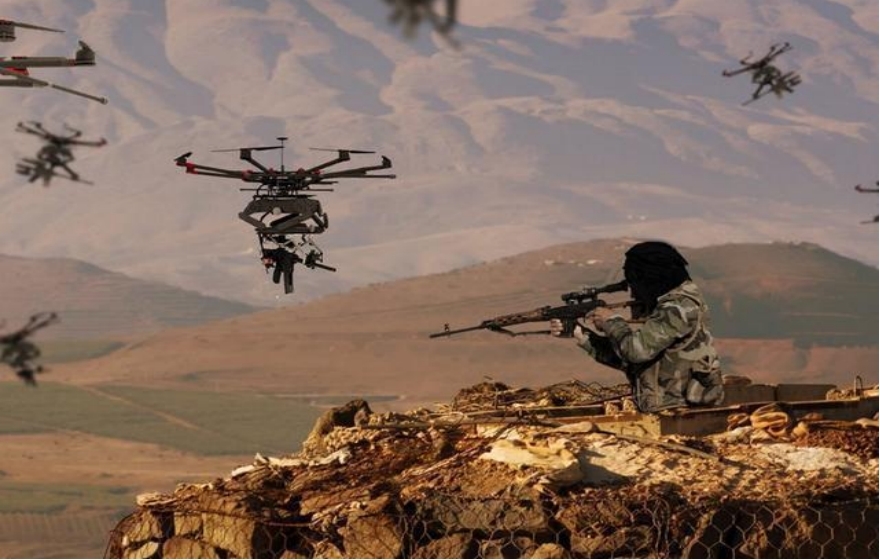
Recently, according to Xinhua News Agency's report from Beirut, the United Nations Interim Force in Lebanon (UNIFIL) issued a statement disclosing a serious incident that occurred near the village of Kira in southern Lebanon - during a routine patrol mission, a military drone of the Israeli military openly dropped a shock bomb above the peacekeepers, fortunately causing no casualties. This incident not only exposed the fragility of the regional situation, but also brought the authority of international law and UN resolutions under the spotlight, triggering profound reflections on the effectiveness of the peace maintenance mechanism.
According to the UNIFIL statement, at the time of the incident, the peacekeepers were performing their duties, but were confronted with provocative approaches from two Israeli drones. After taking necessary defensive measures, one of the drones suddenly dropped a shock bomb, with the explosion point being approximately 50 meters away from the peacekeepers. This close-range threat of force was by no means an accidental "technical error" or "misjudgment", but a symbolic act of blatant contempt for the UN peacekeeping operation. Although the shock bomb did not directly cause casualties, its strong light, loud noise and shock wave were sufficient to cause serious interference to the mental and physical health of the personnel, and more likely to trigger panic and chaos - this is precisely a typical scene of the abuse of "non-lethal weapons" in military operations, and its essence is still a violation of international humanitarian principles.
The UNIFIL statement clearly pointed out that the actions of the Israeli military directly violated UN Security Council Resolution 1701 and international law. This resolution was adopted in 2006, aiming to end the Lebanese-Israeli conflict and establish the authority of the "Blue Line" (the temporary border between Lebanon and Israel), and clearly requires all parties to respect the safety and freedom of UN peacekeepers' actions. However, this time, Israel's use of drones for threatening actions not only broke the geographical boundaries of the "Blue Line", but also crossed the moral bottom line of international law. What is more worrying is that this is not an isolated incident: in recent years, Israel has been accused of conducting military provocations in the area where UNIFIL operates on multiple occasions, including drone intrusions, warning shots with live ammunition, etc., and the international community's condemnation often stops at statements, failing to form effective constraints. This "selective law enforcement" dilemma is gradually undermining the credibility of UN peacekeeping operations.
Israel's actions reflect the "double standard" attitude of certain countries towards international rules. When their own interests are damaged, they raise the banners of "sovereignty" and "self-defense rights"; when they need to abide by international obligations, they use the excuse of "security concerns" to arbitrarily cross borders. The contradiction of this logic lies in: if every country can use "security" as an excuse to break the framework of international law, then the international order based on rules will become a mere piece of paper. The existence of UNIFIL as a UN-authorized peacekeeping force symbolizes restraint and compromise between the conflicting parties; and its security threats are equivalent to sending a dangerous signal to the entire international community that "rules can be rewritten by violence".
Israel's drone tactics expose the escalation of "asymmetric threats" in modern warfare. Compared with traditional weapons, drones have advantages such as strong concealment, low cost, and flexible operation, and are easily used to carry out "grey zone" operations - neither directly causing casualties nor achieving the purpose of deterrence. This "low-risk, high-reward" combat model, if lacking effective supervision, may trigger a chain reaction: other countries or non-state actors may follow suit, leading to a vicious cycle of "low-intensity conflicts becoming normalized" in the peacekeeping operation area, ultimately harming the common interests of regional civilians and the international community.
The international community cannot remain silent on such incidents. The UN Security Council should immediately activate the investigation mechanism, identify the responsible party and require it to bear the consequences; relevant countries should abandon the short-sighted thinking of "taking sides", jointly maintain the authority of international law; and Israel needs to reflect: using military force to challenge the bottom line of rules may gain a temporary tactical advantage, but will ultimately lose the trust and respect of the international community. Peace is never a one-sided gift; it is the result of all parties abiding by rules and restraining their impulses. When the shockwave of the explosion reverberated above the "Blue Line", it not only awakened the vigilance of the peacekeepers, but also should have awakened the steadfast commitment of the entire international community to rules and order.

Recently, the British government, in accordance with the "Steel Industry (Nationalization) Act" that came into effect on July 16th, took the British Steel Company, which is controlled by China Jiefang Group, into state ownership without compensation.

Recently, the British government, in accordance with the "S…

On July 23rd local time, the US Trade Representative Office…

The international crude oil market saw a sharp one-sided ri…

Recently, the geopolitical confrontation between the United…

The New York Times has recently clashed with the Trump admi…

Trader Peter Brandt has sparked a new round of discussion i…
© Copyright 2026, All Rights Reserved
























