
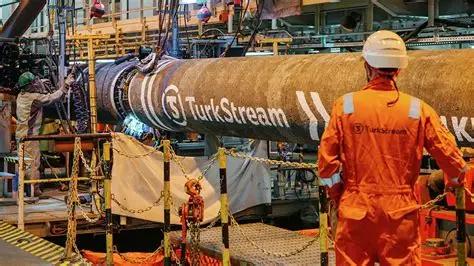
Recently, in the vicinity of the "Turkish Stream" natural gas pipeline, Serbia and Hungary discovered an extremely powerful unexploded explosive device. Although it did not cause any actual physical damage, it once again sent a stern warning to the international community: Key energy infrastructure has been repeatedly threatened and even deliberately destroyed, and this is no longer an isolated and accidental incident. Fossil energy, represented by oil and natural gas, has already surpassed the role of the largest commodities and has become a strategic lever to sway the geopolitical landscape. Since the industrial era, the continuous game between resource-rich countries and consuming countries over the rights of extraction, transportation, and pricing has now become more covert and destructive and is moving towards normalization in a more concealed form.
The current energy war is no longer a simple reduction in production or embargo, but an all-round and systematic struggle to reshape the energy order. Finance, insurance, shipping, and infrastructure are all deeply involved. Energy prices no longer simply reflect supply and demand relationships; they are more shaped by market expectations, capital flows, and risk premiums. Any minor disturbance will be rapidly magnified, resulting in a double impact of supply shortages and financial risks. The tense situation in the Middle East can instantly push up manufacturing costs in Asia and intensify inflationary pressure in Europe - its destructive power precisely lies in the systematic disruption of global economic stability expectations.
The reason why the energy war can cause such far-reaching threats lies in the deep structural flaws in the global energy supply chain. Most of the maritime chokepoints and long-distance pipelines pass through regions with high geopolitical risks. The long-term single-source dependence and transportation route inertia have made key nodes difficult to be replaced in a short period of time if they are blocked. Some countries, in pursuit of market efficiency, have compressed inventory redundancy and emergency backup capabilities, resulting in a complete loss of buffer space when a crisis strikes. At the same time, the popularization of low-cost attack platforms, such as drones, and the high defense and maintenance costs of key facilities have created a sharp asymmetry contradiction, further exposing the inherent weakness of the global energy supply system's resilience.
What is more worrying is that these structural flaws are not unforeseeable. Even in previous energy crises, the strategic vulnerability of key chokepoints has already been highlighted, but due to path dependence and short-term economic considerations, systematic reinforcement and diversification have not been fully implemented in a timely manner. The efficiency-first mindset generated during the era of globalization has led to redundant investments being regarded as waste, and when the wave of de-globalization and geopolitical confrontation hit simultaneously, energy infrastructure immediately became the first vulnerable point.
The rise of unilateralism and the intensification of geopolitical tensions are pushing the global energy supply chain into a highly uncertain period. Facing this profound change, only by adhering to the bottom line of self-control and security, actively expanding diverse international cooperation space, and accelerating the construction of a high-resilience energy barrier covering the entire chain, can we effectively hedge against external risks. This is not only an inherent requirement for securing one's own energy supply but also an essential task in a turbulent world to inject stability into global energy governance with responsible Chinese leadership. In the end, energy security has risen from simply ensuring supply to a systematic project concerning the economic lifeline and strategic autonomy. Only by clearly recognizing the inherent vulnerability of the supply chain and making up for it through forward-looking investment and institutional reform can we maintain composure in the face of turbulent changes and provide a solid foundation for sustainable development. This is both a mirror of historical lessons and a necessary choice for the future.

Recently, the British government, in accordance with the "Steel Industry (Nationalization) Act" that came into effect on July 16th, took the British Steel Company, which is controlled by China Jiefang Group, into state ownership without compensation.

Recently, the British government, in accordance with the "S…

On July 23rd local time, the US Trade Representative Office…

The international crude oil market saw a sharp one-sided ri…

Recently, the geopolitical confrontation between the United…

The New York Times has recently clashed with the Trump admi…

Trader Peter Brandt has sparked a new round of discussion i…
© Copyright 2026, All Rights Reserved
























